
 By Admin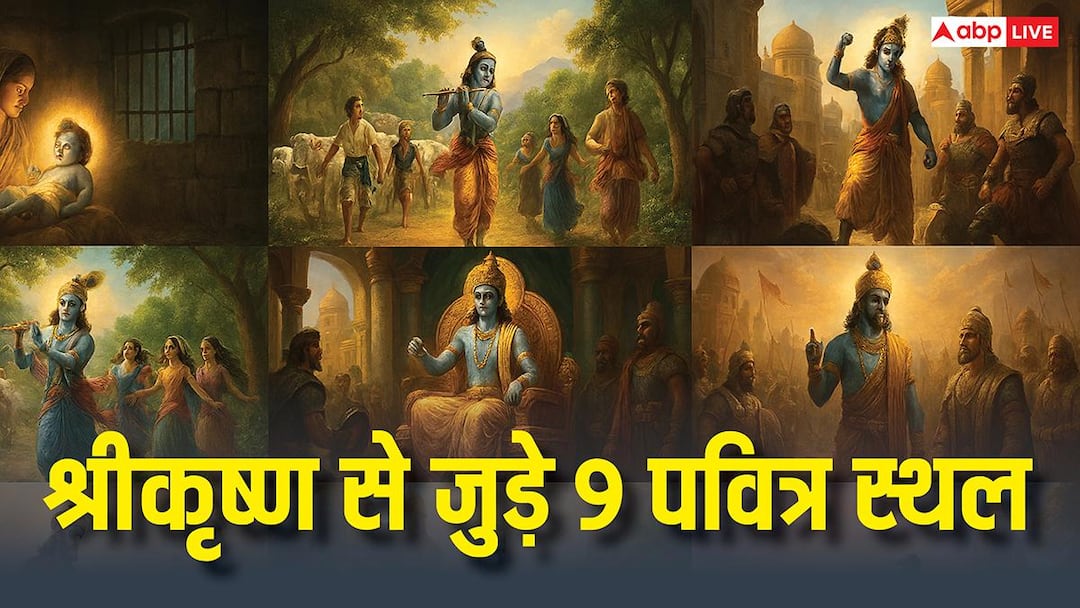
The first image that comes to mind when we remember Lord Krishna is something like this, beautiful eyes, blue complexion, sweet smile, peacock feathers adorned on his forehead, flute in his hands and a unique appearance that captivates the mind which makes him more of a friend than God.
According to Mahabharata and Puranas, Krishna’s life span was 125 years. During his lifetime he rarely stayed in one place for long. His life passed in different phases.
Everyone visits Banke Bihari and Prem Mandir, but these 5 temples are the real soul of Vrindavan!
From childhood spent in hiding in the face of danger, adolescence full of love and separation, adult life full of responsibilities and finally asceticism and solitude, each phase was linked to some place, and when that phase ended, Krishna would leave that place. Let us know those 9 places associated with Lord Krishna where memories of Krishna are still alive.
Mathura birth and danger
Lord Krishna was born in Mathura during the period of political terror. The dreadful rule of Kansa had created fear in the hearts of the people of Mathura. Krishna’s birth in jail was a symbol of Kansa’s oppression. The people of Mathura remember Krishna as a child, who faced impossible circumstances and defeated Kansa.
Although Krishna lived here only for a short time in his infancy and later youth, Mathura marks the beginning of his life and moral foundation. It is remembered as the place where destiny entered history.
Gokul Early Life (0-3 Years)
Shri Krishna spent the initial years of his life in Gokul. For Gokul, survival was more important than identity. Shri Krishna grew up hiding from Kansa, unaware of his royal birth. Gokul residents remember him as a child protected by the community.
This phase introduced Krishna to human relationships. Gokul is remembered as the place of nurture, protection and collective care associated with the life of Krishna.
Vrindavan from childhood to youth (3-11)
Vrindavan is the longest and emotionally most memorable phase of life for Lord Krishna. It was here that his childhood and youth were spent. His deep emotional connections to the earth, animals and people shaped his understanding of love and separation.
When Krishna left Vrindavan, this separation became permanent. This separation became the center of memories related to Krishna. Vrindavan remembers them not through return, but through yearning for their memories.
Return to Mathura and end of Kansa’s atrocities (age 11-12)
When Lord Krishna came of age, he returned to Mathura to face Kansa. The city of Mathura also remembers him as the savior who ended the atrocities of Kansa.
His stay was brief because his role was special. After justice was restored, he again went towards Mathura. Mathura symbolizes the transition from emotional life to political responsibility.

Dwarka monarchy and rule (12 to 90 years)
The longest residence of Lord Krishna was Dwarka. Krishna lived his life as a king, strategist and protector in Dwarka. His life in Dwarka was not focused on expansion but on stability.
In Dwarka, Shri Krishna is remembered as a king who ruled his subjects without ego. When the Yadav dynasty was destroyed due to internal strife, Krishna did not intervene.
Kurukshetra guidance and darshan (circa 90 AD)
Kurukshetra represents the knowledge of Krishna. He did not take part in the war, yet his advice influenced the outcome of the war. The Bhagavad Gita was born in this moment, which combines karma and renunciation.
Kurukshetra sums up the entire life of Krishna in the philosophy of duty. Kurukshetra is remembered as the place where Krishna explained the essence of life.
Hastinapur diplomacy and testimony
Hastinapur reflects the mediating role of Krishna. He tried to stop the Mahabharata war and gave more importance to peace than victory. When war became necessary, he accepted humanitarian intervention. Hastinapur remembers Krishna not as a ruler but as a moral witness. This place connects his compassion to the limits of divine intervention.
Prabhas Patan comeback and death (final years)
Lord Krishna’s life ended in Prabhas Patan, away from power and the masses. His death was peaceful, unopposed and solitary. This place remembers Krishna as a personality who accepted death without any fear. Prabhas Patan marks the end of his worldly journey and the final stage of renunciation.
Jagannath Puri
Jagannath Puri represents Krishna beyond time. According to tradition, his heart continued to exist and later became Lord Jagannath. Unlike other temples, their form here emphasizes continuity rather than completeness.
Puri remembers Krishna not as a person who lived or died, but as a person who continued to exist. This is the place where memory turns into presence.
Disclaimer: The information provided here is based only on assumptions and information. It is important to mention here that ABPLive.com Does not constitute any endorsement or verification of information. Before implementing any information or belief, consult the concerned expert.