
 By Admin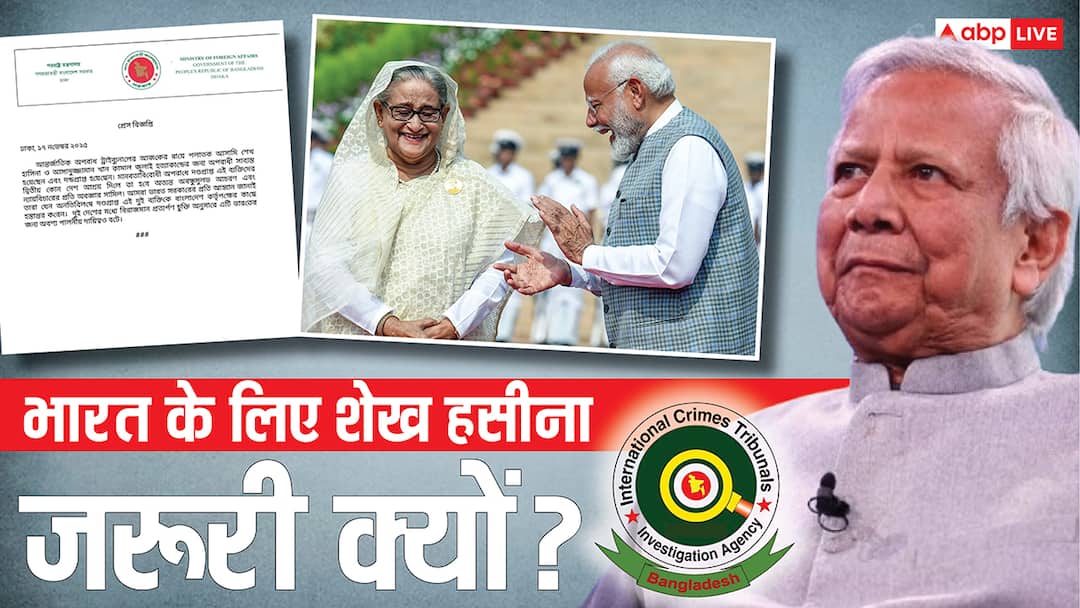
On November 17, the International Crimes Tribunal (ICT) court sentenced former Bangladesh PM Sheikh Hasina to death. He is taking refuge in India since 2024. Bangladesh has been continuously pressurizing India to return Sheikh Hasina. Experts believe that India will not want to return Hasina, even if there is enmity with Mohammad Yunus. For this, India can cite the extradition treaty. In ABP Explainer, let us understand what this treaty is, why India will not return Sheikh Hasina at any cost and what will be its consequences…
Question 1- What is the treaty signed between India and Bangladesh in 2013?
answer- An extradition treaty was signed between India and Bangladesh on 28 January 2013. Then it was amended in 2016, which is fully applicable even today. According to this-
- Both countries will hand over criminals to each other.
- There will be extradition in serious crimes like terrorism, murder, kidnapping, drug trafficking, money laundering and corruption.
- If someone commits a political crime there will be no extradition.
- If the criminal can be sentenced to death in his country, then before handing over, a written guarantee will have to be taken that he will not be hanged.
- Extradition may be refused in cases made out of false or political vendetta.
After renewal in 2013, the process was a bit slow because a lot of evidence had to be provided to ask for extradition. For this reason, the process was made much easier and faster by amending the treaty in 2016. This means that now there is no need to provide complete evidence to ask for extradition. Just showing the arrest warrant of a competent court against that person is enough.
Under this treaty, ULFA leader Anup Chetia was handed over by Bangladesh to India after 17 years in 2016. At the same time, in 2020, India handed over two culprits involved in the murder of Sheikh Hasina’s father Sheikh Mujibur Rahman to Bangladesh in 2020.
On July 9, 2025, the Yunus government demanded India to send back Sheikh Hasina but India did not give any official reply. Now after Sheikh Hasina gets death sentence, Bangladesh will again press for her extradition.
Question 2- What is there in this treaty, due to which India can deny the return of Sheikh Hasina?
answer- Extradition has not been made mandatory in this treaty. The treaty clearly allows for a number of exceptions under which India can refuse to extradite Sheikh Hasina…
1. Article 6- Grounds of political crime
- The treaty says extradition can be refused if the crime was committed ‘for political reasons’. India may consider the ICT trial as ‘political revenge’ in Sheikh Hasina’s case, in which Hasina was called the ‘mastermind’. Hasina herself has called it biased and politically motivated.
- The interim government of Bangladesh conducted this trial in collaboration with Hasinee’s opponents, which seems to be political. The treaty does not consider some serious crimes like murder and torture as political, but if the entire case is in a political context, India can deny it. Like there was a change of power by removing Hasina. Section 29 of India’s Extradition Act 1962 also allows this.
2. Article 8- Ground of not being in the interest of justice
- Under Article 8 of the treaty, India can refuse extradition if the life of the accused is in danger, he has not received a fair trial or the objective of the tribunal is political rather than judicial. India can show all this easily.
- In Sheikh Hasina’s case, the trial took place without her, which was completed in a hurry. Hasina did not get a lawyer, international organizations have expressed concern over 1400 deaths, Hasina herself is calling it a political conspiracy and according to many reports, there is government pressure on the judges, which seems like a kangaroo court. India may consider it unjust or oppressive. If India feels that this trial is a part of power grab or anti-India forces, then the denial will be legitimate.
Question 3- Why will India not return Sheikh Hasina at any cost?
answer- On 17 November, India’s Ministry of External Affairs said only that any extradition promise would be in the “best interests of the people of Bangladesh”. That means India does not want to hand back Sheikh Hasina at any cost. There are 3 big reasons for this…
- Foreign affairs expert and JNU professor. Rajan Kumar says, ‘After the coup in Bangladesh, the influence of fundamentalist forces, who sympathize with Pakistan, has increased. Due to giving shelter to Sheikh Hasina, anti-India sentiment will increase there, which will have a direct impact on the peace and stability of the border areas of India.
- Sheikh Hasina’s 15-year government built deep relations with India. Extradition of militants (ULFA and NSCN) in the North-East, curbing smuggling and limiting China’s influence. If India hands them over, instability will increase in Bangladesh. This may cause harm to India’s border security.
- In India, both the government and the opposition support Hasina. If extradition happens, relations with Bangladesh will become tense. But denial will not break relations, because India is economically strong.
For now Sheikh Hasina will remain in India. The Indian government has extended his visa and can seek protection in the Supreme Court under Article 21 (right to life). The extradition treaty gives India the freedom to walk on the ‘diplomatic tightrope’. That means there is less benefit and more harm from extradition.
Question 4- If Sheikh Hasina is not returned, tension will increase between India and Bangladesh, what will be the consequences?
answer- According to Dr. Rajan Kumar, India’s non-return of Hasina can weaken bilateral relations, but due to India’s strategic strength, there is no major war-like crisis. According to experts, there will be 4 major consequences of increasing tension…
1. Deep rift in political relations and diplomatic isolation
- The interim government of Bangladesh is already adopting an anti-India stance. He will call the refusal of extradition an ‘extremely unfriendly act’ and ‘disregard for justice’. In this, bilateral meetings may be canceled and Bangladesh will present India as a ‘dominant power’.
- This will make the relations between India and Bangladesh fragile, which are already on the verge of breaking after 2024. After the Bangladesh elections in February 2026, the new government may become more anti-India. India may feel isolated in regional forums like SAARC or BIMSTEC.
2. Increase in border security and illegal migration
- The 4,096 km long border between India and Bangladesh is already a hub of smuggling and infiltration. Tension will increase deployment on the border, but cooperation will reduce. Joint patrolling may also stop. Bangladesh can incite violence on the border by calling Hasina’s supporters as ‘Indian agents’.
- Illegal Bangladeshi infiltration may increase in India’s north-eastern states like Assam, Tripura and Meghalaya, which will incite local discontent. Violence on the border has increased by 30% since 2024.
3. Decrease in economic cooperation and trade
- Bangladesh is India’s largest trading partner. In 2024, there will be trade of 14 billion dollars between the two countries. Garments, medicines and electricity exports will be affected due to tension. Bangladesh is dependent on India for energy and connectivity. Then he can run ‘Boycott India’ campaign.
- Infrastructure projects in India’s northeast may be halted, including the Akhaura-Agartala rail project. Bangladesh’s already deteriorating economy will worsen further. India may also suffer a loss of about 2 to 3 billion dollars.
4. Impact on regional and global diplomacy
- Bangladesh is already getting closer to Pakistan and China, who are trying to encircle India. Forums like Quad or IORA will be affected by increasing tension. India’s ‘Act East’ policy will weaken.
- Diplomatic rhetoric will increase and tensions may increase leading to a ‘strategic shift’ between China and Pakistan. This will be the most dangerous situation for India.
- This month, Pakistan’s warship reached Bangladesh. Due to strengthening of relations with China, India will remain insecure from the Northeast to the Bay of Bengal.
- America and Europe may put pressure on Hasina’s human rights record, but India will get support because Bangladesh’s trial is being considered as ‘vendetta politics’. Bangladesh’s instability could create a refugee crisis for India.
Question 5- On what charges was Sheikh Hasina punished and what is the way forward?
answer- Sheikh Hasina faces 5 charges in ICT Court…
- Giving inflammatory speeches.
- Ordering the use of lethal weapons to suppress and eliminate protesters.
- Abu Saeed, a student of Begum Rokeya University, shot dead in Rangpur.
- Six protesters shot dead in Chankharpul area of Dhaka.
- Six people were burnt to death in Ashulia.
According to the Daily Star report, Sheikh Hasina has been convicted on all charges. He was given death sentence under Section 4 of the Indian Penal Code for shooting dead six unarmed protesters in Chankharpul on August 5 last year.
Sheikh Hasina can challenge the tribunal’s decision in the higher court of Bangladesh. She can demand re-examination of the evidence and review citing unfair trial. Apart from this, Hasina can seek asylum or protection in India or any other country citing ‘threat to her life’.