
 By Admin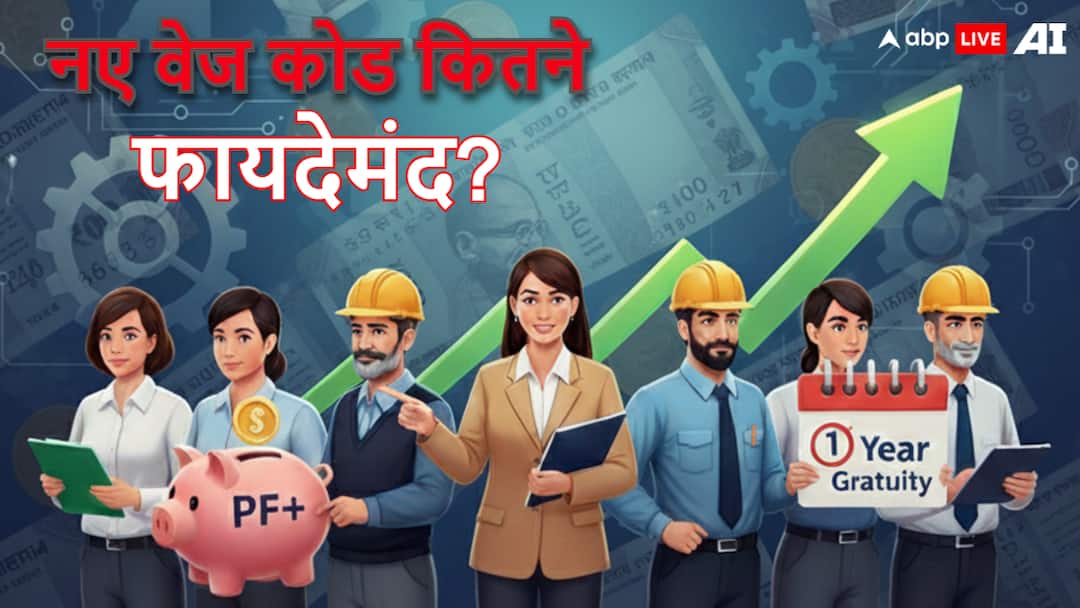
From November 21, 2025, the Central Government has merged 29 old labor laws into four new codes. Under this, companies will now have to change the salary structure, in which the basic salary must be at least 50% of the total CTC. In ABP Explainer, let us understand what are the new codes, why the old 29 codes were combined together and how much benefit and loss it will cause to you…
Question 1- What are the new labor codes and how are they being implemented?
answer- Earlier there were 29 different labor laws in India, which were confusing. Now these have been combined into four codes-
- Code on Wages (2019)
- Industrial Relations Code (2020)
- Code on Social Security (2020)
- OSHWC Code (2020)
Detailed rules will be notified in the next 41 days, under which all companies will have to restructure their salary structure. These codes were passed in 2020, but there was a delay in making the rules. Now states will also have to update their rules accordingly. According to the Labor Ministry, this will ease business ease and strengthen the rights of workers. These will be implemented across the country from April 2025, which will benefit more than 50 crore workers.
The objective of these new rules is to provide timely and overtime wages, minimum wages, equal opportunities and salaries to women, social security, free health checkup to every worker. With the new law, the employee will get the benefit of gratuity in only 1 year instead of 5.
The government says that the old labor laws were made between 1930–1950, when work, industry and technology were completely different from today. The new codes have been created keeping in mind the modern needs and international standards. Therefore, the old 29 labor laws have been simplified and converted into four labor codes.
Question 2- What is the new definition of wage and what effect will it have on basic salary?
answer- The definition of ‘wage’ was different in the old laws, due to which companies kept the basic salary less and gave more allowances (HRA, conveyance). Now the wage includes basic salary + dearness allowance (DA) + retaining allowance. A. At least 50% of total CTC must be basic + DA. If the allowances are more than 50%, the extra portion will be added to the wages.
Question 3- How can take-home salary be reduced according to the new rules?
answer- The new rules may reduce the monthly take-home of employees, because deductions will increase if CTC remains fixed. Suppose someone’s CTC is Rs 40,000. Earlier the basic was 30-40% (Rs 12,000-15,000), so the PF contribution (at 12% basic) would have been Rs 1,500-2,00. Now if you have to pay 50% of basic i.e. Rs 20,000, then PF will be around Rs 2,000. Meaning the take-home salary will be reduced by Rs 1,000.
Question 4- What are the new rules of gratuity and how will it be received in 1 year?
answer- Gratuity is a financial assistance given by the company to its employees, which can also be called appreciation amount. It is decided on the basis of your service and salary.
The biggest update is of gratuity. With the new law, now the employee will be able to get the benefit of gratuity in just 1 year instead of 5 years. At the same time, the limit of tax-free gratuity has been increased from Rs 10 lakh to Rs 20 lakh.
- This amount will be tax-free, that is, the employee will get the full amount of gratuity. The employer will have to pay the gratuity within 30 days. If there is delay, 10% annual interest will be charged and the compensation can also be up to double.
- This will be applicable in both private and public sector. For example, if an employee works for 5 years, he will get 15 days’ wages for every year. This change will increase financial security at the time of retirement.
Question 5- What benefit will women get from the new wages?
answer- Women will be able to work in night shifts and in all categories with their approval and safety measures. Like mining, heavy machinery and dangerous places. Women will get equal payment and their representation in grievance panels will be necessary. Maternity leave was increased from 12 weeks to 26 weeks, which is a big relief for women.
Question 6- What changes took place regarding working time?
answer- Working hours in most sectors will be 8–12 hours per day and 48 hours per week, with double pay for overtime and written consent required where necessary. In sectors like exports, leaves will accumulate after 180 working days.
Apart from this, you will get 1 day paid leave for every 20 days of work. Earned leave has been increased from 15 to 30 days annually, but it will be applicable after 1 year of service.
Question 7- What is special for Social Security and gig workers?
answer- Social security has been strengthened in the new codes…
- Employers will have to contribute 0.65% of wages to the EDLI scheme, which will provide life and disability cover.
- Workers in the unorganized sector will get life insurance and health benefits for the first time.
- At the same time, gig and platform workers, like Uber drivers or food delivery boys, will get health insurance, accident cover and social security.
- With the fixed-term employment code, contract workers will get the same rights as permanent workers.
- It is necessary to register shops and establishments online, failing which a fine of up to Rs 5 lakh will be imposed.
Question 8- Apart from this, what is new in the new codes, what will be its benefits?
answer- In the new codes…
- Workers in every sector will get the minimum wage linked to the National Floor Rate, along with timely payment and unauthorized deductions will be stopped.
- Now it will be necessary for all employers to give appointment letter to every worker. This will keep the job records of the workers clean, there will be transparency in salaries and it will be easy for them to access the benefits.
- It will be necessary for workers working in hazardous factories, plantations, contract labor and mines (who are more than the prescribed number) to undergo free health checkup every year.
- The coverage of the Social Security Code will spread across the country. This includes MSME employees, even a single laborer in hazardous places, platform workers and those sectors which were earlier out of the essential scheme of ESI.
- Now journalists, freelancers, dubbing artists and people associated with media will also come under the ambit of labor protection.
- Contract workers and those coming from other cities will now get the same salary as permanent employees, government welfare schemes, and such facilities which will continue even if they move from one place to another.
Question 9- How will employees benefit from this in the coming times?
answer- In future, these codes will cover more of the unorganized sector and discrimination will reduce. Appointment letters will become formal with digital compliance. Gig workers will get social security, which will boost the economy. But to balance the impact on take-home, the government can issue CTC adjustment guidelines.
Question 10- Why did the government make these changes, what is the planning?
answer- The central government has made these changes to modernize the codes workforce. Earlier the lodges were outdated, covering only 30% of the workers.
- Now uniform wage definition will reduce discrimination.
- There will be gender equality in hiring and wages.
- With the new law, the layoff threshold increased from 100 to 300 workers.
- For small factories, relaxation was given to 20-40 workers. Overtime will be available at double rate.
- Social security contribution has been made mandatory to support the gig economy.