
 By Admin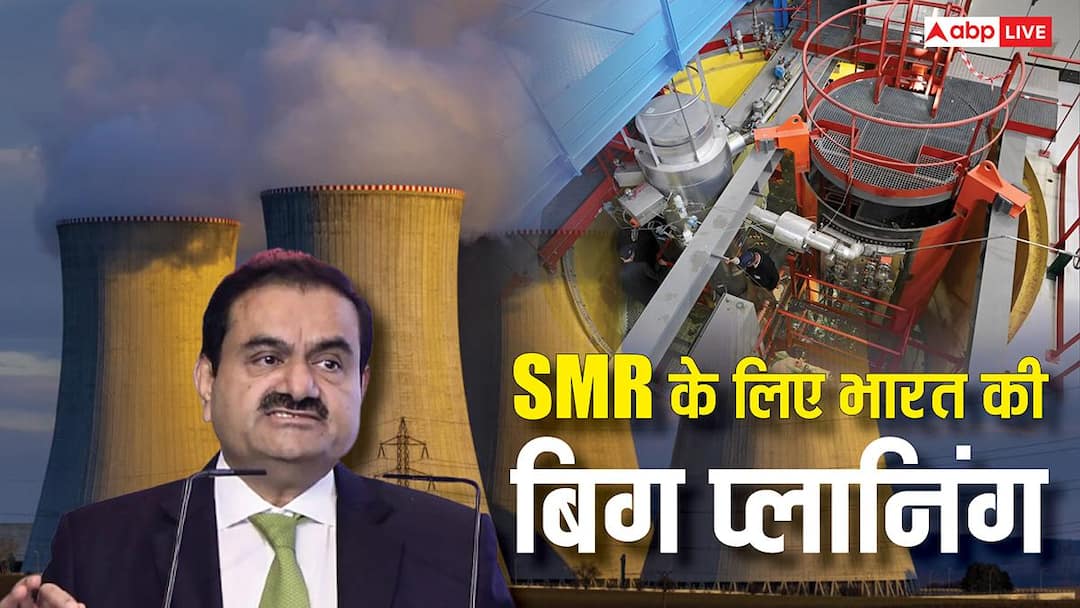
Adani Group is in talks with the Uttar Pradesh government to build Small Modular Reactor (SMR) in public-private partnership. This is part of opening up the nuclear energy sector in India to private investment. Adani Group is planning to build eight SMRs of 200 MW capacity in the state. If this deal goes through, Adani will get a total nuclear capacity of 1.6 GW and will be at the forefront of India’s nuclear development.
Many Indian companies are interested in SMR
India’s nuclear sector is now opening up for private companies. Big companies like Reliance Industries, Tata Power, Adani Power, Hindalco, JSW Energy and Jindal Steel & Power are showing interest in developing SMR under the ‘Bharat SMR’ initiative. Recent legal changes have made private investment possible for the first time, which will boost capacity and innovation.
Target to increase nuclear energy capacity by 2047
SMR technology is perfect for India’s diverse and remote energy needs. India aims to reach 100 GW of nuclear energy capacity by 2047, which will depend on larger reactors and faster deployment of SMRs. Earlier this year, a power ministry panel report said reaching 100 GW from the current 8.8 GW would require Rs 19.28 trillion ($214 billion at the current exchange rate).
Modi government plans to immediately spend $2.23 billion (Rs 200 billion) on SMR research and development. India has earlier talked about SMR technology cooperation with America, Russia and France. Government agencies alone cannot achieve nuclear power targets. Now India wants to tap the private sector, where money is more and there is capacity for timely construction and innovation. The public-private partnership with Adani will give the company the advantage of being first in India’s new nuclear power industry.
What are small nuclear power reactors?
The International Atomic Energy Agency (IAEA) defines ‘small’ as having a capacity of up to 300 megawatts electric (MWE), one-third the capacity of conventional nuclear power reactors. ‘Modular’ means that the system and components can be assembled in a factory and transported to location as a unit. ‘Reactors’ create energy by generating heat from nuclear fission.
Small reactors require special technology, but they are less expensive to transmit. Four types of small reactors are being developed – light water reactor, fast neutron reactor, graphite-moderated high temperature reactor and some types of molten salt reactor.
Which countries are working on SMR?
There are big players in America like Westinghouse, Babcock & Wilcox, Holtec and Newscale Power. China has some of the most advanced SMRs. China is developing small district-level heating reactors with a capacity of 100 to 200 MWT to replace coal-based heating plants in northern parts. India’s 220 MWE Pressurized Heavy Water Reactors (PHWR) are also SMRs.
Nuclear Power Corporation of India (NPCIL) is offering 220 and 540 MWE versions internationally. Pakistan’s Chashma has Chinese 300-325 MWE PWR (CNP-300) SMR. UK, Canada, Russia, Japan, South Korea, Denmark and South Africa are also players.