
 By Admin
Dollar vs Rupee: Last year i.e. in 2025, there was a decline of about 3.5 percent in the Indian rupee, due to which it became one of the weakest currencies of Asia. This trend of weakness of the rupee continues in the year 2026 and currently it is trading around the level of 90 to 91 against the US dollar. There is talk everywhere about the fall of the rupee, which has become a matter of concern for the government and policy makers. However, the Reserve Bank of India (RBI) has intervened from time to time to support the rupee, so that its excessive fall can be prevented.
Now the question arises that why is the rupee falling so fast and what could be its future trend. To understand this, it is important to first know what is the economics of falling rupee and what is its relation with the country’s GDP and economy.
When we buy any goods or services within the country, we pay in rupees, but when any item is imported from abroad, the payment is made either in the currency of that country or in such an international currency which is accepted by both the countries. This is the reason why a large part of global trade is done in US dollars.

Why does the rupee fall?
India also imports most of its goods in dollars. This means that for import, dollars are first bought by paying rupees. When the rupee weakens, one has to pay more rupees to buy one dollar. For example, where earlier one had to pay about 80 rupees for one dollar, now one has to spend more than 91 rupees for it. This difference is called exchange rate, which keeps changing daily according to the market conditions.
There are many factors behind the fall of the rupee, the biggest reason of which is global economic and geopolitical turmoil. At one time, during the UPA government, India was placed in the group of ‘Fragile Five’ i.e. weak economies, which included countries like Brazil, Indonesia, South Africa and Turkey. But after about 15 years, India has become the fourth largest economy in the world and is being seen as a ‘bright spot’ globally. Despite this, at present, war-like situations around the world, geopolitical tensions and America’s strict trade policies are putting pressure on the market.
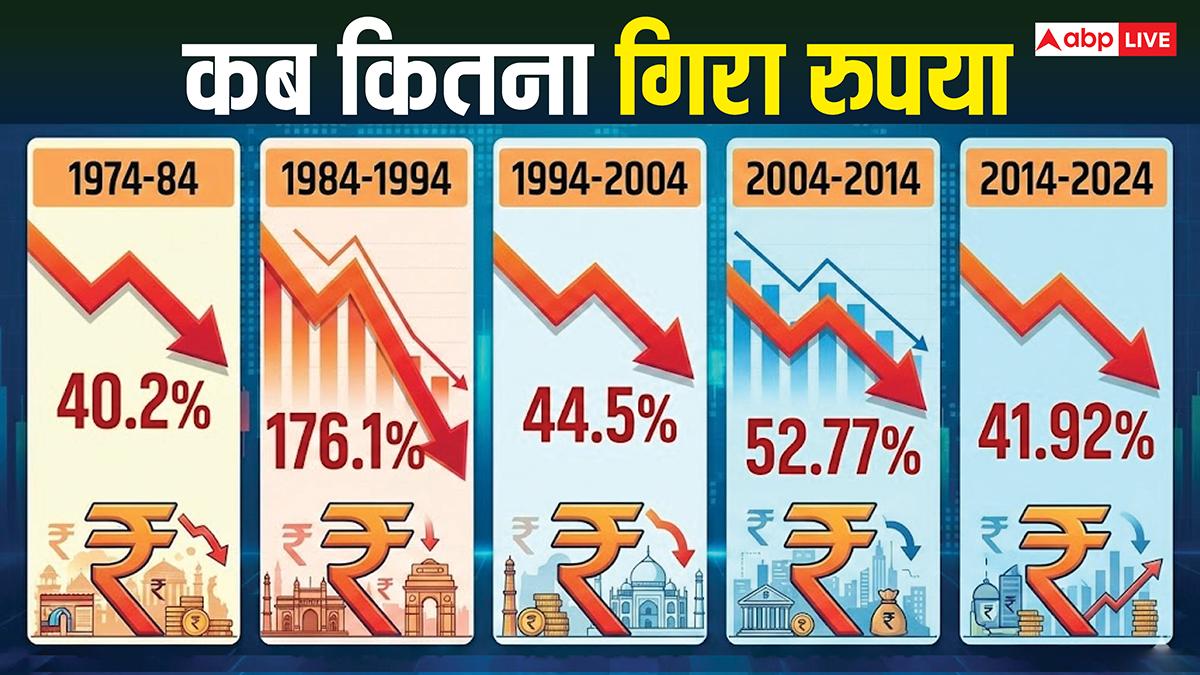
When and how much did the rupee fall?
| Year | in percentage |
| 1974-84 | 40.2 |
| 1984-1994 | 176.1 |
| 1994-2004 | 44.5 |
| 2004-2014 | 52.77 |
| 2014-2024 | 41.92 |
What is the effect of falling rupee?
Investors’ concerns have increased due to US President Donald Trump imposing high tariffs on many countries including India. The result is that foreign investors are withdrawing money from emerging markets like India and moving towards safer markets like America. Due to this, the demand for dollars is increasing and there is pressure on the rupee.
Also, in the environment of global uncertainty, investors are investing in safe assets like gold, due to which the demand for gold has increased and the rupee has weakened and deepened. However, one positive aspect is that India’s foreign exchange reserves have strengthened significantly. While in March 2014, RBI had foreign exchange reserves of about $30,400 crore, now this figure has almost tripled.
If we look at the impact of falling rupee, both its positive and negative aspects come to the fore. Talking about negative impact, importers suffer losses because they have to pay more rupees for the dollar. Its burden also increases on students studying abroad, those traveling abroad and companies taking foreign loans, because their expenses are in dollars. This may also increase the trade deficit and put pressure on inflation.
At the same time, the weakness of the rupee also has some benefits. Exporters get direct benefit from this, because they get paid in dollars and due to the dollar becoming expensive, their income increases in rupees. Apart from this, the earnings of Indians working abroad also increase, because the value of remittances sent by them increases due to the decline in the value of rupee against the dollar.
How much will the rupee break next?
Regarding the future trend of the rupee, market experts believe that the rupee may remain in the range of 90 to 92 per dollar in the current year. However, some experts also say that if India has a trade deal with America and the uncertainties related to tariffs are reduced, then the rupee may see an improvement. In such a situation, in the coming time the rupee may strengthen to the level of 86 to 88 against the dollar.
Read this also: Indian rupee lost its strength due to foreign capital withdrawal, lost its strength in front of US dollar