
 By Admin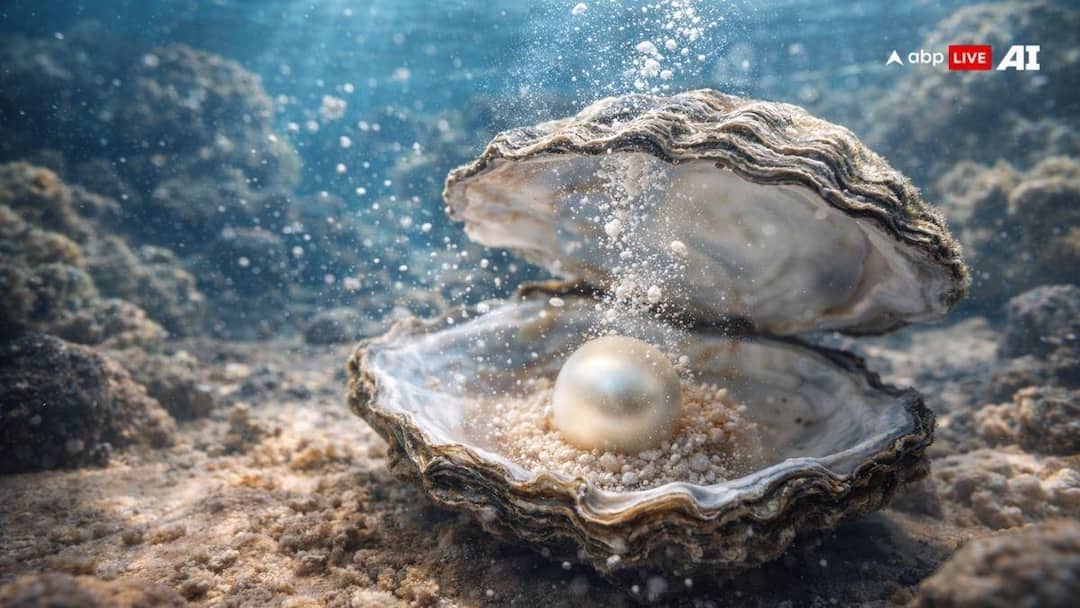
Pearl Formation: Pearls are one of the most fascinating natural gemstones found on earth. This is not because they are extracted from rocks but because they are made by living organisms underwater. Unlike diamonds or gold, pearls are formed through a natural defense mechanism inside mollusks like oysters and mussels. Let us know how pearls are formed inside the sea.
Formation is caused by an external particle
The process of pearl formation begins when a foreign particle such as a grain of sand, a small stone or debris accidentally enters the soft tissue of a mollusk. This causes a lot of discomfort and irritation because the mollusk has no easy way to remove it from its body.
Nature’s defense mechanism becomes active
The mollusk activates a natural protective reaction to expel it from the body. It starts moving it apart instead of pulling it out to avoid injury and reduce irritation. The mollusk begins to secrete a smooth and shiny substance called nacre, which is known as mother of pearl. Necker is mainly composed of calcium carbonate and conchiolin. It covers the outer particles.
Pearls develop over time
Necrosis accumulates layer by layer over time, with thousands of microscopic layers gradually forming around the irritant. Each layer increases the pearl’s size, smoothness and shine. This process can take months or even years.
As the layers continue to accumulate the outer particle turns into a fully formed pearl. The shape, size and luster of the pearl depends on how evenly the layers of neckerve have been deposited.
Why is pearl so rare?
The formation of a natural pearl is a very rare phenomenon as it depends entirely on chance. Because of this rarity, natural pearls are very valuable. Nowadays, most of the pearls available in the market are cultured pearls. In fact, humans deliberately start this natural process under controlled conditions by inserting a small nucleus in an oyster.
Also read: Why is a toy horse with a sad face going viral in China, what message does it give?