
 By Admin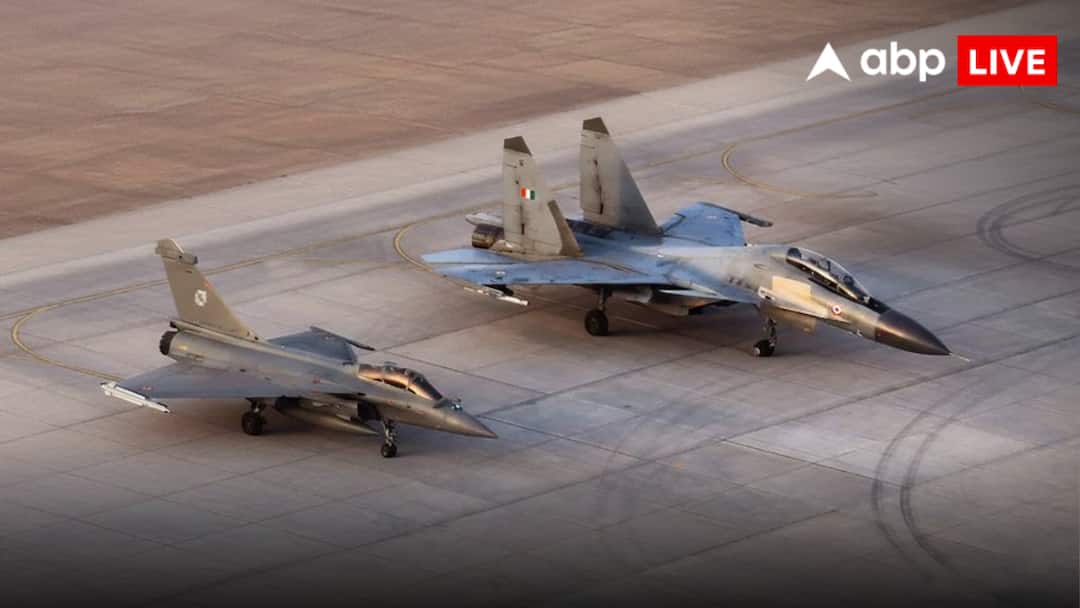
A big decision regarding the Su-30MKI, the most powerful fighter aircraft of the Indian Air Force, is going to be taken soon. On one hand, the ‘Super Sukhoi’ upgrade program is expected to get the approval of the Cabinet Committee on Security in the next one to two months, on the other hand, with the inclusion of Israel’s deadly Rampage missile in it, its strike capability has increased manifold. After this upgrade, Su-30MKI will not only remain the backbone of the Indian Air Force, but will also be seen standing at the forefront of the list of the world’s deadliest fighter jets.
According to HAL Chairman and Managing Director DK Sunil, technical preparations for the major upgrade program of Su-30MKI have been completed. All important aspects have been agreed upon between Hindustan Aeronautics Limited, Indian Air Force and DRDO and now only formal approval is awaited. Under this scheme, 84 Su-30MKI fighter aircraft will be equipped with state-of-the-art technology.
Why is the upgrade considered important?
This upgrade is also considered very important because Su-30MKI is still the most numerous and most powerful fighter jet of the Air Force. It plays a decisive role in air defense, deep strike and maritime operations. As a large number of aircraft have now entered their second decade of service, this upgrade has become necessary to keep them fully capable beyond 2040. Especially until the future indigenous fighter jet AMCA joins the Air Force.
Su-30MKI will have state-of-the-art technology
Under the Super Sukhoi upgrade, the Su-30MKI will be taken to a completely new level. It will include long-range AESA radar, state-of-the-art digital cockpit, artificial intelligence based multi-function display and voice command system. Along with this, new IRST system, advanced self-protection jammer, better electronic warfare and advanced data link capabilities will also be added.
Su-30MKI’s destructive power increased with Rampage Missile
Meanwhile, another major increase in the firepower of Su-30MKI occurred when the Indian Air Force included Israel’s supersonic Rampage air-to-surface missile in it. This is the same missile, which was recently used during Operation Sindoor and which caused heavy damage to enemy targets.
The Rampage missile reaches the target at supersonic speed and its heavy warhead is capable of destroying even the strongest targets. According to defense experts, this missile is very difficult for the existing air defense system to track, due to which it is considered capable of dodging even the state-of-the-art systems like S-400, THAAD and Iron Dome.
Why is Rampage dangerous for air defense systems?
The biggest strength of Rampage missile is its high speed, low altitude flight and precise guidance system. This missile flies at a speed of about 1975 kilometers per hour and is equipped with a powerful warhead of about 570 kg. Its design is such that it becomes visible late to radar and air defense systems, making it extremely difficult to intercept.
This missile is capable of targeting important targets like enemy bunkers, command centres, airfields, bridges and warships. Earlier it was included in Jaguar Darin-III and MiG-29K aircraft of the Navy, but its effect on a heavy and long-range fighter like Su-30MKI is considered to be more fatal. For this, necessary changes have also been made in the airframe and fire control system of the aircraft.
Where does Su-30MKI stand compared to Rafale?
Although Rafale is considered a state-of-the-art multi-role fighter jet, but experts believe that with longer range, more weapon carrying capacity, twin engine power and now supersonic missile like Rampage, Su-30MKI can prove to be more lethal in deep strike and stand-off attacks.
This is the reason why defense experts consider Su-30MKI to be a more powerful platform than Rafale in many missions. Interestingly, while the Su-30MKI and MiG-29K are fighter jets of Russian origin, the Rampage missile has been developed in Israel. India had purchased the first batch of this missile during the increased tension with China in 2020-21 and since then it has become an important part of the precision strike capability of the Indian Air Force.