
 By Admin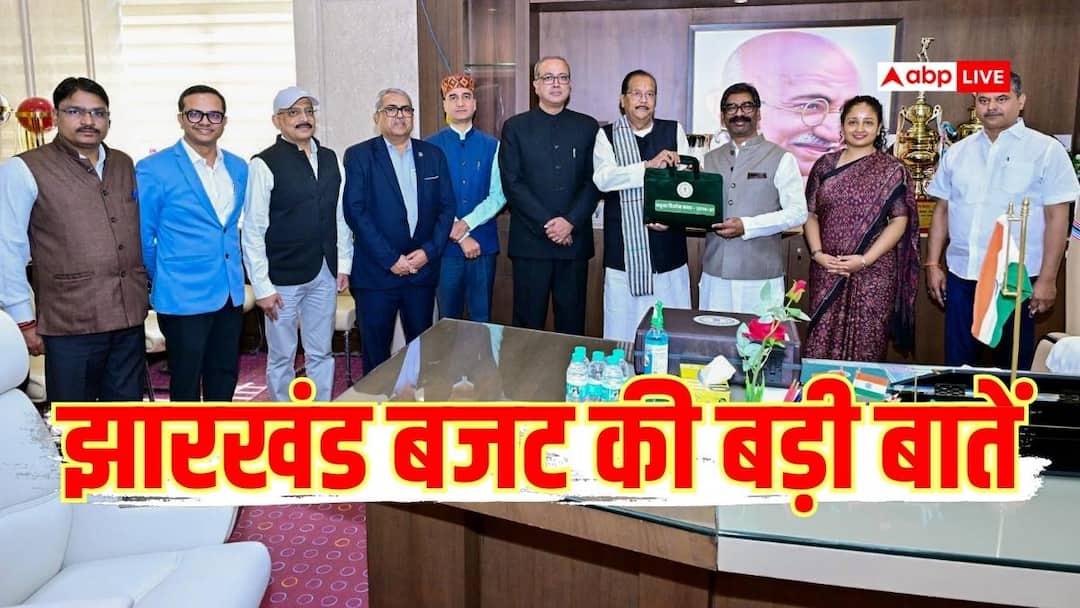
Hemant Soren’s government in Jharkhand on Tuesday (February 24) presented ‘Abu Dishom Budget’ of Rs 1,58,560 crore for the financial year 2026-27 in the Assembly. This has been described as the budget of the government led by Chief Minister Hemant Soren focused on inclusive, sustainable and public welfare development. State Finance Minister Radhakrishna Kishore presented this budget. The Finance Minister said that this budget shows the state’s commitment to wipe the tears of the poor and bring a smile on the face of every citizen.
Many announcements regarding education, health, tourism and women
- Many announcements have been made in the budget related to education, health, tourism, infrastructure and women empowerment.
- A target has been set to start 100 new ‘CM Schools of Excellence’ in the state, where education will be taught on CBSE lines from 2027-28.
- The establishment of a model school for the dependents of martyrs has also been announced.
- The proposal to establish Dr. Bhimrao Ambedkar University in Chatra district has also been included in the budget.
- Five new girls residential schools will be opened in the state. Two such schools will open in Dhanbad
- One school each will be established in Palamu, Latehar and Garhwa.
- In the direction of women empowerment, ‘Mahila Kisan Khushhali Yojana’ has been announced, for which a provision of Rs 25 crore has been made.
Central government accused of lack of economic support
In the last financial year 2025-26, the government had presented a budget of Rs 1,45,400 crore. This time the size of the budget has been increased by about nine percent. During the budget speech, the Finance Minister accused the Central Government of lack of economic cooperation. He said that about Rs 16,000 crore has been received short in tax share and grant head, which includes about Rs 5,000 crore tax share and Rs 11,000 crore grant. The state is incurring a loss of approximately Rs 4,000 crore every year due to GST rate rationalization. Due to implementation of 60:40 ratio in MNREGA, there has been an additional burden of Rs 5,640 crore on the state. He also mentioned about the outstanding of Rs 1.36 lakh crore on coal companies.
How much amount in the budget for Mainiyan Samman Yojana?
- Maximum provision has been made in the budget for women welfare and social security schemes.
- Under the Chief Minister Mainiyan Samman Yojana, Rs 14,065.57 crore has been earmarked to provide Rs 2,500 per month to women aged 18 to 50 years.
- Rs 3,517.23 crore will be spent on Sarvajan Pension Scheme and Rs 1,463.58 crore will be spent on National Pension Schemes.
- The total budget of the Women and Child Development Department has been kept at Rs 22,995.69 crore.
- A provision of Rs 7,990.30 crore has been made for the health sector.
- A target has been set to launch a special scheme of Rs 200 crore for cancer treatment and open 750 “Abua Dispensaries”.
Emphasis also on strengthening the agricultural sector
- To strengthen the agriculture sector, the allocation of Birsa Seed Production Scheme was increased to Rs 145 crore.
- Rs 475.50 crore allocated for soil and water conservation schemes.
- There is a provision of Rs 75 crore for solar energy based irrigation and Rs 80 crore for distribution of agricultural equipment.
- A provision of Rs 4,100 crore has been made under “Abua Awas Yojana”.
- Rs 66 crore will be spent on “Palash” brand to promote the products of Sakhi Mandals.
- In the education sector, a provision of Rs 16,251.43 crore for primary and secondary education and Rs 2,564.45 crore for higher and technical education.
What is the estimate regarding growth rate in the budget?
The growth rate in the year 2022-23 was 7.2 percent (constant price), which increased to 7.5 percent in 2023-24. It stood at 7.02 percent in the year 2024-25, while it is expected to be 7.72 percent in 2025-26. In the coming financial year 2026-27, the growth rate is estimated to be 6.90 percent at constant prices of 2011-12 and 10.03 percent at current prices.
The state’s debt-GSDP ratio was 30.2 percent in the year 2021-22, which will come down to 28.4 percent in 2022-23, 27.7 percent in 2023-24 and 25.3 percent in 2024-25. It is expected to remain stable around 25 percent in the years 2025-26 and 2026-27.