
 By Admin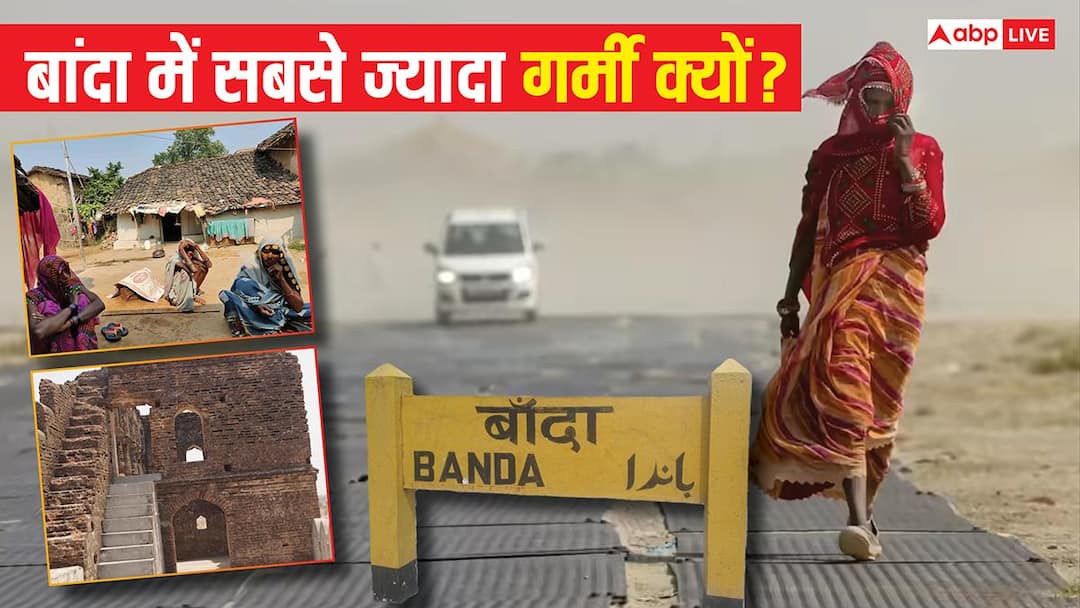
A place where there is silence on the streets after 10 in the morning. Where instead of working in the fields during the day, farmers are forced to plow under the light of LED lights at night. Where workers are ready to give up up to 40 percent of their wages to escape the heat. Where electrical transformers become so hot that they have to be kept cool by continuously pouring water on them. This is not the script of a horror movie, but the reality of Banda situated on the semi-arid plateau of Bundelkhand in Uttar Pradesh. The maximum temperature recorded here on May 21, 2026 was 48 degrees Celsius. This is not a trivial figure. Banda has become the hottest city in the world for the third consecutive day. Let us understand why there is such severe heat in Banda and what effect is it having on life?
Banda: This season’s ‘hotspot’
This is not the first time that Banda has made headlines. The city has repeatedly emerged as the hottest destination in the world and the country throughout the season:
- 27 April 2026: The temperature reached 47.6 degrees Celsius, which was the hottest April day since 1951. On this day, Banda remained at number one in the list of 8,212 weather stations around the world.
- 17 April 2026: With 45.4 degrees Celsius it became the hottest place in Asia.
- 17 May 2026: Once again the hottest city in Asia with 46.4 degrees Celsius.
- 19 May 2026: The mercury reached 48.2 degrees Celsius and Banda remained the hottest city in the world for the third consecutive day.
- 20 May 2026: The temperature was 48 degrees Celsius and it remained the hottest city in India for the fourth consecutive day.
On May 19, 2026, 40 cities of Uttar Pradesh alone were included in the list of 100 hottest places in the world, but Banda was at the top among them. The thing to note is that Banda has left behind even the traditionally hot cities of Rajasthan like Churu and Jaisalmer. On May 21, temperatures higher than Banda were recorded only in Egypt’s Aswan at 49.4 degrees Celsius and Saudi Arabia’s Arafat at 48.4 degrees Celsius. Khajuraho stood fourth in the list of highest temperature in the world with 47.4 degrees Celsius.
Why is it so hot in Banda?
It’s not just the weather. There are many man-made reasons behind this, which have gradually transformed Banda into a furnace. Experts call it the ‘vicious cycle of heat’:
- Indiscriminate Sand Mining: This is the biggest and most dangerous reason for the heat of Banda. Every day 2,000 to 3,000 trucks of sand and morang are illegally mined in the Ken River basin. Padmashree awarded water conservation expert Uma Shankar Pandey says that excessive mining has completely destroyed the natural cooling system of the river. The river sand used to absorb water and keep the ground cool, it has now vanished. Instead, the rocky surfaces are absorbing heat and releasing it at night.
- Rapidly disappearing forests: According to a study by Banda Agricultural University, the district has lost about one-sixth of its dense forest area between 1991-92 and 2021-22. Open forests have also decreased at approximately the same pace. The result is that today only 3 percent of the area of the district is covered with greenery, which is one of the lowest figures in Uttar Pradesh.
- Drying Water Source: Rivers like Ken and Baghain are continuously shrinking. Professor of Geology Department of Lucknow University. According to Dhruv Sen Singh, depletion of water bodies, lack of moisture and increase in sandy surfaces have turned Banda into a ‘heat island’.
- Geographical structure: This rocky and stony area of Bundelkhand absorbs heat throughout the day. The problem is that even before the night has completely cooled down, the next scorching morning begins. On top of that, the hot westerly winds coming from the Thar Desert of Rajasthan make it even hotter.
What effect is this scorching heat having on life?
This scorching heat of Banda has completely disrupted people’s lives:
- Silence in the day: After 10 in the morning the streets, shops and markets of the city become completely empty. A shopkeeper in Atarra town told a news website that he has made almost no sales since April.
- Farming at night: Farmers are forced to do farming at night under the light of LED floodlights, because it has become impossible to work in the fields during the day.
- Migration of workers: According to contractors, many workers are willing to give up up to 40 percent of their wages to avoid working between 10 am and 5 pm.
- Collapsed power system: Due to excessive load, more than 1,379 transformers of 44 substations are failing repeatedly. Electricity department employees are continuously pouring water to keep them cool.
- The exodus started early: Migration from villages to cities has started much earlier than usual this year.
Banda is known for its role in the War of Independence of 1857, but today it is more in news for its scorching heat and chronic water shortage. This justifies the concerns of Prahlad Valmiki, a resident of Bhaddu village, who says, ‘The time has come that serious attention should be paid to this. Otherwise Banda will become unlivable.