
 By Admin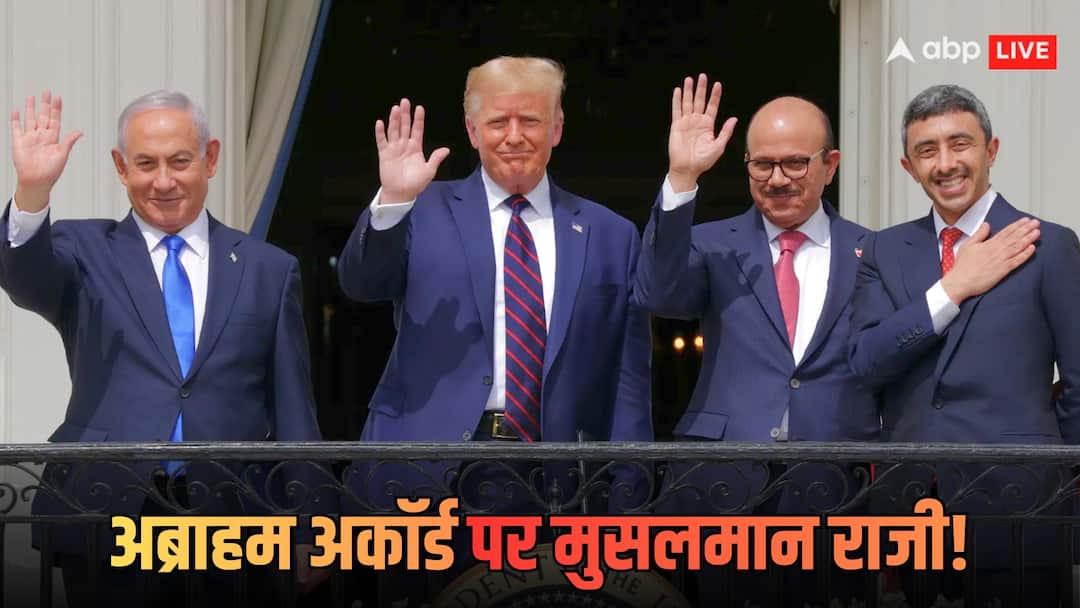
US President Donald Trump caught the attention of the whole world by writing a post on the social media platform Truth Social on May 25, 2026. He made a big appeal to the leaders of Muslim countries like Saudi Arabia, Qatar, Pakistan, Turkey, Egypt, Jordan, UAE and Bahrain. Trump clearly said that now is the time for all of you to strengthen relations with Israel and sign the Abraham Accords. Trump called it a ‘Mandatory Request’. He even said that countries which will not do so should not be part of the Iran deal. This proves their bad intentions.
Just before this, on Saturday, Trump had held a conference call with the leaders of these eight countries. According to the report of American news outlet Axios, when Trump raised the issue of recognizing Israel during the call, there was silence on the line for a few moments. Many leaders were surprised to hear this demand. But the question is, is this the Abraham Accord?
What is the Abraham Accords?
Abraham Accords is not a single document, rather it is a series of many agreements. Through this, Arab and Muslim countries normalize their relations with Israel and strengthen entire diplomatic relations. These agreements were brokered by the US and are considered the biggest foreign policy achievements of Trump’s first term (2017-2021).
Talking about the name, ‘Abraham’ i.e. Hazrat Ibrahim, who is considered a big personality in all the three religions, Judaism, Christianity and Islam. These agreements are based on the spirit of peace and brotherhood among the three religions. Its biggest specialty is that it broke a decades-old unwritten condition of the Middle East. The traditional stance of the Arab countries was that they would not recognize Israel until the Palestinians became an independent country. The Abraham Accords broke precisely this barrier.
When and how did the Abraham Accords begin?
15 September 2020. The White House Lawn in Washington, DC. On one side Israeli Prime Minister Benjamin Netanyahu, on the other side UAE Foreign Minister Sheikh Abdullah bin Zayed and Bahrain Foreign Minister Abdullatif Al-Zayani. All three signed a document that changed the political map of the Middle East.
Trump’s son-in-law and senior advisor Jared Kushner played an important role in concluding this agreement. The UAE and Bahrain became the first Arab countries to formally recognize Israel since 1994. After this, Morocco (December 2020), Sudan (January 2021) and most recently Kazakhstan (November 2025) also joined this agreement.
At present five countries are part of the Abraham Accord. Additionally, Egypt (1979) and Jordan (1994) have already signed peace agreements with Israel.
What effect did the Abraham Records have on Israel?
Until five years ago, Israeli citizens could not travel to the Gulf countries. Direct phone calls from UAE to Israel were also blocked. But everything changed after the Abraham Accords.
- Business: The most shocking figure is that of trade. In 2020, trade between Israel and UAE was just over $50 million, but in 2024 it will increase to more than $3.3 billion (about Rs 27,500 crore). Between 2021 and 2024, trade between Israel and Abraham Accord countries increased by 127%. In 2023, the total trade of these countries with Israel will cross $4 billion, which was 16% more than 2022.
- Tourism and air connectivity: Today there are many flights daily between Dubai and Tel Aviv. 10% of Ben-Gurion Airport’s traffic is now on UAE routes.
- Trump’s claim: Trump wrote in his post that ‘Abraham Accord has proved to be an economic, financial and social boom for the countries involved in it (UAE, Bahrain, Morocco, Sudan and Kazakhstan). So much so that even in this era of war and conflict, the current members never even talked about leaving or stopping it.
Abraham Accord does not solve Palestine issue
The biggest weakness of the Abraham Accords is that it completely ignores the Israel-Palestine issue. Palestinian leaders called it a ‘stab in the back’ and accused Arab countries of betraying the Palestinians. These agreements are not particularly popular among the common people in the Middle East. The main reason for this is that they do not find a solution to the Palestinian issue.
Experts say that ‘the biggest problem is that the Abraham Accord tries to erase Palestinians from the map.’ The Hamas attack of October 2023 and the subsequent Israeli action in Gaza severely tested the strength of these agreements. But despite this, no country has yet backed out from the agreement.
What does Trump want now?
Trump clearly said, ‘This should start with the immediate signing of Saudi Arabia and Qatar and everyone else should follow their lead.’ He warned that countries which do not do so should not be part of the Iran deal. He also indicated that if there is a peace agreement with Iran, it would be an honor to include Iran in it.
Protests started immediately regarding this demand of Trump. Pakistan first rejected this proposal outright. A Pakistani security source said Trump is using Iran ceasefire diplomacy to push for a major expansion of the Abraham Accords, but ‘these two issues are not and cannot be linked.’ Pakistan is not bound to accept any such demand.
This matter is even more sensitive for Saudi Arabia. He is the birthplace of Islam and the guardian of the two holiest sites, Mecca and Medina. Its old stance is that until a clear roadmap is made for the state of Palestine, it will not recognize Israel.
So what will happen next in this case?
The story of Abraham Accord is not over yet. Trump wants to make this the biggest part of his legacy. He wrote, ‘The Middle East will be united, powerful and economically strong, perhaps like no other region of the world.’
But the ground reality is that the Israel-Palestine conflict, the Gaza war and the anger of the general Muslim public are the biggest obstacles in this path. Pakistan has already said no and other countries have maintained silence till now. Ali Waez, Crisis Group’s Iran project director, says, ‘Trump is trying to sell the Iran deal as a sequel to the Abraham Accords, but he is replacing one fantasy with another. From forcing Iran to surrender to pretending that a weak deal can lay the foundation for a new order in the Middle East.