
 By Admin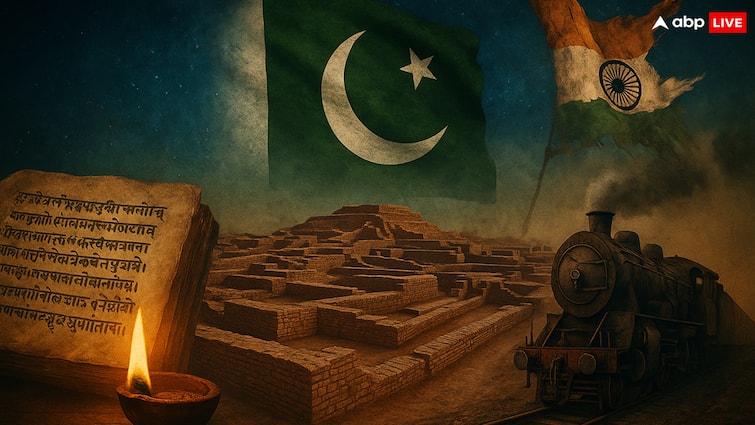
The ground on which the sound of the Vedas was echoed, where Buddha gave the message of compassion and where the first tone of Sanskrit erupted, today the same land is called Islamic Republic Pakistan. The question surprises whether Pakistan was once a Hindu nation, and if not, how did it become an Islamic country. The answer is hidden in the combination of history, religion and politics. Let’s know how
Today’s Pakistan is the same land which has been called Saptasindhu Pradesh in the Vedas. The civilization of the Indus Valley, Mohenjodaro, Harappa, Taxila, flourished on this earth. Yajna took place here, the sages meditated, and Buddhism spread.
This region was originally part of Indian culture, but over time both religion and power changed. In the eighth century, Arab General Muhammad bin Qasim invaded Sindh.
King Dahar fought with valor but was defeated, and for the first time Islamic rule was established on this land. After this, the Islamic culture spread to the depths under the rule of Ghajanvi, Gauri, Lodhi and Mughals.
History stained with fire and blood!
Hindus and Muslims lived together during the British Raj, but the walls of mistrust were erected between them. The Muslim League, built in 1906, announced that Muslims need their own distinct identity in Hindu -dominated India. The two nation theory started from here, the idea that laid the foundation of a new tragedy.
Mohammad Ali Jinnah made it a question of Islamic existence, while Gandhi and Nehru kept talking about unbroken India. The Lahore proposal of 1940 formally gave a formal form of a separate nation for Muslim -dominated areas, and in 1947, in 1947, the Sapna became true in the flood of blood.
Punjab and Bengal burns at the time of partition. Nearly one million people were killed and more than one crore were displaced. The areas of Sindh, Punjab and Balochistan, which were previously inhabited by Hindus and Sikhs, were vacant. The bells of the temples went calm, the echo of Ajan took place. In 1947, the Hindu population in these parts of Pakistan was about 15 percent, but by the 1951 census it had come down to less than two percent.
In 1956, Pakistan declared itself an Islamic Republic. The concept of secularism was constitutionally rejected. The Sharia law came into force under the rule of Zia-ul-Haq, and Islam was made at the root of politics and justice system. This process of Islamicization completely transformed Pakistan into a religious nation, while India chose the path of a parallel state.
Today, the Hindu population in Pakistan has been reduced to about 1.8 percent. They mostly live in areas like Tharaparkar and Mirpurkhas in Sindh. Many temples Heritage Sites are declared but the freedom of worship is limited. Families whose roots were there for centuries, they either migrated or learned to be scared.
Religion and Hato Hanti, Dharma Rakshati Rakshit:
The verses of Manusmriti are remembered, religion and Hato Hanti, Dharma Rakshati Rakshit :. That is, one who destroys religion is destroyed. He who protects him, he survives. The history of Pakistan is a lively example of this truth. India kept religion separate from politics, while Pakistan made religion politics.
Therefore, it would not be wrong to say that Pakistan was never a Hindu nation, but it was definitely the land of Hindu culture. His soil had the smell of Vedic era, the history of Vedas flowed in his rivers.
Time, power and principles eradicated that identity. The boundaries have changed, but the soil is the one who still asks, who I am, the land of the Indus or the Republic of Islamic? Sometimes the lamp used to light on this earth, now it is just the echo of Ajan, this contradiction of history is the real story of Pakistan.
Disclaimer: The information provided here is based only on beliefs and information. It is important to mention here that Abplive.com does not confirm any kind of recognition, information. Before implementing any information or recognition, consult the concerned expert.