
 By Admin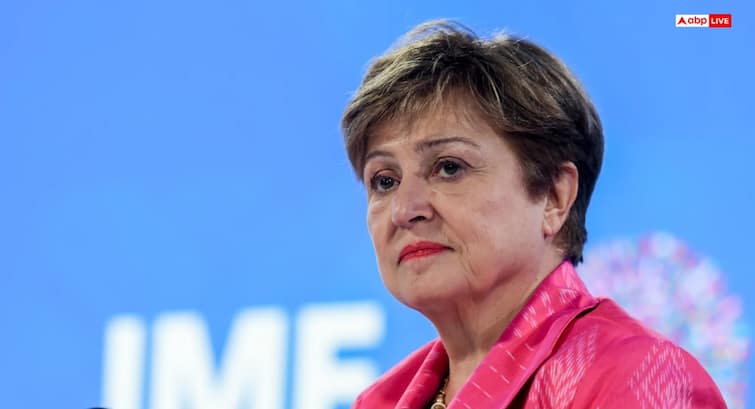
The world economy is currently going through a difficult phase. International Monetary Fund (IMF) Managing Director Kristalina Georgieva recently warned that ‘uncertainty has now become the new reality, so everyone should tighten their belts.’ Within 48 hours of his warning, US President Donald Trump threatened to impose up to 100% import duty on products coming from China.
This step has been taken in response to restrictions on the export of ‘rare earth minerals’ by China. After this announcement, sharp fluctuations were seen in the global markets, which further increased the concern of investors. These developments are taking place at a time when the annual meeting of the IMF and the World Bank is going to be held in Washington, in which the Finance Minister and the Central Bank Governor will review the global economic situation.
Despite shocks, global economy shows resilience
In her prepared speech, Kristalina Georgieva said that despite several shocks at the beginning of this year, the world economy has shown strength. Anticipating Trump’s possible policies, companies had made changes in their supply chains, thereby averting a large-scale trade conflict. Many countries chose strategic agreement instead of confrontation with America.
New trade policies and geopolitical tensions become challenges
However, the new tariff dispute between America and China makes it clear that trade risks are still not over. According to the report of the United Nations Conference on Trade and Development (UNCTAD), global trade increased by more than $ 500 billion in the first half of 2025, but increasing uncertainty and geopolitical tensions remain a major challenge for developing countries. Meanwhile, strategies like ‘friendshoring’ (increasing trade with trusted partners) have also emerged, due to which the global trade structure is changing rapidly.
Rapidly increasing investment in AI
Markets around the world are witnessing tremendous investment in companies related to artificial intelligence (AI), especially in data centers, semiconductors, servers and telecom equipment. According to WTO data, 20% of the growth in global trade in the first half of 2025 was due to AI-related goods, the majority of which went to the US from Asia.
However, experts have warned that this rally could take the form of artificially inflated valuations. The Bank of England has said that if the expectations related to AI are not met then there could be a sudden big fall in the market. IMF chief Georgieva has compared the current situation to the dot-com bubble of 2000.
Uncertainty increased due to American policies
The Trump administration’s use of import tariffs as an ‘economic weapon’, unfunded tax cuts and challenging institutions like the US Federal Reserve – all these together are raising questions about the credibility of the US economy. So far the markets are bearing these shocks, but any loss of confidence at any time can affect the dollar and its related assets.
Georgieva’s message ahead of the IMF-World Bank meeting in Washington is clear that the world economy is facing threats from many fronts, be it trade tensions, political conflict or a possible AI investment bubble. The IMF chief clearly said that the coming months will be the real test of global economic stability. Investors, governments and businesses will have to exercise caution and vigilance, because economic flexibility also has a limit.