
 By Admin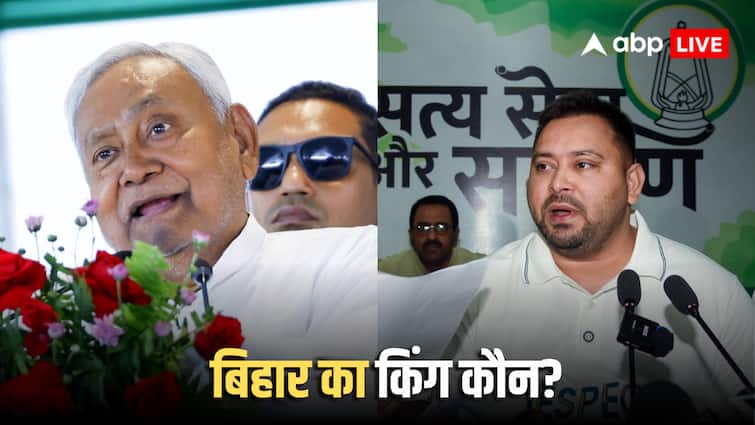
The politics of Bihar has once again become heated. Assembly elections are near and the atmosphere in the state is election-coloured. Amidst the posters, speeches and rallies, now the discussion is about only one question, who will become the king of Bihar this time and who will remain out of the race? Meanwhile, political analyst Amitabh Tiwari has presented a study which has given an opportunity to understand the entire electoral equation afresh. By doing a comparative analysis of the results of the last six to seven elections, three assembly and three Lok Sabha elections, he has told which party is strong and whose ground is slipping.
This time the position of Janata Dal (United) i.e. JDU in Bihar looks more unstable than balanced. According to Amitabh Tiwari’s analysis, there are about 17 seats of JDU, which have been kept in the very strong category, but out of these, the party has won only 6 to 7. At the same time, JDU’s performance has been weak even in 31 seats of strong category. Out of these, only four to five seats came to its account.
A matter of concern for JDU
If we talk about moderate seats, JDU has about 34 such seats, where its performance has been neither very good nor very bad, but it is a matter of great concern that 116 seats of the party fall in the difficult category. That is, such seats, where it has been almost impossible to win. Out of these seats, JDU has won only one or two seats. JDU has not even been able to open its account on 45 seats in the weak category.
BJP’s mathematics hold on some seats
The position of Bharatiya Janata Party (BJP) is also not much different from JDU. According to the analysis, 19 seats of BJP are considered very strong but out of them only six to seven have been won. Even out of 47 strong seats, BJP could win only 4 to 5. While the party won three out of 44 seats in the middle category, its position in the difficult seats was very weak. There are about 70 seats where BJP’s performance was below expectations and 63 seats where the party did not win even a single victory. It is clearly visible from these figures that the traditional vote bank of BJP is slipping in many areas, especially in rural areas where there is resentment regarding the policies of the alliance.
RJD’s lead
If any party has maintained its hold in the last few years, it is the Rashtriya Janata Dal (RJD). RJD has a total of 16 seats, which have been kept in the strong category and out of these, the party has been continuously winning 4 to 5 seats. RJD’s performance on middle category seats was also balanced, winning three out of 16 seats. Interestingly, out of the 116 difficult category seats of RJD, the party has managed to win one or two seats. This shows that even though the area is difficult, Lalu Yadav’s traditional vote bank is still effective in some areas. However, RJD’s account has not yet been opened on 93 seats in the weak category.
Congress and Left parties have limited influence, limited expectations
The position of Congress can be said to be the weakest in Bihar. He has no seat in the very strong category. Only 7 seats fall in the middle category and out of these it has won 3. Congress’s performance in 44 difficult seats was very weak – barely winning one or two seats. Even the name of Congress was not visible on 189 weak seats. Whereas, if we talk about Left parties, the position of both CPI-ML and CPM is almost the same. The analysis shows that the Left parties do not have any strong or very strong seats. CPM has won only 1 or 2 out of 11 difficult seats, while it has failed to win on more than 200 seats in the weaker category.
condition of small parties
The position of parties like HAM (Hindustan Awam Morcha), RLSP, LJP and VIP is marginalized in this electoral equation. These parties do not have any very strong or strong seats. LJP has 23 middle category seats, out of which it has won only three. RLSP and HAM have some difficult category seats, where their victory has been limited. VIP Party, which was once with NDA and is now included in the Grand Alliance. He has 5 tough seats and has a winning record on only one or two of them. It is clear from this that small parties can now maintain electoral survival only by depending on big alliances.
North vs South Bihar two political pictures
In Amitabh Tiwari’s analysis, Bihar has been divided into two parts, North Bihar and South Bihar. JDU’s hold in North Bihar seems to be more than in the South. Here it has 12 very strong seats, out of which it has won 6 to 7. It has 5 very strong seats in South Bihar, out of which it won 5 out of 7. BJP has 15 strong seats in North Bihar, in which its victory ratio is around 6:7, while the situation is a little weak in South Bihar. RJD’s hold in North Bihar has been permanent. Here it has won six to seven seats out of 16. RJD’s influence has been limited in South Bihar.
Also read: Uproar outside the house of Minister Konda Surekha in Telangana, daughter Susmita Patel clashed with the police over the arrest of former OSD.