
 By Admin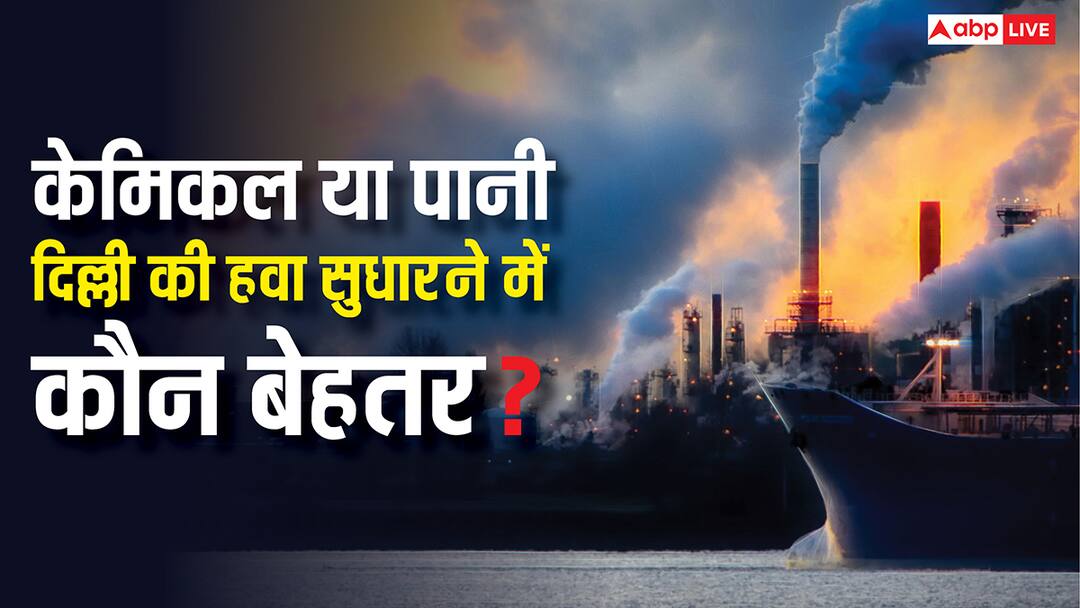
The people of Delhi are in need of fresh air at this time. The pollution in his state is so severe that it is difficult to even breathe freely. The mornings are surrounded by fog and dust. Water is sprayed on the streets, while scientists look at the thin layer of chemicals and talk about who can really clean the air? Is water alone reliable or are chemicals better at preventing airborne dust? It has been revealed in the reports. Let us know what the experts have said.
Delhi’s air is in very poor category
The air quality index (AQI) in Delhi reached 335 on Wednesday morning and was recorded in the ‘very poor’ category. This is the second consecutive day when the air quality in the capital reached dangerous levels. People got some relief on Sunday and Monday, but after Tuesday night, dust and particles again surrounded the city. Delhi government has continuously sprinkled water on the roads to control pollution. On an average, this process happens on about 3,000 kilometers of roads every day. Water collects particles and reduces dust. This method is considered simple, cheap and quickly available.
What is the safer solution, water or chemicals?
But a recent study has raised the question whether water alone is enough to eliminate pollution or whether dust-removing chemicals are more effective. A joint study by Enviro Policy Research India (EPRI) and National Environmental Engineering Research Institute (NEERI) revealed that chemicals can trap airborne dust for a longer period of time than water.
According to a 2018 study by CPCB, chemical dust repellents were found to be 50–60% effective, while water was only 25–30% effective. During the study, dust levels dropped by about 30% after using the chemical and remained stable for six hours. In contrast, the effect of water was visible only for 10–15 minutes, because the surface dries quickly.
How much does water sprinkling cost?
In fact, water sprinkling is the oldest and widely used solution in Delhi. Its biggest feature is that it is a cheap solution and can be easily used on every road. It costs about Rs 2160 to control 100 square meter area with water for six hours, whereas chemical dust control costs only Rs 100.
effect of chemical
However, experts advise caution when using chemicals. If used incorrectly, these chemicals can prove dangerous to the environment and public health. The thin chemical layer formed on the surface stabilizes the dust, but due to movement or air circulation it breaks. Therefore it is difficult to use it in the entire city. A senior scientist of the Commission for Air Quality Management (CAQM) said that chemical dust suppressants are used in some limited areas, where there is less movement. In other places water is suitable because it is more flexible and safe.
Also read: After Baba Venga, which Baba became famous in the world, whose predictions turn out to be absolutely correct?