
 By Admin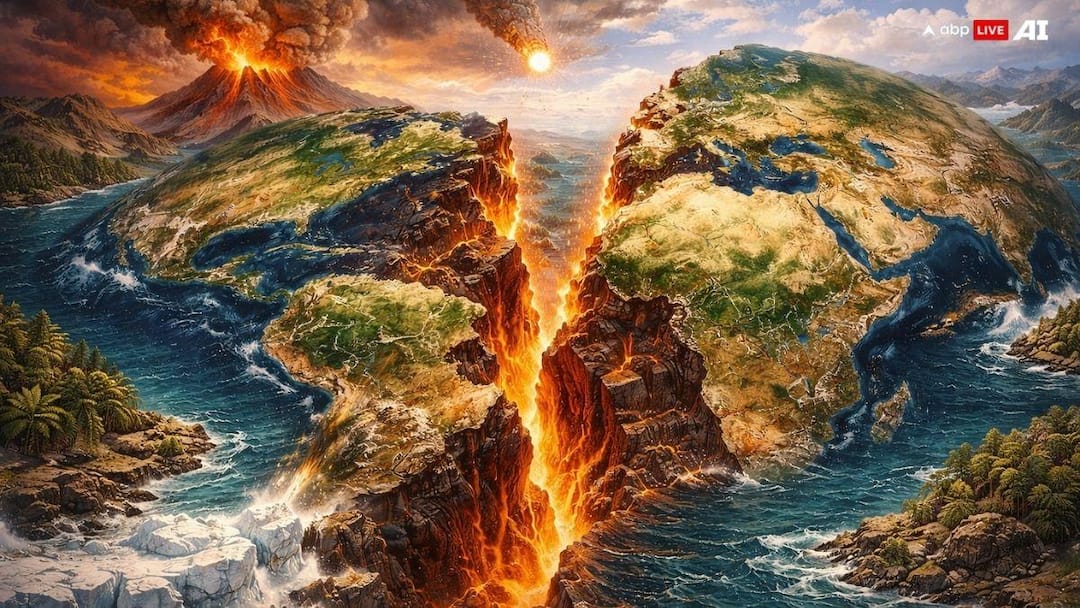
Continent Formation: The continents we see today were not always in their current shape or position. Asia, Europe, Africa and the rest of the world’s landmasses are the result of a slow geological journey over hundreds of millions of years. This entire matter has been explained by the principles of continental drift and plate tectonics. It explains how the Earth’s surface is constantly moving and reshaping itself. Let us know how continents were formed from Asia to Europe.
when all the continents were one
About 300 million years ago, all the continents of the Earth were connected together into one large land mass. It was known as Pangea. This supercontinent was surrounded by a large global ocean named Panthalassa. Life, climate and geography were quite different at that time. Also the idea of separate continents did not exist. Pangea was caused by the slow motion of tectonic plates pushing the land together over millions of years.
The rupture began deep inside the Earth
About 200 million years ago, powerful forces beneath the Earth’s surface began to act on Pangea. The heat emanating from the Earth’s core created convection currents in the mantle, due to which cracks appeared in the supercontinent and it slowly started falling apart. This was the beginning of continental separation. This is such a slow process that it took millions of years to become noticeable.
Laurasia and Gondwanaland
As soon as Pangea broke, it first divided into two large land parts. The northern part became Laurasia, while the southern part became Gondwanaland, which later broke into Africa, South America, Antarctica, Australia, and the Indian subcontinent. This division laid the foundation of the modern continental layout.
Why are Asia and Europe so closely connected?
Asia and Europe evolved together as part of Laurasia and remained connected on a single tectonic plate called the Eurasian Plate. This is why geographically Asia and Europe are sometimes considered to be a single continent, Eurasia, with no clear natural boundary between them.
India’s dramatic collision with Asia
One of the most dramatic chapters of continental formation involves the Indian subcontinent. After the separation of Gondwanaland, the Indian Plate moved rapidly north and collided with the Eurasian Plate about 40-50 million years ago. Due to this tremendous collision the upper layer of the earth bent and rose up. Due to this, the Himalayan mountain range was formed which is still growing today.
A process that is still ongoing
The formation of continents is not an ended story. The tectonic plates are still moving at the rate of a few centimeters every year. They are growing almost as fast as nails grow. These movements are continuously affecting the earth. Because of this, earthquakes, volcanic eruptions and gradual shifting of continents occur.
Also read: What are e-buses, whose introduction in the North-East was announced in the budget? How will this make traveling easier?