
 By Admin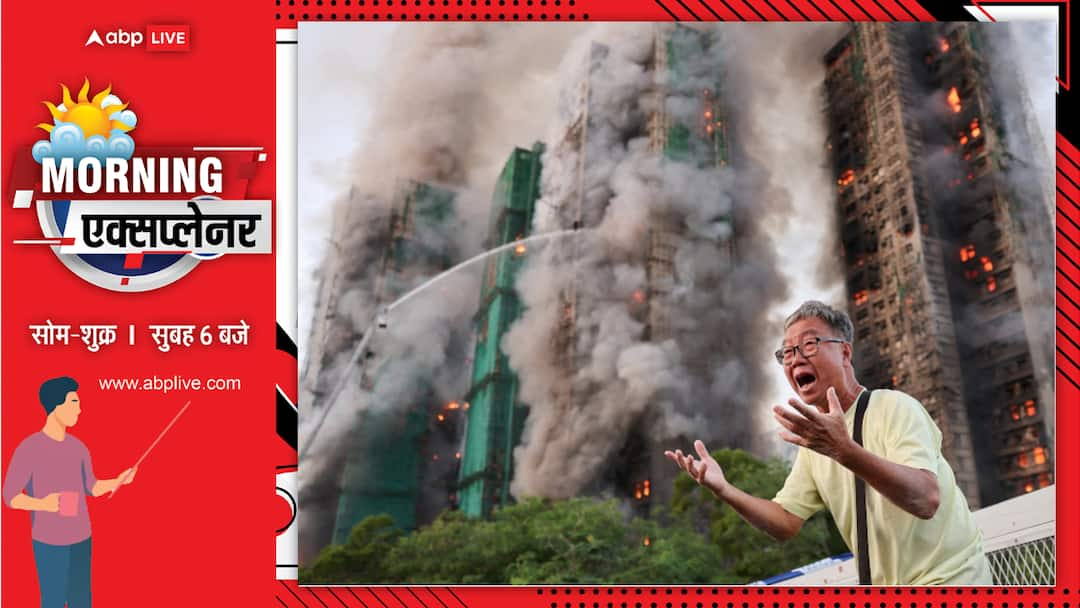
On November 26, at 2:52 pm, a fire broke out in a large residential complex in the Tai Po district of Hong Kong, China. Till the time of writing this news, 55 people have died in this accident, while 76 are seriously injured and 279 people are missing. This is the worst fire in 77 years. But the surprising thing is that China, which has made hundreds of inventions like 5G, AI, gunpowder, flying car and fake rain, could not control the fire. In ABP Explainer, let us understand what are the current circumstances of this accident, how technology around the world gets lost in fire and why it is impossible to control it…
Question 1- How did the biggest fire in China in 77 years happen and what is the situation now?
answer- The Wang Fuk Court Complex in China where the fire broke out, has a total of 8 buildings. Wang Fuk Court is a housing complex in the Tai Po area of the New Territories, which is currently undergoing renovation and repair. All the towers were covered with bamboo scaffolding. There are 1,984 flats in this estate and around 4,000 people live here. Each building has 35 floors.
The fire spread rapidly through the bamboo scaffolding installed outside the buildings. Due to the strong wind and burning debris, the flames spread from one building to another. When the fire broke out, many people did not even notice it because the windows were closed due to repairs.

The team that came to extinguish the fire also had to face a lot of problems. The temperature was so high on many floors that firefighters were not able to reach those places. During this time a firefighter also died. Police have also arrested three people including the contractor. Suspicion of negligence or culpable homicide has been raised against them in the case of fire.
However, the police has not given much information about them. At the same time, election campaign activities have been postponed before the elections to be held on December 7. China’s local public broadcaster RTHK quoted the police as saying that many people were still trapped in the towers.
According to Hong Kong media South China Morning Post, this is the worst fire in 77 years. Earlier in 1948, there was an explosion in a five-storey warehouse, in which 176 people were killed. After this, in 1962, about 44 people died in a fire in Shui Po area. At the same time, in November 1996, 41 people were killed and 81 were injured in a fire in the Garley Building in Kowloon.
Question 2- How did China, which was at the forefront of technology in the world, lose to fire?
answer- China has made many big inventions in the last decade and a half…
- Become the world’s first country to launch 6G test satellite in 2023.
- Maglev train running at a speed of 600 kilometers per hour in 2024.
- It has the world’s largest and most powerful quantum computer ‘Juzhang-3’, which is 1 million times faster than America’s ‘Frontier’.
- The number of 5G base stations is more than 38 lakh. This means that even the rest of the world together could not spend this much.
- The base module of the Lunar Research Station, launched in 2025, is completely made of Chinese technology.
- The world’s tallest (1,000 meter) skyscraper ‘Sky City’ was also built by China.
- This China holds 70% of the global market in EV batteries, 80% in solar panels and such dominance in drone technology that DJI alone holds 90% of the commercial market.
China may have won a lot of accolades across the world for its technology, but this one fire showed that technology is a ‘tool’, not a ‘solution’. China invested in renewable energy and EVs, but missed out on basic safety features like fire-resistant materials. Despite China’s technological advances, this accident was the result of human error and outdated practices…
- Flammable Materials: These buildings were constructed from July 2024. They were supported by bamboo and covered with green netting, which is common in China and especially Hong Kong. This scaffolding is an alternative to steel scaffolding, which is widely used in construction work because it is light and very strong. It is easy to carry and reach heights. Long bamboo poles can be easily joined together, allowing scaffolding to be quickly erected around large buildings. But the Styrophone blocks on the elevator windows (which were not fire extinguishing, but decorative) allowed the fire to spread rapidly. The fire started from outside, but reached the flats through the corridor.
- Negligence in construction: The police arrested those responsible of the construction company, alleging gross negligence. Initially the investigation found that the use of inflammable material was a violation of safety standards. Hong Kong has high housing standards, but weak monitoring of renovation. Hong Kong is famous worldwide for its use of bamboo scaffolding. To make this, long bamboo poles are erected by tying them with nylon fasteners. However, once bamboo catches fire, it burns quickly and the flames spread rapidly upwards. This is the reason why the Government’s Development Bureau is trying to gradually eliminate the use of bamboo scaffolding.
- Shortcomings of Smart System: Modern buildings have AI-based smoke detectors, automatic sprinklers and alarms, which can prevent the spread of fire by 50-70%. But this was an old complex, where such technology was limited.
- Lack of drones and robots: China is advanced in fire-fighting robots and drones, but there was a delay in deploying them in dense settlements. As a result, firefighters had to take risks.

Question 3- Why is it so difficult to control fire, and technology around the world fails?
answer- First of all let’s understand fire. It is a chemical reaction, which is formed and spreads from four basic elements. It is called ‘Fire Tetrahedron’, which is an upgraded version of the old ‘Fire Triangle’. According to the National Fire Protection Association (NFPA) report All About Fire: A Guide for Reporters, these four elements of fire are…
- fuel: Anything that burns, like wood, plastic or clothes.
- Oxygen: The gas present in the air, which gives breath to fire.
- Heat: Which is the initial spark or heat source.
- Chemical Chain Reaction: This is the most important element, because once it starts, it starts running automatically.
Due to the combination of these four elements, the fire not only burns but also starts spreading rapidly. According to NFPA, more than 80% of fires worldwide start from the wrong mix of these elements. Once the chain reaction starts, it becomes impossible to stop the fire.
- In the National Institute of Standards and Technology (NIST) study ‘Defining Flashover for Fire Hazard Calculations’, experiments proved that during a flashover, temperatures can reach 600 degrees Celsius to 1,000 degrees in less than 30 seconds. An experiment video showed that a fire started by burning a sofa can control the entire room in 3-5 minutes, because hot air rises up and cold air is drawn in from below, like a vacuum cleaner.
- Even the fastest fire drone takes 4-8 minutes to reach this fire and the fire truck takes 10-15 minutes in traffic. This technology does not reach as fast as the fire spreads.
- Then comes the play of oxygen, which makes the fire immortal. To extinguish the fire, water is poured, which reduces the heat, but does not completely eliminate oxygen. Foam or CO2 gas can block oxygen, but the air pressure in tall buildings is so strong that these chemicals evaporate within 10-15 seconds.
- Internet of Things i.e. IoT sensors can monitor oxygen levels, but once the fire spreads, the ventilation systems themselves feed the fire. Surprisingly, even in an advanced city like Singapore in 2023, the CO2 system failed in a high-rise fire because the fire had already started the chain reaction.
- Today’s buildings are filled with plastic, polyurethane foam, Styrophone and PVC pipes. It burns 5-10 times faster than old wood or brick. In experimenters at Underwriters Laboratories (UL), modern furniture sofas spread fire 20 times faster than vintage furniture from the 1950s because they contain synthetic foam that melts at 1000 degrees and fuels the fire.
- Tall buildings are the biggest enemy of fire. The water pressure automatically reduces above 100 meters, hence water has to be added by helicopter or drone, which proves to be inadequate. There is a ‘stack effect’ in high-rises, that is, hot air goes up, cold comes down, due to which fire and smoke spread faster.
The bitter truth is that technology cannot stop the fire, but can only slow it down. NFPA and USFA reports say that 70% of fires can be prevented if buildings follow codes. But as long as there is negligence and cost-cutting, the country making 6G or AI will also lose with a small spark.
Question 4- When and how much destruction has fire caused across the world?
answer- 5 terrible fire accidents in the world prove that it remains the oldest and most dangerous enemy of humans…
1. California Wildfires (2025): On January 7, Santa Ana winds and drought caused 14 devastating wildfires in Los Angeles County, USA. Some of the work was done by the electrical wires. There were more than 32 deaths, more than 15 thousand houses and shops were destroyed and more than 40 thousand acres of area was burnt to ashes.

2. Grenfell Tower Fire (2017): On June 14, a fire that started from a short circuit in a refrigerator engulfed London’s 24-storey Grenfell Tower in just 30 minutes, as flammable cladding gave the fire rocket speed and a ‘stay-put’ policy trapped people on the upper floors. 72 people died in this and the entire tower was destroyed.
3. Great Chicago Fire (1871): On October 8–10, dry weather and high winds swept across the city of Chicago, USA, when a lantern kicked by a cow caused a fall and fire (though, this is legend). It burnt 9 square kilometers of area, destroyed 17,400 buildings and left more than 1 lakh people homeless. About 300 people died in this. It was America’s first major urban fire, leading to the establishment of modern fire departments and pushing the city toward steel-frame buildings.