
 By Admin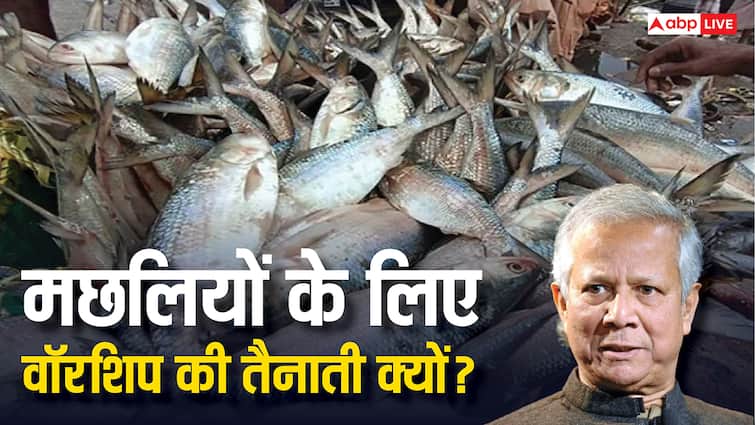
Army has been deployed in Bangladesh to protect Hilsa fish from illegal fishing. According to news agency AFP, 17 warships, drones and patrol helicopters were deployed for this. This means that the fish are being protected more than any VVIP person.
So let us understand in ABP Explainer, what is Hilsa fish, why is it the responsibility of the army to protect it and for what reasons the Yunus government does not want to lose them…
Question 1- What is Hilsa fish and where is it found?
answer- Hilsa fish is also called Ilish fish. It is a shiny silver looking sea fish, whose length can usually be up to 50 centimeters and weight can be more than 3 kilograms. This fish is found in the sea, estuaries (where the river meets the sea) and rivers. It has a lot of small thorns, which make it a little difficult to eat but delicious. Hilsa is also called the ‘queen of fishes’ in Bengal, because its taste is salty-sweet and creamy.
It is found in many countries including India, Pakistan, Bangladesh, Myanmar, Malaysia and Thailand. Hilsa is the national fish of Bangladesh and has been given the status of ‘mother’ there. Hilsa return from the sea (warm water) to the rivers (cold water) every year during breeding season to spawn.
Its price in Dhaka, Bangladesh is 2,800 to 3,000 taka i.e. 2,050 to 2,200 rupees per kilogram.

Question 2- What arrangements did the Government of Bangladesh make for its protection?
answer- Yunus government of Bangladesh made 4 major arrangements for the protection of Hilsa…
- 22-day fishing ban: The Yunus government imposed a complete ban on catching, carrying, storing, selling and marketing of Hilsa across the country from October 4 to October 25.
- Navy and Air Force deployment: To prevent illegal fishing, warships, patrol helicopters, patrolling vehicles and drones were deployed on 24-hour surveillance. 17 warships are deployed in the Bay of Bengal and the places where the river meets the sea.
- Compensation to fishermen: During the ban, every fisherman family is being given 25 kg of rice free of cost, so that they can survive. However, the fishermen families are not happy with this. “The three weeks are very difficult for the fishermen because we have no other means of survival,” 60-year-old fisherman Sattar Majhi told AFP.
- Hilsa Conservation Campaign 2025: This campaign is based on the successful efforts of 2024, in which fertility timing is decided keeping in mind the phases of the moon.

Year 3- Why does the Bangladesh government want to save it, for which it deployed the army?
answer- Bangladesh government wants to save this fish for 3 big reasons…
- National Fish and Cultural Importance: Hilsa is the national fish of Bangladesh, which is a symbol of the country’s identity and cultural heritage. Its preservation is linked to national pride.
- economic value: According to ORF’s research report, Bangladesh is the world’s largest Hilsa fish producing country. It ranks third in terms of fish production worldwide. Hilsa fish is its major export product, meeting about 75% of the global supply. Fisheries contribute about 3-4% to the GDP of Bangladesh. Hilsa’s share in the total fish production of Bangladesh is 12 percent. Here, 5.50 lakh to 6 lakh tonnes of fish is caught every year, providing livelihood to 5 lakh fishermen and 20 lakh people in related industries. Bangladesh exported 71,477 tonnes of fish and fish products (such as shrimp, hilsa, other marine fish) in the financial year 2023-2024 (FY24). Earned about 4,376 crore taka from this.
- Fertility Conservation: The breeding season of Hilsa fish is during the south-west monsoon i.e. July to October and sometimes in January-March. A female lays thousands of eggs. The small fishes hatched from the eggs return to the sea. It rises in rivers like Ganga for 50-100 kilometers or sometimes up to 1200 kilometers. Indian fishermen catch fish in the brackish waters of the Ganga River and its delta, which meet the needs of Kolkata and West Bengal. But excessive fishing can reduce the fish stock at the time of Hilsa breeding. In such a situation, fishing is banned during breeding season.
Question 4- Does Bangladesh government supply Hilsa fish to India?
answer- Yes. Bangladesh created ‘Hilsa Diplomacy’, an informal diplomatic strategy between the two countries, to supply Hilsa fish to India. In this, Bangladesh exports its national fish Hilsa to India, so that bilateral relations are strengthened. It is mainly done during Bengali festivals like Durga Puja, when the demand for Hilsa is at its peak in West Bengal. Because of this, this export acts as a cultural, economic and diplomatic bridge.
This tradition was started by then Prime Minister Sheikh Hasina in 1996, before the Ganga water-sharing treaty, when she sent Hilsa fish as a gift to former West Bengal CM Jyoti Basu. In 2012, Sheikh Hasina formalized ‘Hilsa Diplomacy’. According to ORF, Bangladesh exported 500 tonnes of Hilsa to India in 2019, 1,200 tonnes in 2020-2022 and 5,000 tonnes in 2023. The Yunus government imposed a ban after the coup in Bangladesh in 2024. But now approval has been given to export 1,200 tonnes of Hilsa fish in 2025.