
 By Admin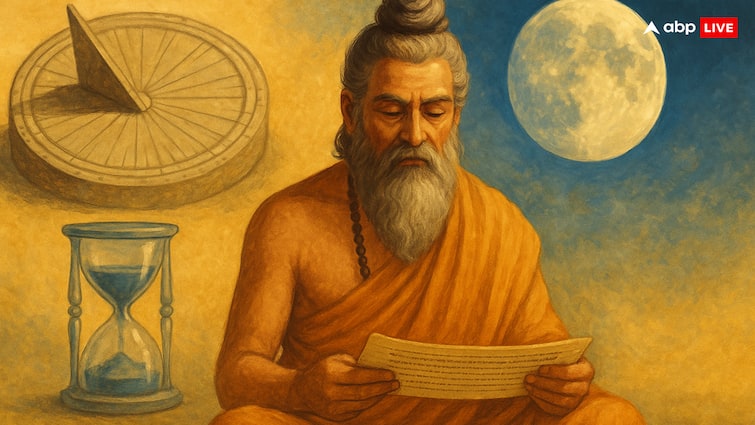
In ancient India, Time Measurement in Ancient India was not only scientific process, but it was deeply connected in every aspect of religion, astrology and life.
From Vedic Period to Medieval Period, time calculation was done with means like Sun (Sun), Moon (Moon), Constellations, Constellations, Water Clock and Panchang.
These devices were used not only in daily life, but also in yajna, fasting, festivals, war and agriculture. Let’s know how
Sun Clock: Sun is the lord of Kalachakra!
Vedic proof:
It is said in the Rigveda (10.85.13) –
‘Suryo Devo Yatra Kalachakran Vahi’
(Surya Dev is going to run the Kalachakra)
How did the sun work
Ganomon (stick) was made in the middle by making an hour lines on a stone or metal plank. Time was known by changing the angle of the shadow of the sun.
How was it used in religious works?
Its use was common for Sandhya-Vandan, Agnihotra, daily worship and time to start the journey.
Water Clock: Current calculation from watch to Muhurta
- Classical mentions:
A detailed description of water-waters is found in the texts of Suryasiddhanta and Bhaskaracharya.
1 day = 60 clock (decreased), 1 clock = 24 minutes, 1 Muhurta = 48 minutes. - Religious importance:
To measure Aarti, Naivedya and Mahapuja in temples.
To set auspicious moments of huge religious events like Kumbh Mela. - Astrological experiment:
In eclipse, fasting and marriage-muhurta determination.
What was the way of measurement of the moon and constellation -based time?
- Vedic reference:
It is said in the Atharvaveda –
‘Moon Masanan Raja’
(Moon is the king of month) - How was it done
The night time of the moon (Amavasya, Purnima etc.) and the status of the constellations was decided. - Religious Uses:
Festivals like Karva Chauth, Mahashivaratri, Janmashtami are based on the lunar philosophy.
Sand-Ghadi and Deepak-Ghadi: Time’s fire
- Calculation of time due to lamp oil burning or sand fall in ancient times.
- Use of lamp clock in temples in South India for Abhishek and Aarti time.
- In Buddhist monasteries, meditation was measured with incense sticks.
Almanac and astrological time science
Date, war, constellation, yoga and Karan are considered to be 5 parts of these almanacs. The formulas of Varahamihira’s Brihat Samhita and Bhaskaracharya’s principle Shiromani are found to be the formulas of Muhurta determination. On the basis of this, a combination of planetary and clock was done to decide the time of auspicious works.
Modern Comparison: Ancient times from measurement to digital age
- Then: Sun, lunar, water-wage, sand-wage, almanac
- Now: Nuclear clocks, digital watch, celestial software
- Equality: Even today, the Panchang and Muhurta calculations are considered the same principles which were decided thousands of years ago.
Time measurement in ancient India was not only a means of knowing ‘hour’ and ‘minutes’, it was a period of time-system of religion, astrology, agriculture, war, business and society. This is the reason that Kaal has been called the ‘form of God’ in Vedic literature-‘Kal: Sarveshu Bhuteshu’ (Mahabharata).
FAQS
Q1. What were the main means of measurement time in ancient India?
Suryaghadi, water-clock, sand-clock, lamp-wage, moon-nakshatra and almanac.
Q2. What was the religious significance of water and water?
The auspicious time of Aarti, Puja and festival-festival was determined by water-wandering.
Q3. What are the 5 organs of almanac?
Date, war, constellation, yoga and karan.
Disclaimer: Here information provided here is based only on beliefs and information. It is important to mention here that Abplive.com does not confirm any kind of recognition, information. Before implementing any information or recognition, consult the concerned expert.