
 By Admin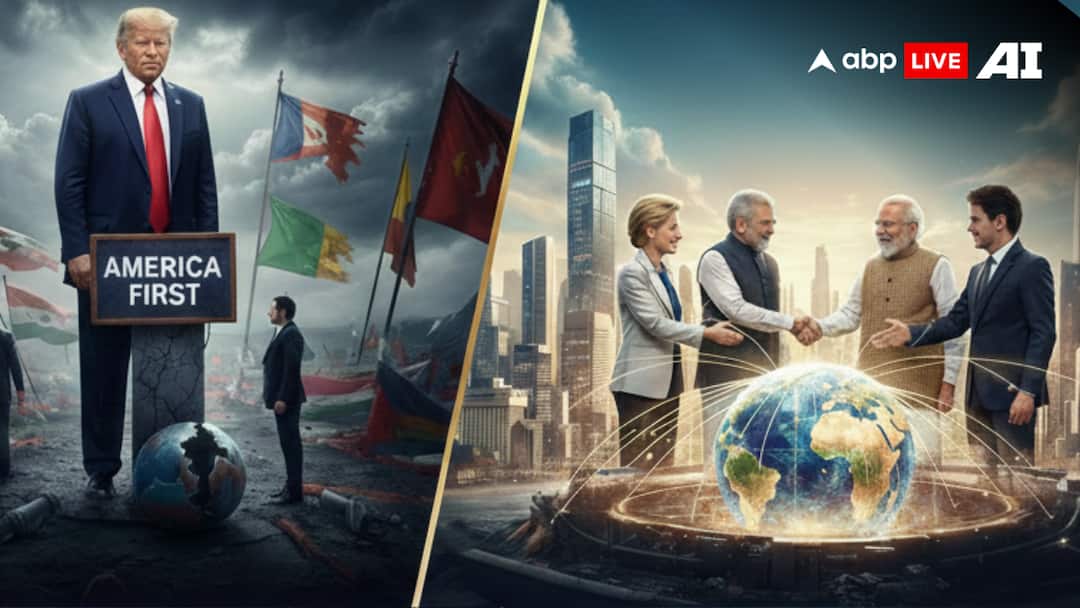
The economic and business politics of the world is changing rapidly. Due to US President Donald Trump’s protectionist policies, high tariffs and uncertain trade stance, many big countries are now adopting the strategy of reducing their dependence on America. India is emerging as a strong and reliable economic partner at the center of this global change. Many countries in Europe, Asia and North America are now moving away from the traditional West-centric model towards a West-East economic axis, where India is being seen as a long-term option and strategic balance.
British Prime Minister Keir Starmer’s visit to China is an indication of this changing global equation. This will be the first visit to China by a British Prime Minister in the last 8 years. The purpose of this tour is to improve the deteriorated relations with China and strengthen trade cooperation again. Starmer will also be accompanied by senior ministers and many big business leaders. In Beijing he will meet President Xi Jinping and Prime Minister Li Qiang, while business meetings will be organized in Shanghai. According to Reuters, Britain is now considering America as an uncertain partner and wants to reduce its economic dependence. Currently, China is Britain’s fourth largest trading partner and by the middle of 2025, trade between the two countries is expected to reach more than £100 billion.
Canada’s strategy changed, India became primary partner
Canada, a close ally of America, has also started a major change in its foreign and trade policy. Canadian Prime Minister Mark Carney is preparing to visit India in the first week of March. This visit is taking place at a time when Donald Trump threatened to impose heavy tariffs on Canada and created controversy by calling it the 51st American state. Canadian Foreign Minister Anita Anand clearly said in Davos that Canada will never become a part of America. He also said that Canada wants to double its exports outside the US in the next ten years. Under this strategy, India and China have been selected as major partners.
Brazil trusts India, the new axis of the Global South
India’s role is continuously strengthening in the countries of the Global South. Brazilian President Luiz Inacio Lula da Silva is visiting India in February. He will reach India with a large business delegation and will hold extensive talks with Indian industrialists. This visit is an indication that developing and emerging economies are looking at India not just as a market but as a strategic economic partner.
India-EU FTA becomes a gamechanger
The biggest example of this global change is the India-European Union Free Trade Agreement, which was signed on 26 January 2026. European Commission President Ursula von der Leyen has called it the Mother of All Deals. This agreement connects about 25 percent of the world’s global GDP and about two billion people. Under this, the European Union will reduce or eliminate tariffs on about 97 percent of the products sent to India, while India will also remove tariffs on 93 percent of European products in a phased manner. With this, European cars, wine, chocolate and processed food will become cheaper in India, while Indian textile, pharma, engineering and IT products will get a bigger market in Europe.
America’s concern and India’s clear policy
America seems uncomfortable with these new global alliances. US Treasury Secretary Scott Besant raised questions about India purchasing oil from Russia, while Canada was warned against cheap goods from China. Despite this, the stance of the countries is clear. They now want strategic autonomy and do not want to depend on any one power. India’s Foreign Minister S. Jaishankar said that no country can expect to put a veto on India’s relations with the rest of the world. This thinking is today making India the center of global economic change.
Also read: Free trade deal has been done between which countries till now, from which country does India get the most benefit in trade? know everything