
 By Admin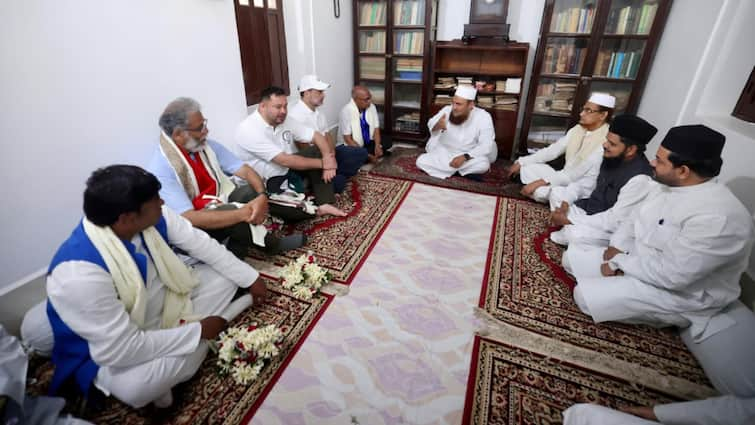
The political stir for Bihar assembly elections has intensified. During the ‘Voter Adhikar Yatra’ in Munger, Congress MP and Leader of Opposition in Lok Sabha Rahul Gandhi reached Jamia Rahmani on Friday (August 22). Apart from former Bihar Deputy CM and RJD leader Tejashwi Yadav, other leaders were also present with him. It has political meanings. Rajiv Gandhi also visited here in 1985 before Rahul Gandhi. In such a situation, this picture is being discussed a lot.
Rahul Gandhi and Tejashwi Yadav went to Jamia Rahmani in Munger and met Amir e Shariah Hazrat Hazrat Maulana Ahmed Wali Faizal Rahmani. RJD leader Tejashwi Yadav wrote on the social media platform X, “Today in Munger, he paid tribute to the elders of Khanqah Rahmani and met Amir-e-Shariyat Hazrat Hazrat Maulana Ahmed Wali Faisal Rahmani.”
Today, in Munger, he paid tribute to the elders of Khanqah Rahmani and met Amir-e-Shariyat Hazrat Maulana Ahmed Wali Faisal Rahmani. #Munger #TEJASHWIYADAV pic.twitter.com/SMAL4OJY47
– Tejashwi Yadav (@YADAVTEJASHWI) August 22, 2025
Why is Khanqah-e-R-Rahmani so important?
The Khanqah-e-R-Ramani located in Munger, Bihar has been working on Islamic education, Tasavuf (spirituality), politics and social issues for the last 125 years. Its founder- Hazrat Maulana Mohammad Ali was Mungeri. Maulana was also among the founders of Nadwatul Uloom, Nadwa in Mungeri, Lucknow. This institute is one of the centers of large Islamic education in India.
These Hanfi are Muslims, Deobandi is close to Masalak. These Muslims have a significant impact in Bihar, Jharkhand, so they also have influence. Secondly, they propagate Islam in a khankahi way, which is close to a system like Gurukul. This institution also has a deep hold on the socio-political land of Bihar.
International recognition in Islamic education
Jamia Rahmani has played an important role in Islamic education and has prepared such graduates which have been recognized internationally to serve knowledge and humanity. The institute not only played important roles in the development of madrasas and other educational institutions and their syllabus all over Bihar, Bengal and Orissa, but all over India.