
 By Admin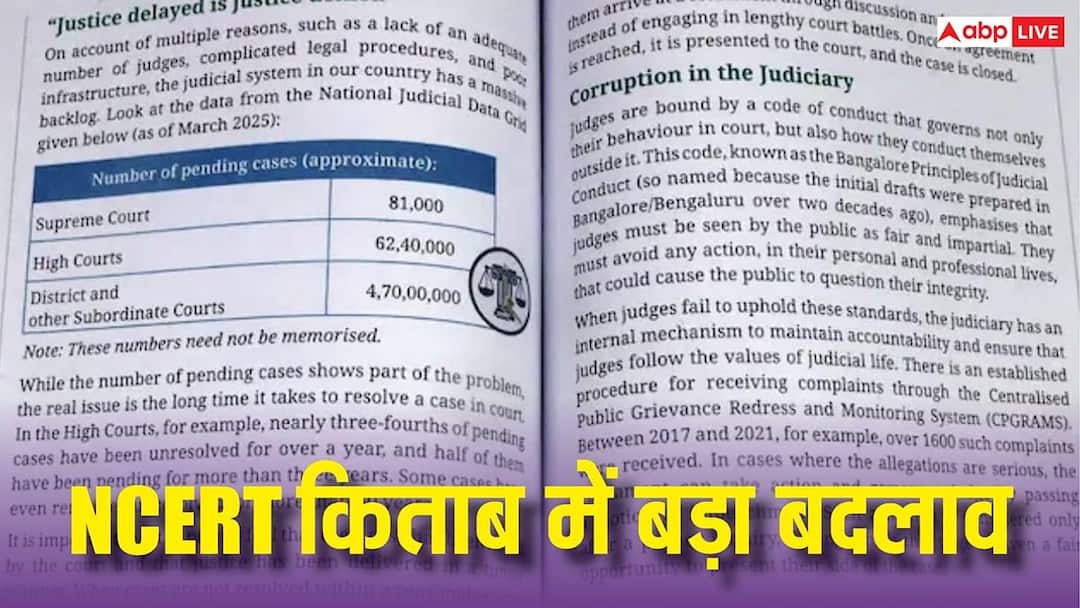
National Council of Educational Research and Training (NCERT) has recently released a new social science book for class 8. This time an important change has been seen in the book. Whereas earlier the emphasis was on the role of the judiciary, the structure of the courts and how the independent judiciary operates, now students have also been made aware of the challenges of the justice system. Issues like “corruption in the judiciary” and pending cases in courts have been clearly covered in the new book.
It has been told in the new book that a large number of cases are pending in the courts of the country. Through statistics, an attempt has been made to make the students understand how much pressure there is on the justice system. According to the book, there are approximately 81,000 cases pending in the Supreme Court of India. At the same time, about 62,40,000 cases are pending in the High Courts of India. Apart from this, about 4,70,00,000 cases are still pending in the district and subordinate courts.
In the book, many reasons have been enumerated behind these pending cases. Among these, shortage of judges, complexity of legal procedures and lack of adequate infrastructure in courts have been cited as the main reasons. An attempt has been made to make the students understand that not only giving decisions is a challenge, but running the entire system effectively is also a big responsibility.
Direct mention of corruption for the first time
This time, incidents of corruption and misconduct within the judiciary have also been mentioned in the book. It has been said in the chapter that judiciary is an important pillar of democracy, but it also faces many challenges. “Corruption at various levels” has been described as a serious problem, which can make access to justice more difficult, especially for the poor and disadvantaged. It has also been made clear in the book that judges are bound by a code of conduct. They have to maintain dignified and impartial behavior not only inside the court but also in their personal lives.
If a complaint comes against a judge, there is a prescribed procedure for it. If serious allegations are made against a judge, Parliament has the right to remove him from office through the process of impeachment. This process is long and based on investigation, in which the concerned judge is given full opportunity to present his side. In this way, the system of balance and accountability within the democratic framework has also been explained in the book.
Complaint and accountability system
The new book also tells about “Centralised Public Grievance Redress and Monitoring System (CPGRAMS)”, through which complaints can be registered. According to the book, more than 1,600 complaints were registered between 2017 and 2021. With this, it has been explained to the students that there is a system of accountability even within the judiciary.
Statement of former Chief Justice
A statement by former Chief Justice of India BR Gavai is also mentioned in the chapter. According to his statement given in July 2025, incidents of corruption and misconduct have also come to light within the judiciary. He had said that such incidents weaken public confidence. It was also said that only transparent, prompt and strict action can strengthen the trust of the people again. He described transparency and accountability as essential qualities of democracy.
Example of Electoral Bond and IT Act
Two important examples are also given in the book to make the students understand the topic better – Electoral Bonds and Information Technology Law. It is told in the book that in 2018, the government had launched the Electoral Bond Scheme, under which individuals and companies could make secret donations to political parties. Later the Supreme Court of India declared this scheme unconstitutional. The court said that voters have the right to know who is giving money to political parties. Through this example, it has been explained to the students how the courts protect the Constitution.
The second example is related to ‘Information Technology Act, 2009’. It has been told in the book that a provision was added to this law, under which one could face jail for posts made on social media or internet. In the year 2015, a law student had challenged this provision. After this, the Supreme Court canceled it, saying it was against freedom of expression. Students have been asked what decision the court took in these cases and what were the constitutional arguments behind it.
How different from the old book?
The earlier book, which was based on the 2005 syllabus, covered topics such as independence of the judiciary, structure of courts and citizens’ access. It was mentioned in it that cases take many years to be resolved and the saying “Justice delayed is justice denied” was mentioned. But issues like corruption were not mentioned directly.
After the Covid-19 pandemic, the old syllabus was ‘rationalized’ and many parts were reduced. Now the curriculum has been redrafted under the New Education Policy 2020 and National Curriculum Framework (NCF). New books for classes 1 to 8 have been released and this change is part of that process.
Also read – Shahrukh, Salman or Aamir… who is the most educated among the three Khans, who has studied from where?
Education Loan Information:
Calculate Education Loan EMI