
 By Admin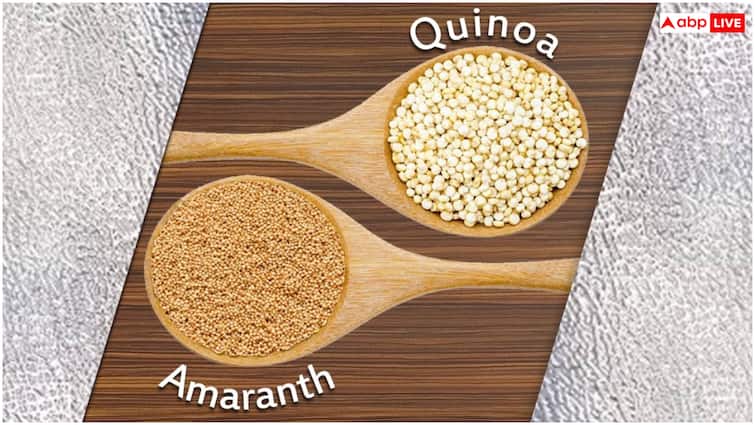
Rajgira and quinoa comparison: Health Conscious people are looking for superfoods nowadays. This is the reason that grains like Rajgira i.e. Amrant and Quinoa are dominated in the market. Both are rich in protein, but the question is, which of these is better for health? Let us know what is the best in both of your health according to nutrients and prices like calories, protein, fat, fiber, calcium, magnesium?
Certified Nutritionist, Diabetes and Health Educator Manas Samarth from Lincolon University College, Malaysia said that both Rajgira and Quinoa are good. Both are psudoserials. This means that these are not real grains, but seeds like seeds. These are gluten-free, which are the best for people with selecket disease. However, there is a difference in the nutritional value of both. According to the data of the USDA, we know what 100 grams of cooked Rajgira and Quinoa get?
Calorie: Who ahead in weight control?
This is very important for calorie counting. 100 grams of cooked Rajgira has only 102 calories, while Quinoa has 120 calories. This means that Rajgira is a low calorie, which is better in weight loss diet. According to Manas Samarth, if you are struggling with diabetes or obesity, then choose Rajgira. It spikes blood sugar less. Quinoa gives a little more energy, but it is necessary to avoid overwriting.
Protein: What is the best for muscle building?
Protein is necessary for body building and daily recovery. 100 grams of cooked Rajgira provides 3.8 grams of protein, Quinoa contains 4.4 grams of protein. Quinoa seems a little ahead, but Rajgira’s protein is more quality. It contains more amino acids like lysine. At the same time, the protein of Quinoa is complete, but Rajgira is better for children and the elderly, as it is easily digested. If you go to the gym, you can mix both and use it.
Fat: What is better in healthy fats?
There is 1.6 grams of healthy fat in Rajgira and 1.9 grams of healthy fat in Quinoa. Both are full of unsaturated fats, which are good for heart. However, Rajgira has more omega-3, which reduces inflammation. Manas Samarth says that there is not much difference in fat level, but Rajgira helps in cholesterol control.
Fiber: Who gives relief from digestion and constipation?
The fiber keeps the intestines clean. In Rajgira, 2.1 grams of fiber and Quinoa contains 2.8 grams of fiber. Quinoa gets more numbers here, because it removes constipation and also reduces the risk of collane cancer. However, Rajgira is also good, especially in diabetes, because it has a glycemic index (GI 55 vs quinoa’s 53).
Calcium: Which stronger partner for bones?
Calcium bone is very important for health. Rajgira provides 47mg calcium, but some studies have been told up to 159mg. Quinoa contains only 17mg calcium. Rajgira is best in strengthening bones. This is a good alternative of milk. Quinoa has low calcium, due to which supplement may have to be taken.
What better for magnesium?
Magnesium muscles relax and control blood pressure. Rajgira has 65mg and Quinoa has 64mg magnesium. In such a situation, both are good, but Rajgira’s combo with iron is considered better. According to the expert, there is a migraine due to lack of magnesium, for which both Rajgira and Quinoa are beneficial. However, Rajgira can be used daily due to being cheap.
What is more right for pockets?
Rajgira (Ramdana) is getting Rs 150-250 per kg in Indian markets, while Quinoa is Rs 400-600 per kg. According to experts, Rajgira is more economical and beneficial according to the price. Rajgira can prove to be better for the middle class family.
Also read: Lack of sleep causes these diseases, know how many hours it is necessary for you to sleep?
Disclaimer: This information is based on the opinion of research studies and experts. Do not consider it an alternative to medical advice. Before adopting any new activity or exercise, consult your doctor or concerned specialist.
Check out Below Health Tools-
Calculate your body mass index (BMI)
Calculate the age through age calculator