
 By Admin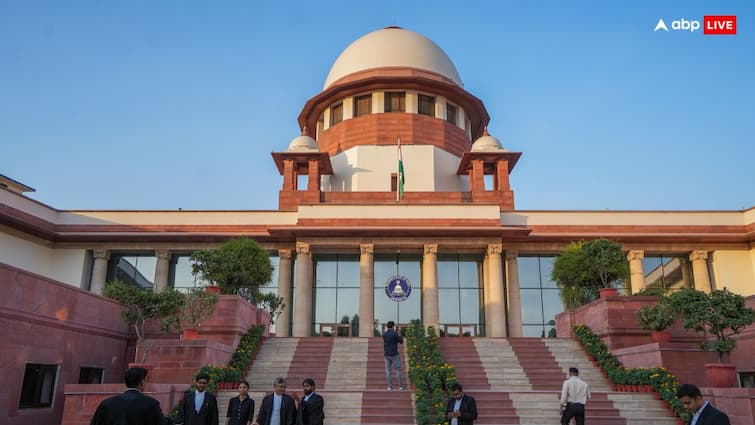
Supreme Court Judgement on New Waqf Act: The Supreme Court proposed to stop some of the major provisions of the Waqf (Amendment) Act, 2025 in an important development on Wednesday (16 April), including the power to involve non-obtained assets declared by the courts and to include non-Muslims in the Central Waqf Councils and Board.
The apex court proposed to pass the order, which the Center opposed and appealed for a detailed hearing before any interim order. The hearing related to 72 petitions against the constitutionality of the Waqf (Amendment) Act, 2025 was held before the bench of Chief Justice Sanjeev Khanna, Justice Sanjay Kumar and Justice KV Vishwanathan.
Supreme Court asked questions from Soleitor General
The court bench will continue the hearing on Thursday (April 17). It expressed displeasure over the inclusion of non-Muslims in the Central Waqf Councils and Board and asked the Center if he was ready to include Muslims in Hindu religious trusts? After hearing the arguments of senior advocates including Kapil Sibal, Rajiv Dhawan, Abhishek Singhvi, CU Singh on behalf of Solicitor General Tushar Mehta and Muslim bodies and individual petitioners, the Chief Justice proposed to issue notice and pass an interim order and said that it will balance the equality.
It is mentioned that some provisions can have serious consequences, especially those who can weaken judicially recognized Waqf properties, the Chief Justice proposed the order. The bench said, “The properties declared as Waqf on behalf of the courts should not be non-defined as Waqf, whether they are Waqf on behalf of the user or Waqf on the deed, although the court is hearing a petition challenging the Waqf Amendment Act 2025.”
Indications to stop a provision of revised law
The bench also indicated to stop a provision of the revised law, stating that the vaqf property will not be considered as a waqf until the property is government land or not by the Collector. The bench looked at the provision-wise objections regarding the Act and expressed objections on several aspects of the law, including including non-Muslims in the Central Waqf Council and State Waqf boards. In this, the District Collector also objected to the provisions allowing the right to settle disputes related to Waqf properties and to allow non-deferred assets to be declared by competent courts.
Speech on petitions filed against Waqf Amendment Act CJI
CJI Sanjeev Khanna said, “Usually, when a law is passed, courts do not interfere at the entry level, but the case may require exception. If the property declared by the user is unacceptable, it can have serious consequences.”
A sharp debate between back and Solicitor General
During the hearing, there was a sharp noise between the bench and the Solicitor General when the judges questioned the argument behind the permission of non-Muslims in the Waqf administration, while Hindu religious institutions do not apply equal mutuality.
The Law Officer said that in addition to ex-officio members in the Waqf Parishad, more than two non-Muslim members will not be included. He offered to say this in an affidavit. However, the bench said that out of 22 members of the Central Waqf Parishad under the new Act, only eight would be Muslims. The bench asked, “If there are eight Muslims, then there can be two judges who are not Muslims. This leads to a majority of non-Muslims. How is it compatible with the religious character of the institution?”
Questions raised on the fairness of a bench with Hindu judges
After this, the tension increased for some time when the Law Officer questioned the fairness of the bench with all Hindu judges. The bench said, “When we sit here, we give up our personal identity. For us, all sides are the same before the law. This comparison is completely wrong.” He asked why non-Hindus should not be included in the advisory board of Hindu temples again?
Court has not issued any formal notice yet
The court has not currently issued any formal notice and said that it will not consider banning the law in the current stage. The bench questioned Mehta as to how the “Waqf from the user” cannot be allowed, as many people would not have the required documents to register such Waqf. “Waqf” means “the user” is a practice in which a property in the form of religious or charitable settlement (Waqf) is given on the basis of long -term, uninterrupted use for its purposes, even if no formal, written announcement of Waqf has been made by the owner.
The amended provision said, “provided that the existing Waqf properties will remain in the form of Waqf property on the day of or before the implementation of the Waqf (Amendment) Act, 2025, except that the property is completely or partially in dispute or government property.”
The bench said, “How will you register such a user’s Waqf?” What documents will they have? This will make something undone. Yes, there is some misuse. But they are also real. I have also read the decisions of the Privy Council. The user’s Waqf is recognized. If you undo it, it will be a problem. The legislature cannot declare any decision, order or decree zero. You can only take Aadhaar. ”
Mehta, however, said that a large section of Muslims does not want to be ruled under the Waqf Act. The bench then asked Mehta, “Are you saying that from now on, you will allow Muslims to be a part of the Hindu Entrance Board?” Say it openly. ”
The Supreme Court said that when a public trust was declared a Waqf 100 or 200 years ago, it could not be taken under the Waqf Board and could not be declared otherwise. The bench said, “You cannot write the past again.” To this Mehta said that the Joint Parliamentary Committee held 38 meetings and investigated 98.2 lakh memorandum before its passage from both houses of Parliament.
CJI said at the beginning of the hearing, “There are two aspects on which we want to talk to both sides.” First of all, should we consider it or be handed over to the High Court? Second, briefly explain what you are really insisting and what you want to argue? We are not saying that there is any stay on the Supreme Court in hearing the petitions against the law and taking decisions.
Kapil Sibal said during the hearing
On behalf of the petitioners, senior advocate Kapil Sibal cited the Waqf Amendment Act and said that he is challenging the provision that only Muslims can wow. Sibal asked, “How can the government decide whether I am a Muslim or not and hence I am eligible to wake up?”
He said, “How can the government say that only those people who have been following Islam for the last five years?”
Senior advocate Abhishek Singhvi, who represents some petitioners, said that the effect of the Waqf Act will be across India and the petitions should not be sent to the High Court. At the same time, opposing the Waqf Act, senior advocate Huzefa Ahmadi said that Waqf on behalf of the user is an established practice of Islam and it cannot be taken away.
72 petitions including AIMIM leader Asaduddin Owaisi, All India Muslim Personal Law Board (AIMPLB), Jamiat Ulama-e-Hind, Dravida Munnetra Kazhagam (DMK), Congress MPs Imran Pratapgarhi and Mohammad Javed have been filed to challenge the validity of the Act.
Center filed a cavity
On April 8, the Center filed a ‘cavity’ in the Supreme Court and appealed for a hearing before passing any order in the case. To ensure that no order is passed by any party to ensure that no order is passed without hearing its side.