
 By Admin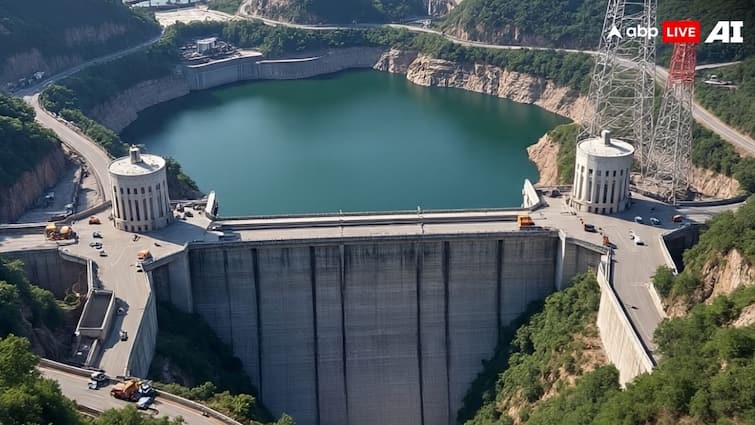
The Government of India has taken cognizance of the news about China starting a huge dam at the bottom of the Yarlung Tsangpo River in Tibet and the issue recently Foreign Minister S.K. Jaishankar had picked up his visit to India along with China’s Foreign Minister Wang Yi during his visit to India.
Minister of State for External Affairs in Rajya Sabha replied
Minister of State for External Affairs Kirti Vardhan Singh also told the Rajya Sabha in a written reply to a question that the project was first made public in 1986 and since then preparations were going on in China. Yarlung Tsangpo River is known as Brahmaputra in India.
Minister of State for External Affairs Singh said that the government closely monitors all activities related to the Brahmaputra river, including hydroelectric projects proposed by China, and takes the necessary precautionary and corrective steps to protect the lives and livelihood of Indian citizens living downwards.
There is a discussion between India and China under ‘specialist level system’
He informed that under the ‘expert level system’ established between India and China in 2006, various issues related to the border rivers are discussed, as well as dialogue through diplomatic mediums.
Singh said, “As a lower -flowing country, India has the right to the water of cross -border rivers. The government has always made its views and concerns clear to the Chinese side, including transparency, counseling and need to protect the interests of the lower back states.”
There was an agreement between India and China
He said that India and China had signed a memorandum of understanding in 2002 to share information on the Yalujangu/Brahmaputra River during the flood season, which was renewed in 2008, 2013 and 2018.
Another similar memorandum of compromise was made in 2005 at the Sutlej River (Longchen Jangbo), which was renewed in 2010 and 2015. The minister said that in 2017, China did not share information related to water of both Brahmaputra and Sutlej rivers and when India objected, China cited technical reasons.
He said that the MoU on the Brahmaputra River ended on June 5, 2023, while the MoU on the Sutlej River ended on November 5, 2020. Singh said, “The water information of the Brahmaputra river has been suspended since June 2023 and the information of the Sutlej River has not been received since 2022.”
Need for cooperation on across the border rivers
The Government of India has underlined the need for cooperation on across the border rivers during several bilateral dialogues and the need to re -shares water related information by China. These include Foreign Minister Jaishankar’s visit to China in July for the meeting of SCO Foreign Ministers (14-16 July) and Chinese Foreign Minister Wang Yi’s visit to India on 18 August.
He was also asked whether the Government of India is planning to build a resistant dam on the Siang River in Arunachal Pradesh. In response to this, Singh said that ‘Upper Siang Multipuritage Project’ (11,200 MW) and ‘Siang Lower HE Project’ (2,700 MW) are proposed projects on the Siang River of Arunachal Pradesh.