
 By Admin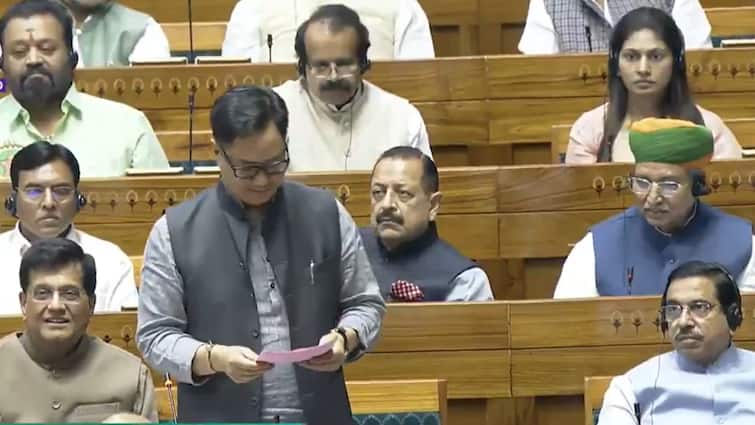
Waqf amendment bill in Lok Sabha: Union Parliamentary Affairs Minister Kiren Rijiju on Wednesday introduced the Waqf Amendment Bill in the Lok Sabha. Starting the discussion on the bill, Kiren Rijiju said, ‘A total of 97,27,772 petitions have been received as online, memorandum, request and suggestion. 284 delegation spoke before the committee and gave suggestions. The government has considered all of them carefully, whether they are through JPC (Joint Parliamentary Committee) or a memorandum given directly.
He further said, ‘Never before has any bill in history has received such a large number of petitions. Many legal experts, community leaders, religious leaders and others gave their suggestions before the committee. Last time, when we introduced the bill, I still told many things. I do not expect, but sure those who were opposing it will change their heart and they will support the bill. I want to say the mind of the mind, no one should consider anyone’s point that the pain of the land should never be considered as auspicious.
‘Waqf also claimed Parliament’
During the discussion, Kiren Rijiju said, ‘In the year 2013, the UPA government gave the Waqf Board the right that the order of the Waqf Board cannot be challenged in any civil court. Had the UPA government been in power, it was not known how many buildings including Parliament building, airport would have been declared Waqf property. In the year 2013, I was very surprised how it was forcibly passed.
He said, ‘After the provision of the Waqf Act in 2013, a case was going on in Delhi since 1977, including several properties including the CGO Complex and Parliament House. The Delhi Waqf Board claimed to have Waqf property on them. The matter was in the court, but at that time the UPA government denotified all the land and handed over to the Waqf Board. If we had not introduced this amendment today, then the Parliament House where we are sitting in it could have been claimed to have Waqf property.
‘Earlier Waqf was invalled’
He said, ‘Someone said that these provisions are non -constitutional. Someone said that they are illegal. This is not a new subject. The bill was passed for the first time before independence. Earlier, Waqf was an invalidate (illegal agreement). The Muslim Waqf Act was brought in 1923. The Act was passed on giving the basis of transparency and accountability.
He further said, ‘For the first time in 1995, the provision of Waqf Tribunal was made. Due to this, a person dissatisfied with any decision taken by the Waqf Board could challenge him in the Waqf Tribunal. This was the first time such a system was established. At that time it was also decided that if there is an income of more than 5 lakh rupees from a Waqf property, then the government would appoint an executive officer for its monitoring. This system was also started in 1995 itself. Why is this issue catching so much today? ‘