
 By Admin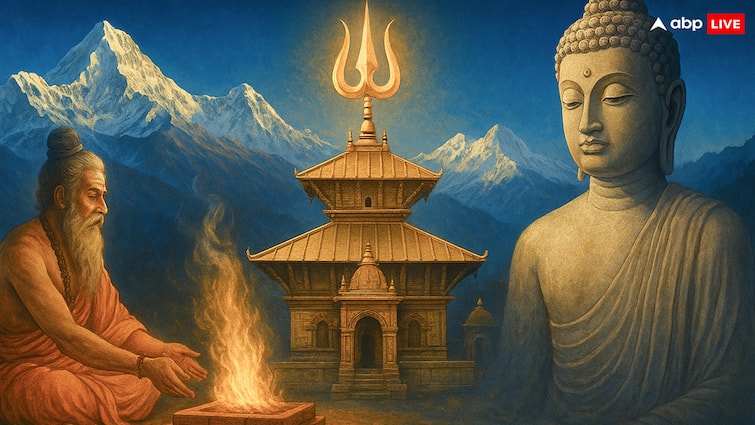
Nepal history: Nepal is a country situated in the lap of Himalayas, which has been called Devbhoomi for centuries. The rivers, valleys and mountains here are not only a geographical identity, but they are witness to cultures and traditions whose roots go back to thousands of years.
When the question arises which religion came first in Nepal, history, Puranas and inscriptions give the same answer that the first Vedic religion, ie Hinduism, has been present here.
Ancient mentions and Vedic formulas
In the Rigveda, the Himalayas have been described as a symbol of divinity. The Mahabharata mentions the Himalayan visit of the Pandavas, while the Skanda Purana clarifies that ‘Himalayas are the abode of gods and sages.’ In these texts, Nepal was addressed with words like ‘Himavati’ and ‘Kirat Pradesh’, not directly by name. This indicates that the land of Nepal was deeply connected to the Vedic tradition.
Pashupatinath Temple: Most Evidence
If we talk about the religious identity of Nepal, then first of all the Pashupatinath temple is remembered. This ancient Shiva temple in Kathmandu is the center of faith not only for Nepal but also for the entire Hindu world. This place is mentioned in both Linga Purana and Shiva Purana.
According to local beliefs, this place has been in existence since the Vedic period, while historically the Lichchavi rulers rebuilt it in the 5th century. The presence of this temple proves that Shiva Puja and Vedic rites were first established in Nepal.
Lichchavi and Malla period impression
The credit for giving concrete form to the presence of Vedic religion in Nepal goes to the Lichchhavi rulers (4th -9th century). The inscriptions issued by him are still evidence of the fact that at that time Vedic deities like Vishnu, Shiva and Surya were widely worshiped. Those inscriptions inscribed in Sanskrit language and secret script shows how deeply the culture of Nepal was related to Vedic traditions.
After this, the Malla period (12th -18th century) really converted Nepal into the valley of temples. Countless temples in Kathmandu, Bhaktapur and Lalitpur still show a glimpse of the religious enthusiasm of that era. This was the same period when Dashain, Tihar and other major Hindu festivals became part of the identity of the state.
Arrival of Buddhism and other traditions
After laying the foundation of Hinduism, other traditions gradually came to Nepal. Prince of Shakya dynasty Siddharth Gautam, whom today the whole world knows in the name of Buddha, was born in Kapilavastu (Nepal-India border). His teachings gave birth to Buddhism, which spread from Lumbini in Nepal all over the world.
Although Buddhism deeply influenced the culture of Nepal, it is also true that Buddhism and Hinduism received a lot from each other.
Even today, in Nepal, Buddha is found to be an incarnation of Vishnu. In addition, the religious beliefs of the original tribes of Nepal are called Kirat Dharma. Nature worship and Vandana of ancestors were prominent in this, but over time it got mixed up in Hindu and Buddhist tradition.
In the medieval period, Islam and Christianity also reached Nepal through traders, but their roots remained limited. Most of the population of Nepal is still associated with Hinduism.
Religious evidence and cultural heritage
Nepal’s identity is not only from temples and pilgrimages, but also to the texts and traditions that give evidence of its deep religious roots. Nepal and Pashupatinath are mentioned in Skanda Purana and Linga Purana.
Vedic mantras are mentioned on Lichchhavi carpet inscriptions. The major festival of Nepal … Dashain, Tihar, Holi and Chhath are completely associated with the Ved-Purana based traditions.
Rites like marriage, birth and death are also done by Vedic method. It is clear from all these evidences that the religious soul of Nepal is composed in Vedic Hinduism.
Modern Nepal and Hindu identity
Today Nepal is considered the only Hindu nation in the world. More than 80 percent of the population here follows Hinduism. Politics, social system and cultural traditions are still deeply influenced by Vedic values.
Tourism of Nepal is also based on this religious identity. Every year millions of devotees travel from India and other countries to Pashupatinath and Janakpur. Lumbini is also equally popular as a Buddhist pilgrimage, but the original soul of Nepal still lies in Shiva-Pashupati and Vedic culture.
On landing in the depth of the history of Nepal, it becomes clear that first of all Hinduism came here and its roots are so strong that even after the arrival of all religions, it is still stuck.
Buddhism further enriched it, Kirat traditions gave it a local form, and other religions added diversity to it. But the basic identity of Nepal is still from the culture of Vedic religion and Shiva-pashupati.
Temples, inscriptions, festival-festivals and lifestyle of Nepal confirm the truth that the Hindu tradition that the soul of this country was related to centuries ago is still its heartbeat.
FAQ
Which religion came first in Nepal?
The first Vedic tradition came to Nepal. Evidence of this is found in Skanda Purana, Lichchavi inscription and Pashupatinath Temple.
Is Buddhism spread from Nepal itself?
Yes, Siddharth Gautam was born in Kapilavastu (Nepal-India border) and Buddhism spread from Lumbini all over the world.
What is the religious identity of Nepal today?
Today Nepal is the only Hindu nation in the world, where more than 80 percent of the population follows Hinduism.
Disclaimer: Here information provided here is based only on beliefs and information. It is important to mention here that Abplive.com does not confirm any kind of recognition, information. Before implementing any information or recognition, consult the concerned expert.