
 By Admin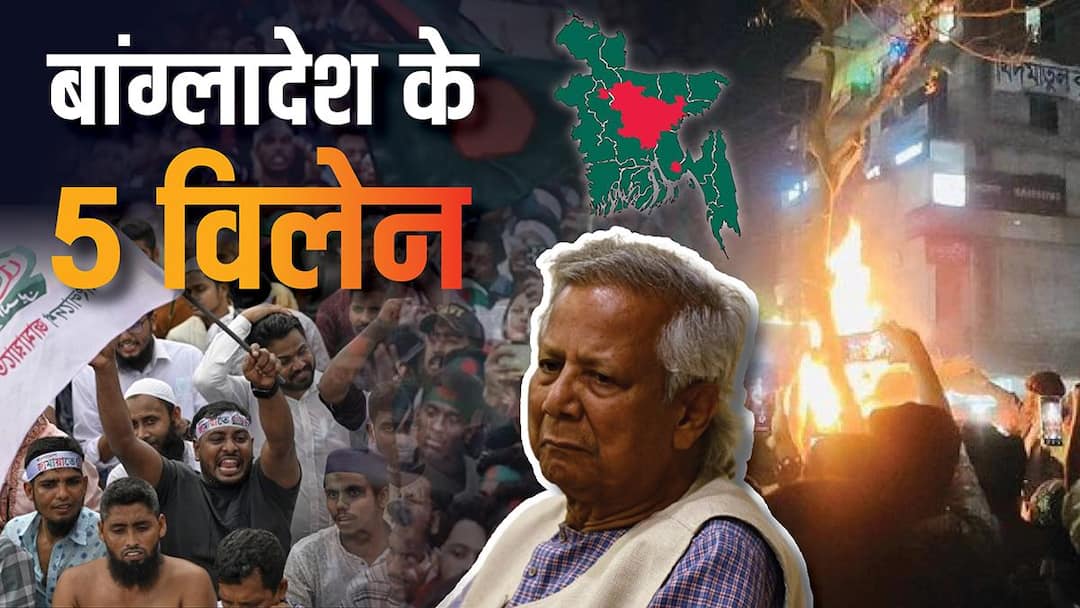
It has been almost one and a half years since the interim government of Muhammad Yunus came to power in Bangladesh, but political turmoil, violence and fundamentalism are increasing in the country. The fundamentalist groups supporting Mohammad Yunus are accusing the government of delaying reforms, not providing justice and secular policies. The murder of Inquilab Manch spokesperson Sharif Usman Hadi has further fueled the violence.
According to experts, now these forces are trying to create instability before the February 2026 elections, due to which attacks on Bangladeshi minorities i.e. Hindus are increasing. According to the UN Human Rights report, more than 2,326 cases were registered from August 2024 to March 2025, which included attacks on temples, property looting and murders.
The reason for increasing fundamentalism in Bangladesh is not only Yunus government but also 5 big villains…
1. Jamaat-e-Islami promoting fundamentalism
This group was banned during the time of Sheikh Hasina, but Yunus removed the ban as soon as he came to government. Now this group is demanding electoral reforms, but is also active in attacks on minorities and anti-India protests. Jamaat-e-Islami has also been accused of being linked to Pakistan’s intelligence agency ISI. Experts believe that Jamaat-e-Islami will benefit from Hadi’s assassination.
2. Hifazat-e-Islam wants to bring Sharia law
According to the East Asia Forum report, this group is made up of Sunni Islamists and their huge madrassa network and supporters, which works against women’s rights and secular reforms. Hifazat-e-Islam has organized large demonstrations on the proposal of equal property rights for women. The leader of this group, Mamunul Haq, also met Yunus, because he is pressurizing to implement Sharia law in Bangladesh. Sheikh Hasina had banned this group, but it got freedom in the Yunus government.
3. Hizb-ut-Tahrir waving ISIS flags in Bangladesh
S. According to the report of Rajaratnam School of International Studies, Hizb-ut-Tahrir is expanding rapidly by recruiting Bangladeshi youth through social media and educational institutions. This group was banned in 2009, but the Yunus government liberated it in 2024. This is a group demanding restoration of Caliphate and Sharia. Hizb-ut-Tahrir had organized big demonstrations in Dhaka during Yunus’s tenure in 2024 and also waved ISIS-like flags. The Yunus government is being accused of failure to stop this.
4. Inquilab Manch advocating radical Islamic culture
According to the report of Al Jazeera, this group was established after the student movement of July 2024. Sharif Usman Hadi, a senior leader of Inquilab Manch, was himself a leader with anti-India and fundamentalist views. After Hadi’s assassination, Inquilab Manch threatened to topple the Yunus government. Earlier this group was a supporter of Yunus, but now there is a direct competition between the government and Inquilab Manch. As a result, after Hadi’s death, violence flared up to such an extent that newspaper offices were torched. Inquilab Manch also wants to implement radical Islamic culture in the country.
5. Influence of Mamunul Haq and Mufti Jashimuddin Rahmani
Mufti Jashimuddin Rahmani was the leader of an al-Qaeda linked group, who was released during the Yunus government. Rahmani is the chief of Al-Qaeda linked terrorist organization Ansarullah Bangla Team (ABT). The release of this terrorist has created problems for India, because this terrorist organization is trying to create a Jihadi network with the help of sleeper cells.
Mamunul Haq was jailed for inciting violence, but was released and is now active. Mamunul Haq is considered a leader in Bangladesh who implemented Islamic principles in government policies, advocated Sharia law and carried forward traditional Islamic works.
Groups spreading poison against India
These groups together are pushing for reforms under Sharia law, ban on women’s rights and anti-India slogans. In many reports he has been described as being linked to Pakistan and other foreign powers. Yunus government is constantly being accused that it is not able to control these forces, due to which attacks on minorities are increasing and instability is increasing in the country.