
 By Admin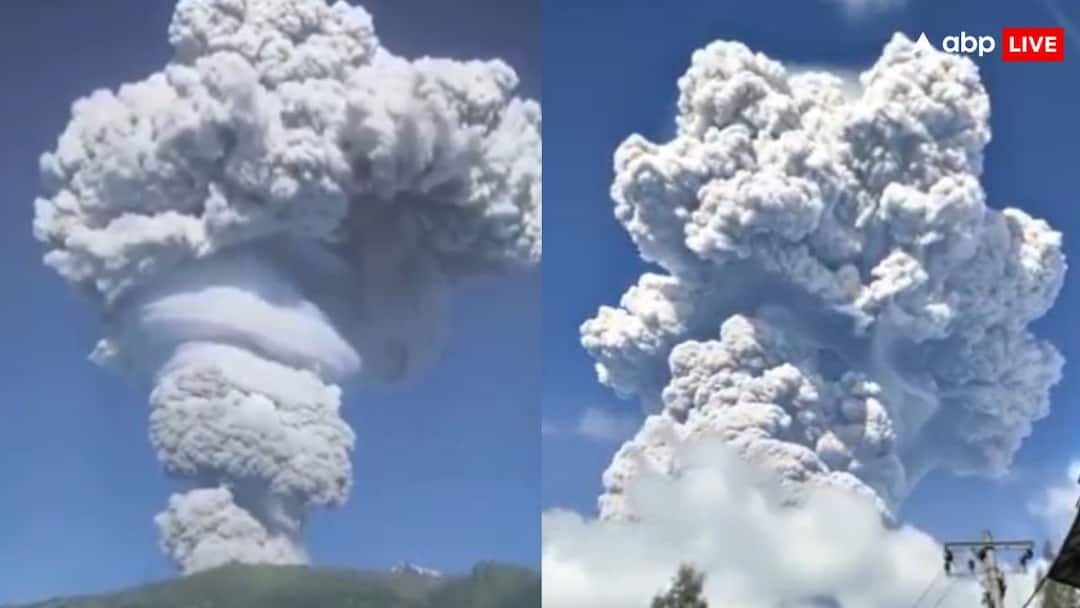
He was calm…very calm and had been in such peace for the last 12 thousand years, but suddenly he burst. When it exploded, it exploded in such a way that the cloud of smoke crossed the rivers, streams, seas, oceans, mountains, plateaus and reached India and the capital Delhi was covered with a blanket of smoke, even if only for a few hours. Now the smoke has cleared. The sky of Delhi is blue again and people have questions in their minds as to what happened that what was calm for 12 thousand years suddenly burst.
Pile of ashes rose 15 km high
Ethiopia is the only country in Africa which Europe could never capture. Approximately 11 crore people are citizens of this country. In this country, a volcano that had been sleeping for 12 thousand years has suddenly erupted. Due to its eruption, a plume of sulfur dioxide and ash reached a height of about 15 km and turned into smoke which crossed the Red Sea, crossed Yemen-Oman, reached the Arabian Gulf from Pakistan to India and now from here it has passed to China.
The flame of Gubbi volcano reached Delhi
The smoke that has caused this devastation is due to the Haile Gubbi volcano, which is in the Afar region of Ethiopia. Although there has been no loss of life due to the eruption of this volcano, wherever this cloud of smoke has reached, people have had some trouble breathing and flights on this route have had to be either canceled or diverted for some time because the ash could damage the flight engine. In India too, 11 flights had to be canceled because the ash had reached Delhi. The biggest question is why did Heli Gubbi explode?
Why did Heli Gubbi volcano erupt?
We understand it by a brick kiln or the chimney in our kitchen. When you cook food in the kitchen, smoke fills the house and to expel it you turn on the chimney. The smoke goes out through the chimney and your house becomes empty of smoke. Similarly, a volcano is the chimney of the earth. The inside of the earth is also full of hot lava, gas and ash. Hot lava is very light and tries to come to the surface.
When the tectonic plates of the earth collide with each other, then this lava tries to come to the surface and only at such a time it tears the upper surface of the earth and comes out. As soon as it comes out, the lava starts freezing and a mountain-like shape is formed. This is called volcano. To put it in simple language, the earth has its own chimney.
Now since the earth is very big, it also has many chimneys. Almost more than 1500. Most of these are in the Ring of Fire area of the Pacific Ocean, where most earthquakes occur and most volcanic eruptions also occur. If we talk in statistics, then 90 percent of the world’s earthquakes and 75 percent of volcanic eruptions occur in this Ring of Fire.
Volcano which had been quiet for 10-12 thousand years suddenly erupted
No one has the correct answer as to why Heli Gubbi erupted, because this volcano has always been silent in the last 10-12 thousand years of history, but generally, all the volcanoes that erupt are due to the tectonic plates of the earth, due to whose movement the volcano explodes because due to the movement of the plates, the pressure on the lava filled inside the volcano increases and it starts struggling to come to the surface of the earth.
Heli Gubbi is part of the Erta Ale volcanic chain and is its southernmost point. This is part of the Afar Rift, where the Earth’s tectonic plates are continuously shifting. This is the reason why other volcanoes in this area like Erta Ale have already been monitored. Due to the calmness of Heli Gubbi, no one noticed and when it exploded, scientists did not get a chance to recover and they could not issue any warning. According to preliminary information, there is a wall of magma beneath the Erta Ale volcanic chain and a wall of 50 km has been broken. The reason for the breaking of this wall was an earthquake, whose intensity was 4.7.
Increased problems for common people in Ethiopia
Now the question for common people and scientists is what will happen next? Common people are directly affected by this. The people who are affected are small farmers and cattle herders. The place where the volcanic eruption took place in the Afar region of Ethiopia is a desert area where there are small villages. Ashes have spread in these villages, due to which there is a crisis of fodder for animals.
If this ash is not removed soon, then there will be a crisis of fodder for the cattle and even if they do not die due to the volcanic eruption, they may die of hunger due to the loss of fodder in the ash. The second impact will be on those who are respiratory patients. Wherever the air comes in contact with the ash emanating from this volcano, people will have trouble breathing.
This is a golden opportunity for scientists to understand volcanoes better. They will try to understand why the volcano which had been sleeping for 12 thousand years erupted. What is the secret of the silence of the volcanoes which have been silent for a long time in other parts of the world?