
 By Admin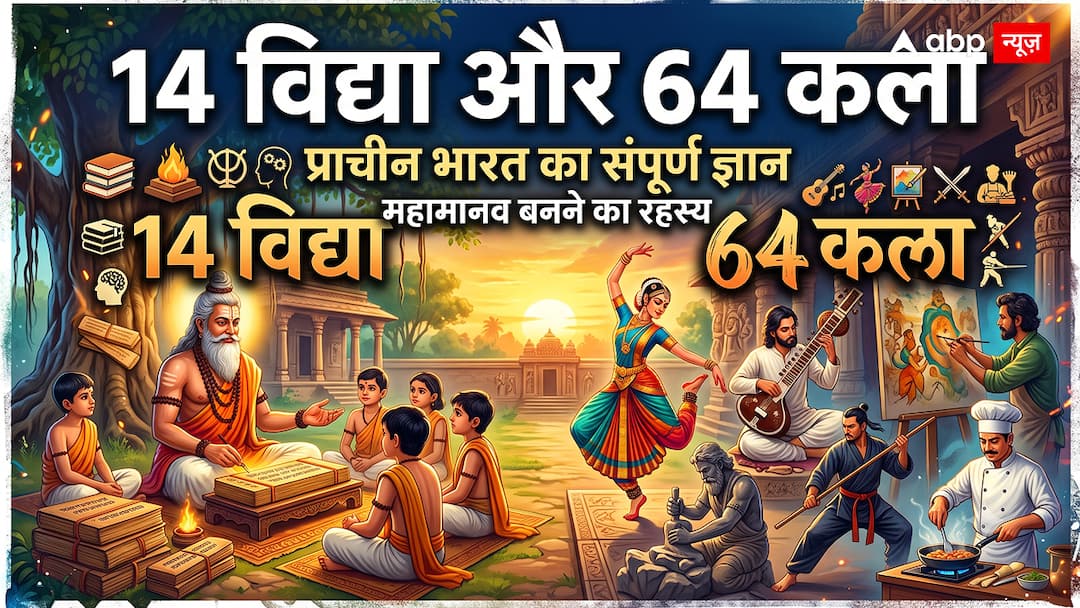
14 Vidya 64 Art: Do you know that the education system of ancient India was thousands of years ahead of today’s Oxford or Harvard? The ‘multi-talented’ or ‘all-rounder’ personality that we talk about today, our ancestors had set a precise criterion for it, which is called 14 Vidya and 64 arts.
In Sanatan tradition, it is believed that the person who learns all these disciplines becomes a complete man or a great man. According to mythology, Lord Krishna had mastered all these knowledge and arts in just 64 days in the Gurukul of Maharishi Sandipani. Let us know what is included in this great encyclopedia of ancient Indian knowledge and skills which still surprises the world.
14 knowledge that awakens the intellect and soul
In ancient India, ‘Vidya’ simply meant theoretical, mental and spiritual knowledge, which was related to your inner development, intelligence and the rules that govern society. The foundation of these 14 sciences rests on our most sacred scriptures, in which the first four Vedas come. Rigveda is the storehouse of the most ancient mantras and hymns of the universe, while the rules of yajna and rituals are explained in Yajurveda.
Samaveda is an ocean of music, tune and rhythm which became the basis of Indian music, whereas Atharvaveda contains deep knowledge of daily life, Ayurveda, science and tantra-mantra. To properly understand this unlimited knowledge of Vedas, our sages had composed six Vedangas, which are the second biggest pillar of this entire education system.
The education under the Vedas teaches us the science of correct pronunciation and voice, while through Kalpa Vidya the correct method of performing religious rituals and yagyas is revealed. To write and speak the language properly, knowledge of grammar was given, while to understand the basic meaning of words and their origin, Nirukta Vidya was used.
Also read- 27 qualities found, still the relationship is not saved! Pune case raised a big question, should marriage be decided only on the basis of matching qualities?
Along with this, the study of poetry was essential for the rules of composition of poetry and astrology for accurate calculation of the time and movement of planets and stars in the universe. To complete this entire knowledge chain, four appendages were very important, which included Puranas which imparted knowledge through history and stories, logic i.e. justice which decided right and wrong, Mimamsa which explained the deep philosophy of Vedas and theology which taught rules and regulations which kept the society organized.
64 miraculous arts that make life worth living
If Vidya was mental and spiritual development, then ‘Art’ meant purely practical skill or skill. To make life beautiful, prosperous, happy and creative, ancient masters had prepared a list of 64 arts. The first and most popular part of these arts was the performing arts like music, dance and acting.
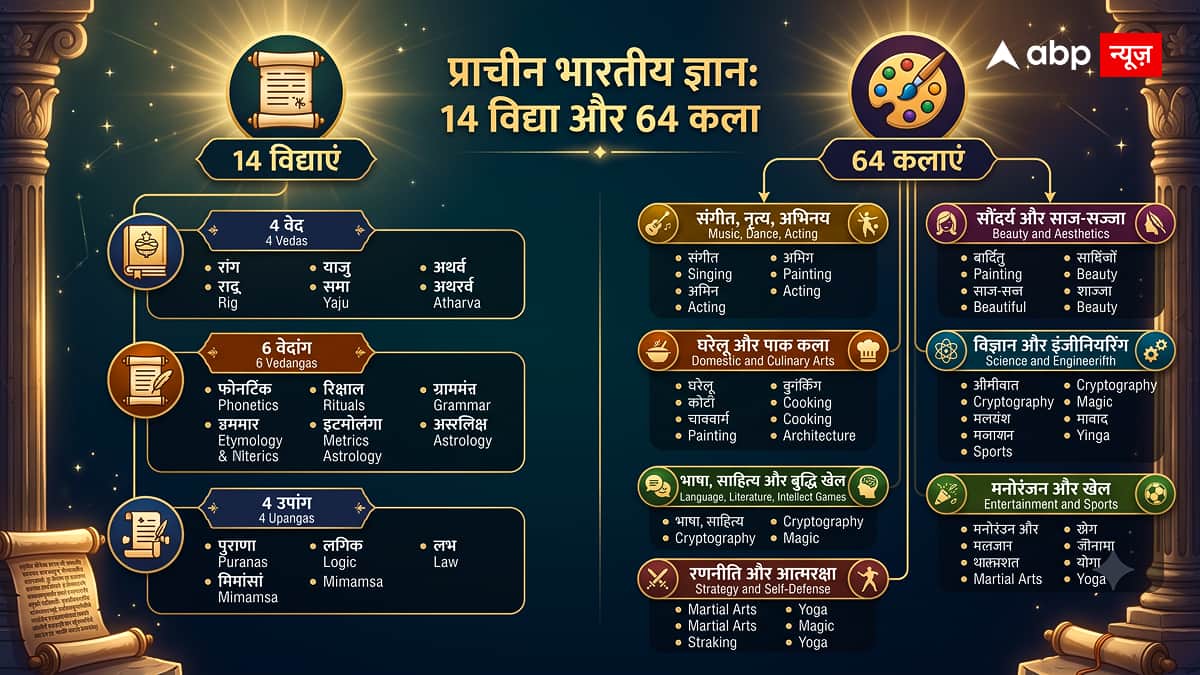
Under this, the art of singing, the skill of playing various musical instruments, classical dance and the dramatic art of acting on stage were taught. Jaltarang Vidya of making music from water vessels, the art of playing special instruments like Veena and Damru and the art of making sounds by tapping on water waves were also a part of this.
In terms of beauty and make-up, ancient India was far ahead of today’s cosmetic and fashion industry. This included the graphic art of painting, the art of applying special makeup on the face and body, and the art of making artistic rangoli from rice and flowers. People learned to arrange beautiful flower beds, paint teeth and clothes with natural colors, and make mosaics of precious stones on the floor.
Along with making beautiful flower necklaces, decorating hair crowns, making proper use of make-up and costumes, and preparing ornaments of leaves and flowers for ears, people were also experts in the art of making fragrant perfumes and incense.
From cooking to science and the ancient skill of coding.
Special arts were also prescribed to make domestic life and kitchen better. This included the culinary art of cooking various delicious dishes and vegetables, the art of preparing medicinal infusions and delicious sherbets, tailoring of clothes, embroidery and weaving work, showing the play of threads and puppets, and mending torn clothes in such a way that they could not be detected.
Apart from this, the science and engineering department of that era was also very strong. Architecture for building palaces and cities, the art of testing the purity of gold, silver and gems, metallurgy for making alloys by melting metals, identifying gem mines, Vriksha Ayurveda for treating diseases of trees and plants, and mechanical art for making machines and parts like modern mechanics were the main parts of the curriculum of that time.
Many interesting games related to language and literature for intellectual development were included in this list. Solving puzzles, playing with the rhymes of verses, finding out the meaning of difficult words, reading texts in the right rhythm and reviewing plays were part of this category. Completing incomplete poems quickly, weaving mats and canes, doing magnificent carvings on wood, and the most surprising thing is that creating secret languages and symbolic codes (cryptography) like today’s coding was also an established art.
Along with this, knowledge of dialects of different regions, understanding of dictionary, identification of rhymes, correct use of figures of speech in poetry, ability to compose a new poem instantly in the mind, and amazing memory power to remember what is heard in a moment and forever were also taught to the youth.
A unique combination of entertainment, strategy and self-defense
64 A large part of the arts was related to entertainment and mental tact. This included performing magic tricks, impersonation, sleight of hand tricks, and managing animal and bird fights.
People taught parrots and mynas to speak, practiced diplomacy to deceive others by concealing their views, and mastered the games of dice and gambling. Apart from this, showing magnet games, making beautiful and safe toys for children, entertaining others, and the skill of massage and hair massage i.e. spa therapy to remove body fatigue were also a part of it.
The sign language of communicating secrets through finger gestures, decorating flower carts, and the knowledge of predicting the future or omens and bad omens by looking at the signs of nature were also very popular.
This grand list of arts ended with the development of discipline, warfare and physical ability. This included the art of learning etiquette and humility, the surefire strategy to win in war or any competition, knowledge of the arena, the art of exercise to make the body like a thunderbolt through exercise and yoga.
Apart from this, the power of correct and effective use of mantras, and the art of waking up the king or guru in the morning by singing melodious worship songs were learned. In short, what today’s world considers to be the best combination of ‘STEM’ (Science, Technology, Engineering, Mathematics) and ‘Liberal Arts’ was implemented in India ages ago, which made a person not just a bookworm but a winner on every front.
Disclaimer: The information provided here is based only on assumptions and information. It is important to mention here that ABPLive.com does not endorse or confirm any information. Before implementing any information or belief, consult the concerned expert.