
 By Admin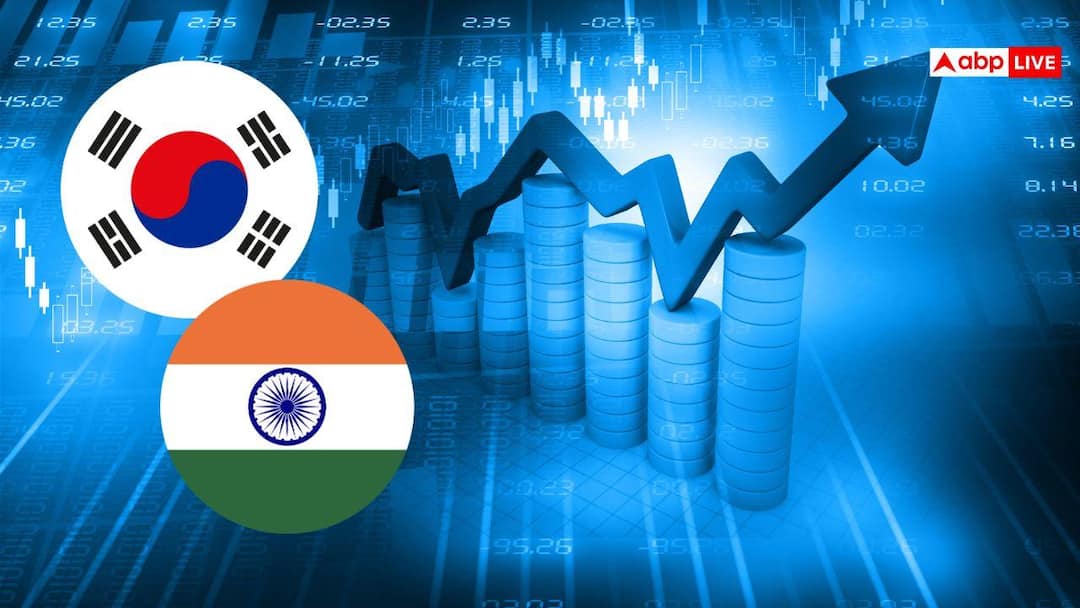
India vs South Korea Share Market: Recently a surprising reshuffle was seen in the hierarchy of the global stock market. South Korea has officially overtaken India to become the world’s sixth largest equity market. According to recent data compiled by Bloomberg, the total market capitalization of listed companies in South Korea reached a record high of US$5.04 trillion, slightly higher than India’s about US$4.8 trillion.
On the surface, this seems like a statistical impossibility. India is the most populous country on earth, home to approximately 1.47 billion people. In contrast, South Korea has a population of only about 51 million. This means that there are approximately 28 times more people in India.
How did South Korea become a bigger market than India?
How can a country with a population less than the state of Karnataka have a bigger and more valuable stock market than the entire Indian subcontinent? To understand this phenomenon we need to look beyond just raw population figures. We need to examine how wealth is created, how corporate giants grow and where global investor money is flowing. Concept of Depth of Market To understand why this happens, imagine two different bakeries.
Foreign Bank FDs: More benefits than Indian banks, know which foreign banks are giving the highest interest on FDs
First Bakery is a huge local shop in a huge, busy neighborhood. It sells thousands of loaves of standard bread every day, to a large crowd of local customers. Its total sales are high because it has so many buyers, but each loaf is cheap, and the bakery relies on simple equipment.
The second bakery is a highly specialized boutique with only a few customers coming through the door. However, it uses state-of-the-art ovens to produce premium, highly refined pastries that are shipped to luxury hotels around the world. Even though it serves very few people locally, the value of its high-tech products makes the entire business extremely prosperous. In this scenario, India is the giant local bakery and South Korea is the high-tech global specialist.
GDP vs GDP per capita
When we look at the broader economic picture, India’s economy is actually much larger than South Korea’s. India’s gross domestic product, or GDP, is approximately US$4.15 trillion, making it one of the world’s largest and fastest growing economic engines. South Korea’s total GDP is remarkably small, amounting to approximately US$1.93 trillion.
However, the picture completely reverses when we look at GDP per capita, which measures economic output per capita. Because India’s huge economic pie is divided among its 1.47 billion people, its per capita GDP is about US$2,800. South Korea divides its pie among just 51 million citizens, giving it a per capita GDP of just over US$37,000. The high per capita GDP means that the average South Korean citizen has immense purchasing power, high savings, and a deep pool of domestic capital ready to invest in corporate equities.
Big questions raised on this big private bank, complaint made to PMO and RBI, know what is the matter
More importantly, it reflects a workforce that is deeply embedded in high-value, high-margin global industries, rather than low-cost labor. The power of corporate giants The structural difference between the two stock markets becomes extremely apparent when you look at their corporate giants. India’s stock market is highly diversified and domestically-focused. Its top giants are firms like Reliance Industries, HDFC Bank, and Bharti Airtel. These are fantastic, highly stable companies, but they primarily make money by selling digital services, banking products and consumer goods to people within India. They are linked to the local economy.
Furthermore, India’s top ten stocks make up only about 18 percent of its total market value, reflecting a very wide distribution of companies. South Korea’s stock market is built on a completely different template. It is ruled by huge, family-run conglomerates called chaebols, which make products for the entire planet. The entire index is heavily concentrated, with the top ten stocks controlling about 58 percent of the total market capitalization.
International investors invested billions
At the center of this ecosystem are two technology giants: Samsung Electronics and SK Hynix. In recent months, a huge global boom in artificial intelligence, or AI, infrastructure has caused a violent surge in demand for high-tech semiconductor and memory chips. Because Samsung and SK Hynix essentially control the global supply of specialized AI memory chips, international investors poured billions of dollars into them.
Recently Samsung and SK Hynix have each crossed the historic milestone of US$1 trillion in individual market valuation. To put this in perspective, the combined value of just two South Korean chip companies now represents about 42 percent of their country’s entire stock market. India, as an economy, has chosen a brilliant path of service-led and domestic-consumption growth, but it currently lacks these multi-trillion-dollar global technology monopolies that can capture huge waves of global capital overnight. Global Capital Flows and Local Realities Stock market valuations are driven by where global institutional money wants to go tomorrow, not just how a country is performing today.
Crude oil prices spoil India’s game
South Korea, along with Taiwan, has become the ultimate destination for global AI infrastructure trade. The benchmark Kospi index has surged more than 100 percent, driven almost entirely by the memory chip super-cycle and proactive corporate governance reforms aimed at boosting shareholder rights. In contrast, India’s stock market has faced a complex set of macroeconomic headwinds. High global crude oil prices, which have climbed above US$100 a barrel, naturally put pressure on India’s fiscal deficit and corporate margins as the country imports most of its energy.
This, combined with concerns about a below-average monsoon forecast and heavy selling by foreign portfolio investors, has seen a slight cooling in Indian benchmark indices. A tale of two different journeys Ultimately, South Korea’s stock market becoming bigger than India’s is a masterclass in economic productivity and market concentration. It shows that a small population, when highly educated and hyper-focused on dominating global technological disruptions, can create corporate value that far exceeds its demographic weight.
India’s economic story is not weak
This does not mean that India’s economic story is weak. India remains a roaring powerhouse of domestic consumption, young talent and long-term structural growth. This simply highlights that while India is busy building a vast, flexible and multifaceted economic foundation for over a billion people, South Korea has built a highly focused, highly specialized technological crown jewel that currently commands a premium on the global stage. Disclaimer: This article is for informational purposes only and is not investment advice.