
 By Admin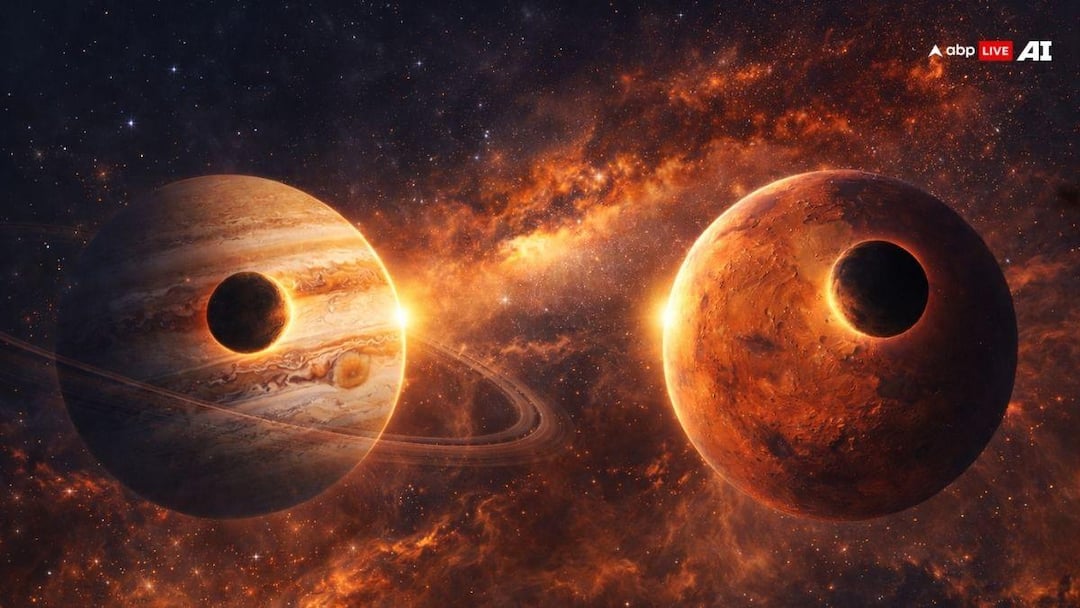
Eclipse On Planets: Today, people in different countries around the world will be able to see the Ring of Fire due to the solar eclipse. People often think that the eclipse can be seen only from Earth. but it’s not like that. According to space science, eclipses also occur on many other planets in our solar system. Let us know how different they are from the eclipses seen on Earth.
Why does eclipse occur on any planet?
A solar eclipse occurs when a moon passes between the sun and its planet. This casts a shadow on the surface of the planet. The size of the moon, its distance from the planet and the planet’s position relative to the Sun decide whether the eclipse will be complete or partial. On Earth, the Moon completely covers the Sun during a total solar eclipse. This is because size is a very rare function of distance. Things look quite different on other planets.
eclipse on mars
Mars has two small moons. These are called Phobos and Deimos. But both are small enough to cover the sun completely. This is the reason why total solar eclipse does not occur on Mars. Instead, a partial eclipse will be visible on Mars. In this a small black figure briefly crosses the sun’s disk.
eclipse of jupiter
The big planet Jupiter has dozens of moons. These include four big moons. Their names are Io, Europa, Ganymede and Callisto. These large moons regularly cast large shadows above Jupiter’s clouds. That total solar eclipse is quite common and spacecraft photographs have captured dark round shadows moving in the colorful atmospheres of the planets.
Eclipse of Saturn, Uranus and Neptune
All these planets have many moons, due to which eclipse is quite possible. However, eclipses on Neptune occur for a very short period of time. This is because it is very far from the sun. Because of this, the size of the Sun appears much smaller and due to its geometry, eclipses occur for a shorter period of time.
eclipse on pluto
Let us tell you that eclipses also occur on Pluto. Its large moon Charon is tidally locked and is larger in proportion than Pluto. Their unique alignment allows the moon to eclipse Pluto completely.
Eclipse on Mercury and Venus
Mercury and Venus have no natural moons. Without a moon to block sunlight, solar eclipses do not usually occur on these planets.
Also read: Who designed the Parliament of Bangladesh, how is its interior?