
 By Admin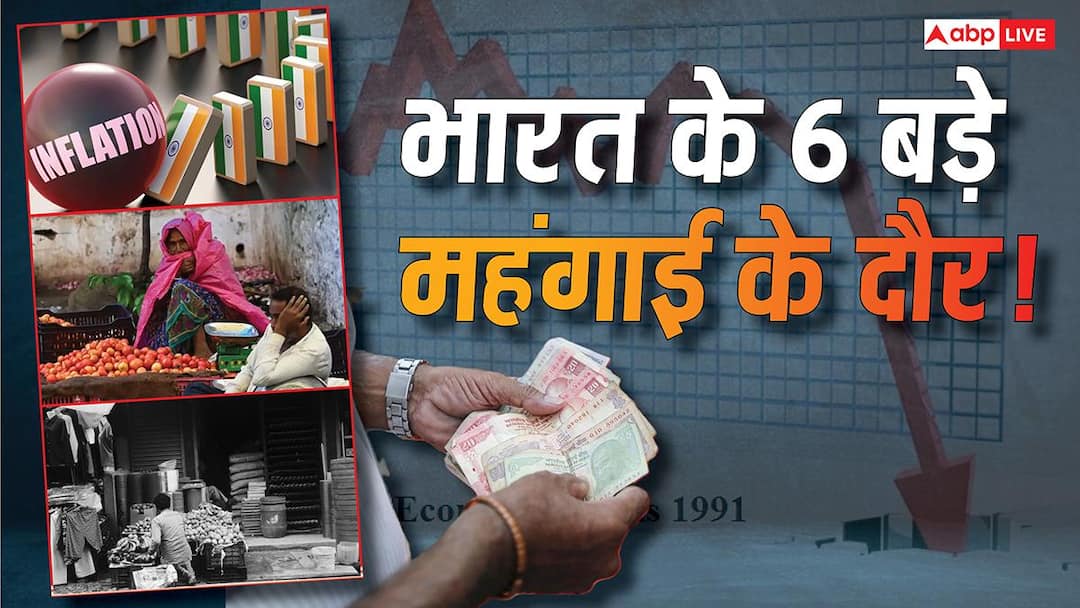
The country’s inflation rate reached 3.48% in 2026, which is the highest level in the last 13 months. The Reserve Bank has predicted an average inflation of 4.6% for the entire financial year 2026-27. It is expected to reach 5.2% in the third quarter (July-September). But the real question is when has inflation had the worst impact on the country? We have tried to understand those most difficult periods after 1947, when prices had made people’s lives extremely difficult. We will talk about those 6 worst times, when the prices of things everywhere were on fire…
1. 1973-74: Oil shock and inflation crossing 20%
According to the report of the National Bureau of Economic Research (NBER), this was the period when India saw inflation crossing 20% for the first time after independence. The biggest reason for this was the global oil crisis of 1973. Due to the oil embargo by Arab countries, the prices of crude oil increased four times within a year, due to which the economy of the entire world was shaken. For a country like India, which imported most of its oil needs, this was a nightmare. Also the drought of 1972 and 1974 ruined the crops. A severe food crisis arose in the country. The prices of wheat, sugar, edible oil and everything were sky high.
- How bad were the circumstances: That year, the inflation rate based on Wholesale Price Index (WPI) had reached a record level of 25.2%. Government figures show that by the end of December 1973, prices were 26% higher than the previous year. The situation was so bad that the budget of 1973 was called ‘Black Budget’.
- outcome: It had a direct impact on the public. There was severe pressure on foreign exchange reserves and a deficit of Rs 437.7 crore was recorded in 1973-74, whereas a year earlier there was a surplus of Rs 100.3 crore.
2. 1979–80: Iran’s revolution and second oil storm
The country had not yet fully recovered from the shock of 1973 when the second oil crisis occurred in 1979. According to the India Budget report ‘The Economic Situation in 1979-80’, this time the reason was the Islamic Revolution in Iran, due to which oil production there came to a standstill. Later the Iran-Iraq war added fuel to the fire. The global supply of oil decreased by only 4%, but the panic in the market was so great that the price of crude oil more than doubled in the next 12 months. There was severe drought in many parts of the country.
- How bad were the circumstances: Although the consumer inflation rate was 6.28% in 1979 as compared to 28.6% in 1974, it jumped to 11.35% in 1980. The rise in prices in the first half of 1979-80 was very rapid and in July alone prices had increased by 4.6%.
- outcome: This crisis changed the entire map of India’s economic policies, due to which efforts to reduce the country’s dependence on oil intensified.
3. 1991: On the verge of bankruptcy
According to Techniques International Journal for Engineering Research (TIJER), the year 1991 brought the biggest crisis in India’s economic history. In fact, the country was struggling with the problem of balance of payments since 1985. Then the increase in oil prices due to the Gulf War, trade impact due to the disintegration of the Soviet Union and political instability together made the situation worse.
- How bad were the circumstances: The inflation rate had reached approximately 13.6%. But the real crisis was the foreign exchange reserves, which had dwindled to barely enough for three weeks of imports. The country was standing on the verge of bankruptcy.
- outcome: The government had to mortgage 47 tonnes of its gold to take a loan from the IMF. This crisis forced India to open its economy and undertake historic economic reforms (LPG reforms) of 1991.
4. 1998-2000: Onion and politics
According to the report of World Bank Blogs, the inflation of this period was limited to the common man’s kitchen and this can be gauged from the fact that it toppled governments. In fact, in 1998, the onion crop failed badly, causing its prices to skyrocket. The situation in Delhi was so bad that BJP had to pay a heavy price in the elections.
- How bad were the circumstances: The dropsy disease spread due to adulteration of onion and mustard oil added fuel to the fire. Consumer Price Index (CPI) data shows that there was a sharp rise in inflation in 1998-99 and in November 1998 it reached a record level of 19.7% annually.
- outcome: This ‘onion politics’ brought down the BJP government in the 1998 Delhi Assembly elections and formed the Congress government under the leadership of Sheila Dikshit. This was a lesson that inflation is not just an issue of economics but also the biggest issue of politics.
5. 2009-2013: A long period of double-digit inflation
According to Capital Mind’s report ‘The History of Inflation in India’, these were those five years when continuous high inflation robbed the common man. After the global recession of 2008, governments around the world spent heavily to save the economy. This resulted in a huge surge in commodity prices. In India too, the prices of food items and fuel continued to increase. Apart from this, there was very little rainfall in 2009, due to which the production was badly affected. Then in 2010, excessive rain and floods further ruined the crops.
- How bad were the circumstances: India faced prolonged high inflation between 2009-10 and 2013-14. During this period the average annual rate remained in double digits. In January 2013, retail inflation had increased to 10.79%, of which the rate of food and beverages was 13.36%.
- outcome: This continuous inflation further fueled the anger against corruption in the country and the Anna movement of 2011 became the biggest proof of this.
6. 2020-2022: Corona, war and supply chain devastation
According to the India Budget report, this is the latest phase when the world, which was somehow recovering after the Corona epidemic, suffered another big shock. In 2020, the supply chain around the world was ruined due to the lockdown caused by the Corona epidemic. After this, the Russia-Ukraine war broke out in 2022, which sent the prices of edible oils and fuel skyrocketing.
- How bad were the circumstances: During the pandemic itself, the consumer inflation rate reached 6.6% in 2020. After this, due to the war, the Wholesale Inflation Rate (WPI) broke all records and in May 2022 it reached the highest level of 16.63%.
- outcome: To control inflation, RBI had to continuously increase the repo rate, due to which the EMI of the common man increased and the pace of the economy got slowed down.