
 By Admin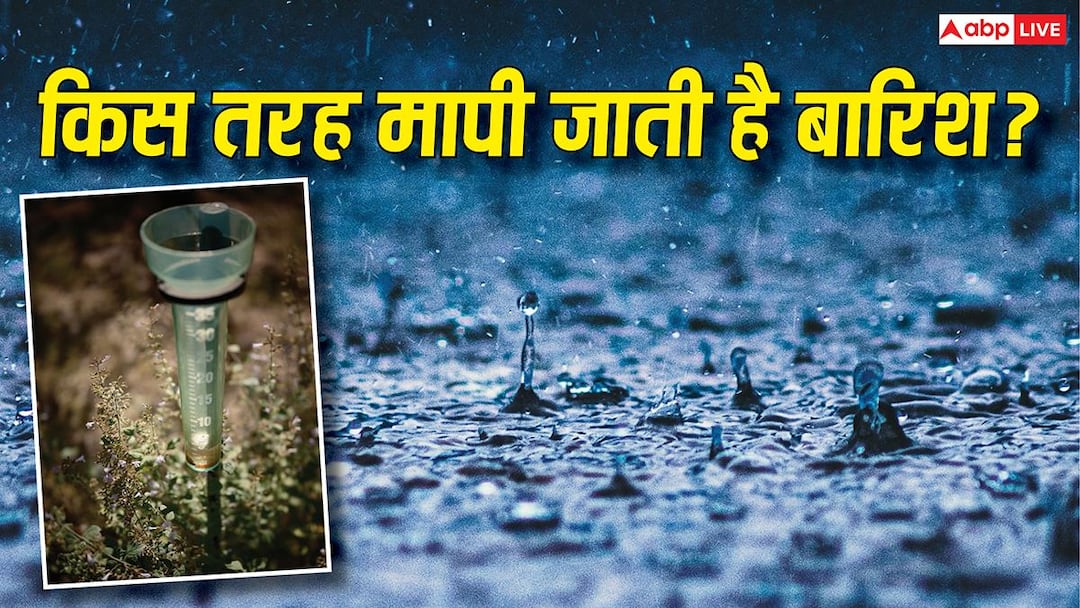
Whenever monsoon arrives, we often hear in the news that so many millimeters or inches of rain has been recorded in some city. But have you ever wondered why rain is not expressed in liters like milk, oil or water? Why do meteorologists use units of length such as inches, centimeters or millimeters to measure drops falling from the sky? There is a very interesting and easy science behind this. Let us understand it in simple words.
Reason for choosing milliliter instead of liter
The biggest reason for measuring rainfall in liters is that the total spread of water cannot be known from liters. The Meteorological Department does not measure the water falling in a single vessel, but the depth of water accumulated in a fixed radius. Its simple meaning is that if rain water falls on a flat ground and it neither dries up nor flows anywhere, then how high a layer will it create on the ground. To measure this depth accurately, the scale of millimeter, centimeter or inch is considered the most correct and scientific.
How does this depth scale work?
If we understand this entire mathematics in common parlance, there are ten millimeters in one centimeter and about 25.4 millimeters in one inch. According to the international standard, if 1 mm of rain is recorded in an area, it means that a total of 1 liter of water has rained in an area of 1 square meter. Similarly, if the Meteorological Department says that 100 mm of heavy rain has occurred at a place, then in simple words, 100 liters of water falls from the sky on every 1 square meter of that area.
Also read: Monsoon Word Origin: Where did the word monsoon come from? Know who said it for the first time, what is its history?
relation between square meter and liter
This method has been considered the international standard for keeping track of rainfall all over the world, because with this unit it becomes very easy to estimate the total amount of water. The special instrument used to measure rainfall is called a rain gauge or rain gauge. This is a very simple and cylinder shaped vessel. There is a scale made on the outer surface of this vessel, through which the height of water can be measured immediately.
Where and how is rain measured?
The meteorological department always keeps this rain gauge in an open place where there are no trees or tall buildings nearby, so that the water falling from the sky can collect directly and without any obstruction. However, in today’s modern era, digital and automatic rain gauges are also being used extensively, which send moment-to-moment information directly to the computer. Nevertheless, the basic principle of measuring water depth is still the same and accurate, with the help of which floods and droughts are assessed around the world.
Also read: Top 10 Best Cities: Which are the top 10 most livable cities in the world, where do India’s Delhi-Mumbai stand?