
 By Admin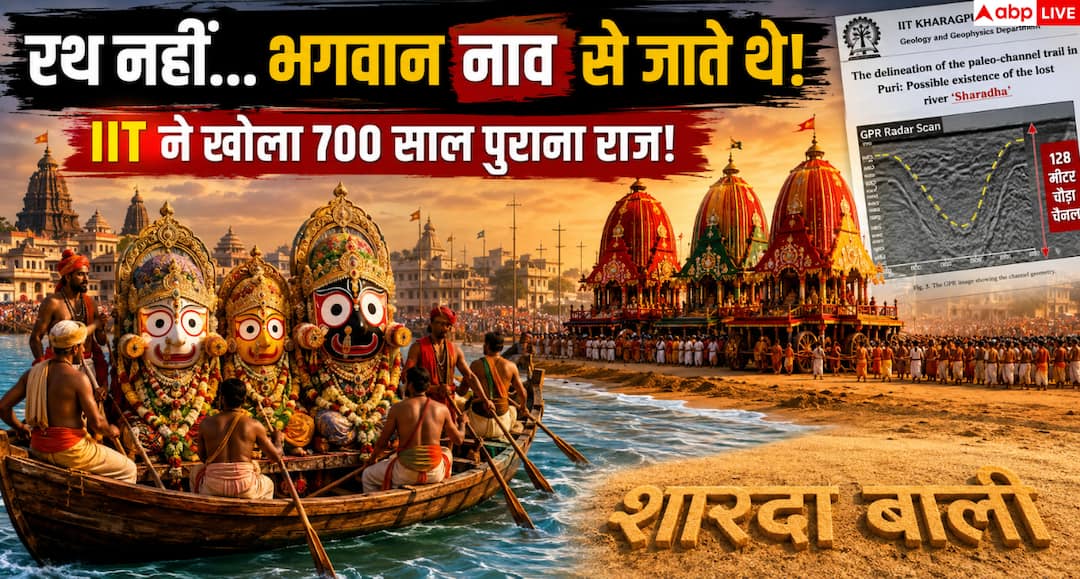
Jagannath Rath Yatra 2026: Puri’s Jagannath Rath Yatra is counted among the grandest religious events in the world. Today, the three chariots of Lord Jagannath, Balabhadra and Goddess Subhadra reach Gundicha temple directly from Sri Mandir. But do you know that there was a time when this journey stopped midway?
The reason behind this was the Malini river, which once flowed between Shrimandir and Gundicha temple. There is special mention of this river in religious traditions and scientific research done in recent years has also given new strength to this ancient belief. Let us know this unique story related to Sharda Bali, Malini River and Rath Yatra.
When the Rath Yatra took place in two phases:
According to ancient beliefs, the road which is today called Bada Danda (Grand Road), once used to flow there Malini river. It was considered a tributary of the Bhargavi river. The river acted as a natural barrier between the Sri Jagannath Temple and the Gundicha Temple.
For this reason, at that time the Rath Yatra could not be completed in one go. In the first phase, Lord Jagannath, Balabhadra and Subhadra used to reach the banks of river Malini riding on their respective chariots. After this, the idols were respectfully taken down from the chariots and taken across the river in special boats. Three other chariots were already ready on the other side of the river, on which Lord Gundicha used to reach the temple. In this way the journey was completed through a total of six chariots.
Tradition changed due to the dream of Rani Sharda Devi:
According to folk beliefs, 13th century Queen Sharda Devi, wife of Gajapati king Narasimha Dev, saw Lord Jagannath in her dream. It is said that the Lord expressed his wish that his journey should reach Gundicha temple directly without any interruption.
The queen considered it a divine order and resolved to close the Malini river. When the treasury was no longer sufficient for this huge task, thousands of devotees from Puri and surrounding areas themselves came forward. People started filling the mouth of the river by bringing sand from the beach with their hands. After a long collective effort the river route was closed.
In memory of this historical and religious event, that huge sandy area was named Sharda Bali. ‘Sharda’ was considered a symbol of the queen’s name, while ‘Bali’ means sand. After this, the Rath Yatra started being completed without any stoppage with only three chariots.
Does scientific research also support this story?
Apart from religious beliefs, scientists have also studied this topic. Year 2020 In IIT Kharagpur Researchers from the Department of Geology and Geophysics of Puri conducted a detailed study in Puri area. The objective of this research was to find out whether any ancient river actually existed below Bada Danda.
Researchers ground penetrating radar (Ground Penetrating Radar – GPR) and paleo-channel (Paleo-channel) Technology used. Paleo-channel is the path of an ancient river, which gets buried underground over time.
Almost under the big stick in the study 128 meters It was revealed that a wide dry river channel was found. In the analysis of the soil, it was also found that the sand present there was not of normal river but had characteristics like marine sand. Researchers linked this to the possibility that at some time this river might have been artificially filled by bringing in external sand.
But, it is also important to note that while scientific research presents geomorphic evidence, the dreams of Queen Sharda Devi and the events related to it are primarily a part of religious traditions and folklore. It is considered appropriate to understand both in their respective context.
Unique confluence of faith and history:
Puri’s Rath Yatra is not just a religious festival but a symbol of centuries-old cultural heritage. The story of Sharda Bali and Malini river makes this heritage even more interesting. On one hand, folk beliefs tell the story of Lord Jagannath’s wish and the dedication of Queen Sharda Devi, while on the other hand, modern scientific research indicates that an ancient river may indeed have once flowed in this area.
This is why even today Sharda Bali is considered not just a sand field, but an important symbol of the confluence of faith, history and science. This story related to Rath Yatra tells that there are many such secrets hidden in the cultural heritage of India, whose layers are revealed from time to time by both history and science together.
Also read- Jagannath Puri 2026: Miracle happened in the sea 200 years ago! Even today the French bell is hanging in the Puri temple.
Disclaimer: The information provided here is based only on assumptions and information. It is important to mention here that ABPLive.com does not endorse or confirm any information. Before implementing any information or belief, consult the concerned expert.