
 By Admin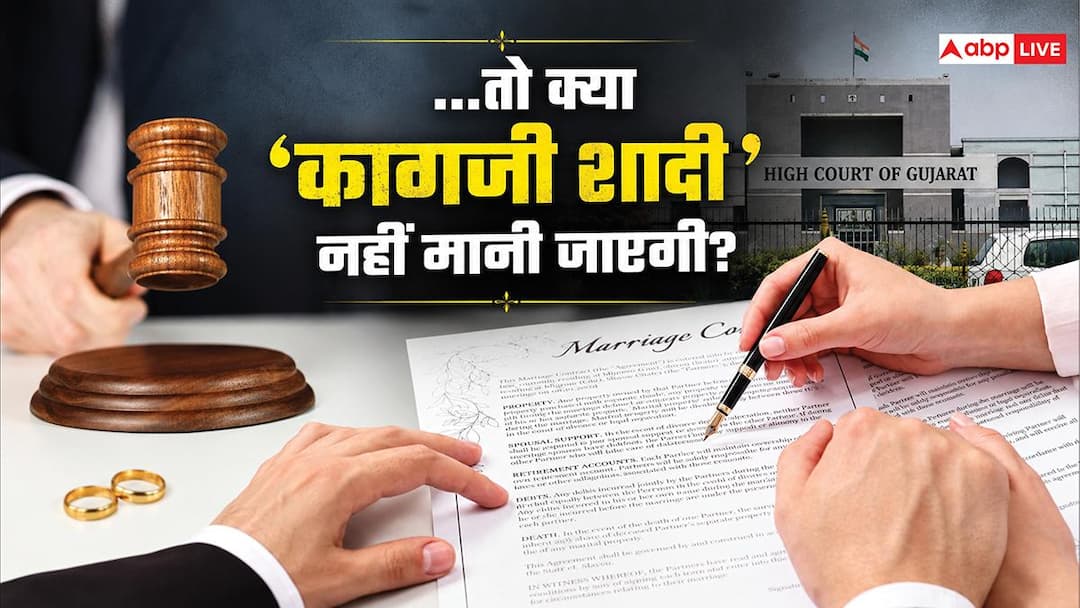
Gujarat High Court has given a decision which has given great clarity regarding Hindu marriage. The court has said that merely by getting a marriage certificate or registration, a marriage will not be considered legally valid. If the required rituals of a Hindu marriage, especially the seven rounds (Saptapadi), have not been performed, the marriage will not be legally recognized. Even if it has not been registered. The court clearly said that marriage is not just an occasion for singing and eating and drinking. This is a sacred ceremony, for which it is necessary to complete the rituals. So will court marriage no longer be considered as marriage and what will be the impact of this decision…
In which case has Gujarat High Court given this decision?
This whole matter is related to the appeal of a person living in Britain. He said that a woman from Ahmedabad got him to sign the documents on the pretext of getting him a job and made a fake marriage certificate. The man did not know that he was married. He came to know about this when the woman approached his parents with the marriage certificate and started introducing herself as his legal wife.
The man told the court that he never performed any marriage ceremony, nor did he ever live with the woman like husband and wife. He also said that the documents were signed fraudulently.
The most surprising thing was that when the matter reached the family court, the woman herself confessed that there was no marriage ceremony between them and they never lived like husband and wife. Despite this, the Family Court dismissed the case only on the basis of marriage certificate, saying that the registered marriage would be considered valid and a full trial was required.
That is, the woman herself was saying that ‘the marriage did not take place’, yet the family court was saying that ‘if there is a certificate, the marriage will be considered, do a full hearing.’ Describing this order as wrong, the person approached the Gujarat High Court.
What did the High Court say while considering the marriage illegal?
Justice Ilesh J in Gujarat High Court. Vora and Justice R.T. Vachani’s bench said 4 big things while giving the verdict:
- Certificate does not constitute marriage: The court said, ‘Marriage certificate is only a record of an already existing marriage. It does not automatically recognize any marriage. That means if the marriage has not taken place, the certificate cannot make it valid.
- Seven rounds are mandatory: Citing Section 7 of the Hindu Marriage Act 1955, the court said that Hindu marriage should be solemnized with customs and rituals. If the rituals involve Saptapadi, the marriage is considered complete and binding only after the completion of the seventh round.
- Family Court’s mistake: The High Court strongly criticized the Family Court and said that when the woman herself admitted that no marriage ceremony took place, then it was wrong to conduct the entire hearing on the basis of the certificate. The court said that when a marriage ‘does not have any foundation’, it cannot be considered valid.
- Importance of marriage: The court also said that Hindu marriage is not just a legal formality. It is a sacrament and a sacred bond. The court asked the youth to understand the sanctity of marriage and not take it lightly.
What does the Hindu Marriage Act 1955 say about marriage?
To understand this decision, one has to understand two important sections of the Hindu Marriage Act 1955:
- Section 7- solemnization of marriage: This section states that Hindu marriages should be solemnized as per customs and rituals. Section 7(2) clearly states, ‘Where the rituals involve Saptapadi (seven rounds), the marriage becomes complete and binding on the taking of the seventh step.’ That means only seven rounds complete the marriage.
- Section 8- Registration of marriage: This section talks about marriage registration. But the court made it clear that registration is only proof that a marriage took place and does not make the marriage valid. If the marriage has not taken place (rituals have not been completed), then registration has no meaning.
Old decision of the Supreme Court: The High Court also cited an old decision of the Supreme Court ‘Ratnamma and others vs. Sujatamma and others’, in which it was said that mere registration of marriage is not proof that the marriage had actually taken place.
So will court marriage no longer have any status?
This question might be coming in the mind of many people, but it is not so. This decision has no effect on court marriage. This decision applies only to Hindu marriages.
Under Court Marriage (Special Marriage Act, 1954), no religious ceremony is required for marriage. In this, both the parties have to sign in front of the Registrar and 30 days’ notice has to be given, that is enough. Because of this, court marriage will remain as valid as before. This decision applies only to those Hindu marriages which are performed under the Hindu Marriage Act.
At the same time, Supreme Court lawyer Dr. A. P. Singh’s opinion is different. He says, ‘After the decision of Gujarat High Court, marriage without Saptapadi will be considered invalid. That means marriage will be zero. Being zero means that the child born after this marriage will not be considered legitimate. In Sanatan Dharma, marriage is not complete without Saptapadi.
What effect will this decision of Gujarat High Court have on the common people?
It will have 5 major impacts:
- Mere registration will not suffice: If you have married as per Hindu customs, then seven rounds are necessary. If seven rounds are not performed (or any other required ritual is not performed), then the marriage will not be considered legal once the marriage certificate is made.
- Fake marriages will be banned: This decision will help in stopping fake marriages. If someone makes a certificate without marriage by merely signing the documents, then it will not be legally valid.
- Burden of proof: If ever the validity of a marriage is questioned, merely showing the certificate will not be enough. It has to be proved that the marriage rituals (especially the seven rounds) were completed.
- No effect on already existing marriages: This decision does not invalidate those marriages which have already taken place and in which the rituals were completed. This decision applies only to those cases where rituals were not performed, only registration was done.
- Impact on children and property: The court declared the marriage ‘void ab initio’ in this case. This means that if a marriage has taken place without rituals, then it will never be considered as having taken place from the legal point of view. This may impact children’s custody, property rights and other legal matters.