
 By Admin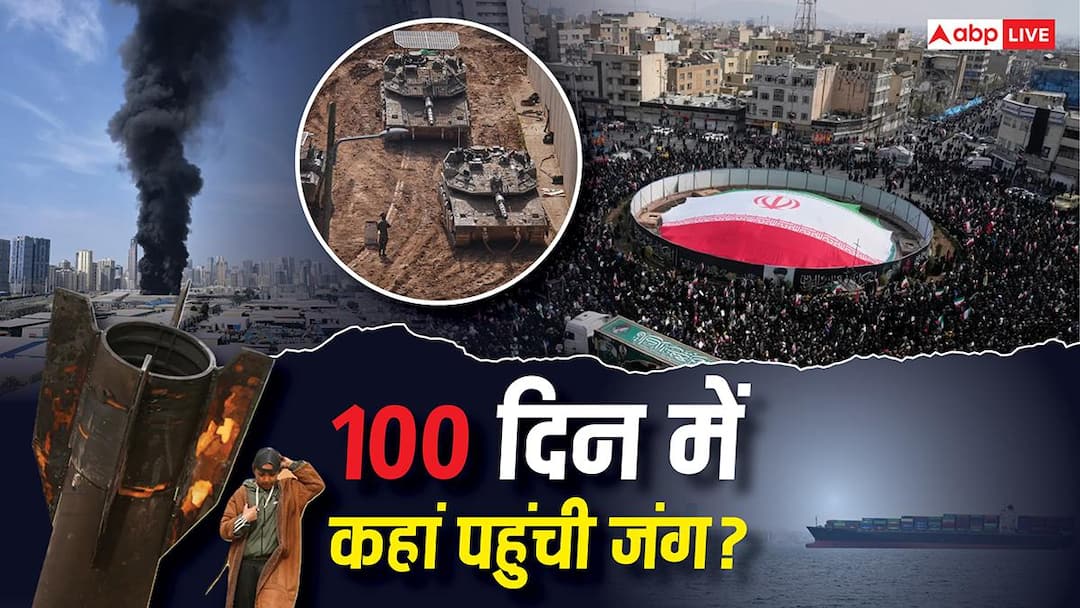
About 100 days ago, on the morning of 28th February, when people in Tehran were busy in their routine life, suddenly fire started raining from the sky. America and Israel together launched such an attack on Iran, whose echo was heard throughout the Middle East. Iran’s supreme leader Ayatollah Ali Khamenei was killed on the very first day. The Strait of Hormuz was closed and a war began, which US President Donald Trump described as ‘very intense’. Today it has crossed 100 days and is still not ending…
Before the war: What was going on inside Iran in January-February 2026?
About two months before the US-Israeli attack, Iran was boiling badly within itself. There was a wave of anti-government protests in the country.
- 1 January 2026 (night): Protesters overturned a car and set fire to several places outside a police station in the city of Ajna in Lorestan province. Reuters identified the place by matching satellite images. Fars News Agency reported that the mob tried to enter the police headquarters at around 6 pm.
- 8 January 2026 (night): People gathered near Tehran’s Tir Square and continuous gunfire was heard in the background. A vehicle caught fire and a person fired a flare into the sky. This footage was released on January 12, when some restrictions were lifted after a 4-day internet blackout.
- 11 January 2026 (released footage): Relatives gathered outside Tehran’s Kahrizak Forensic Medical Center to identify the bodies. Iran’s state TV also showed dozens of body bags, which it described as the work of ‘armed terrorists’.
Amidst these protests, the then Iranian Supreme Leader Ayatollah Ali Khamenei warned, ‘The Americans should know that if they start a war, it will be a regional war.’ On the same day, US President Donald Trump said in West Palm Beach, Florida, ‘Hopefully we will make a deal. If the deal is not made, then we will know whether he (Khamenei) was right or not.
Last peace effort (February 2026)
- 6 February 2026: Oman’s Foreign Minister Sayyid Badr Albusaidi met separately with Iranian and American representatives in Muscat. Abbas Araghchi was from Iran’s side, while Steve Witkoff and Jared Kushner (Trump’s son-in-law) were from America’s side.
- 26 February 2026: These meetings also took place in Geneva. Oman News Agency reported that the talks were being held in a ‘constructive spirit’, but did not yield any results. Just two days later…
War starts: 28 February 2026- ‘Operation Epic Fury’
At around 8 am (Tehran time) American and Israeli forces launched a major air and sea attack on Iran. The US Department of Defense (DVIDS) released footage showing:
- USS Gerald R. Fighter jets took off from the Ford aircraft carrier.
- Missiles were fired from ships.
- Rocket launchers and navigational planes were prepared.
Trump announced on Truth Social, ‘A short time ago, American military forces began major combat operations in Iran.’
A missile fell near Shajareh Tayyebeh Girls School in Minab city. Immediately after the attack, black smoke billowed from the school, people were screaming and debris was scattered. On February 28 itself, state media reported that at least 40 people were killed. But this figure increased to more than 160 by March 3, when body bags of dead bodies were brought to Meenab Morcha. Israeli Defense Minister Israel Katz confirmed that they have struck Iran.
On the same day, US President Trump announced on Truth Social, ‘Khamenei, one of the most evil people in history, is dead.’ A satellite image showed the Supreme Leader’s compound in Tehran heavily damaged.
Iran’s immediate counterattack
- Attack on Bahrain (28 February): The service center of the American Fifth Fleet in Manama, Bahrain was blown up by a missile. In the footage obtained by Reuters, the sound of an explosion is heard from inside the car and people are shouting ‘Oh my God’. Residential buildings also caught fire.
- Hormuz closure (1 March 2026): The Iranian Revolutionary Guard (IRGC) announced in English on the radio that from now on no ships are allowed to pass through the Strait of Hormuz. This will remain in force until further notice.
- Missile at Tel Aviv (1 March): Iran fired a missile into a residential area of Tel Aviv, killing one woman and injuring several others. In the drone view, a large part of the building was seen completely damaged. “This is the price of a just war,” Israeli opposition leader Yair Lapid said at the scene.
- American planes shot down in Kuwait (2 March): A military plane was seen falling from the sky over Al Jahra in Kuwait, whose pilot escaped by parachute. The Kuwaiti Defense Ministry confirmed that several American planes crashed in their territory, but all crew survived safely.
- Saudi Arabia refinery attack (2 March): Aramco oil refinery in Ras Tanura, Saudi Arabia was attacked by drones. In the footage, heavy black smoke was seen covering the entire area.
The third day of the war and after
- Attack on US Consulate in Dubai (3 March): The footage showed that a huge cloud of smoke was rising over the American Consulate in Dubai and people were taking photos from their mobile phones.
- Secretariat of the Assembly of Experts in Qum destroyed (3 March): The secretariat of Iran’s Assembly of Experts was completely demolished in the city of Qum, south of Tehran. This is the same body that chooses the new Supreme Leader. Debris and broken buildings were seen in the footage.
- Iranian warship sinks near Sri Lanka (March 4): US Defense Secretary Pete Hegseth said that an American submarine sank the Iranian warship IRIS Dena off the southern coast of Sri Lanka. The hospital administration of Galle city of Sri Lanka said that 87 bodies were recovered after the morning distress call.
- Sanandaj bombing (5 March): Several explosions took place at night in Sanandaj city of Kurdistan province of Iran. In the footage, fire and black smoke were seen rising into the sky.
- Smoke near Dubai Airport (7 March): A plume of smoke was seen behind the terminal at Dubai International Airport just before Emirates temporarily suspended its flights. Dubai government said that debris fell after interception.
- 6 American soldiers martyred in Kuwait (7 March): Six US Army soldiers were killed in a drone attack on a US military facility in Port Shuaiba, Kuwait. They were all from the 103rd Sustainment Command based in De Moine, Iowa. Trump himself saluted as his body was taken to Dover, Delaware.
Attacks on Iran’s fuel depot and refinery
- On March 7, Tehran’s Shahran Refinery was attacked, causing fire and dense smoke into the sky late at night.
- On March 8, a massive fire broke out at the Akdasiyeh fuel depot. NASA FIRMS detected thermal activity in that area. The Israeli army wrote on Telegram that they targeted several fuel storage facilities in Tehran.
New Supreme Leader (9 March 2026)
Iranian state TV Channel One announced that the Assembly of Experts has elected Mojtaba Khamenei as the new Supreme Leader. Mujtaba is a mid-ranking cleric and has close ties to the Revolutionary Guards.
War at Sea: Oil Tankers, Cargo Ships and Blockades
- On March 12, 2026, Iran attacked oil tankers in Iraqi waters. In the footage, explosions and fire were seen in the tanker.
- On April 19, 2026, the US Navy destroyer USS Spruance opened fire on the Iranian-flagged cargo ship M/V Toska. According to CENTCOM, the crew did not follow warnings for 6 hours. Later the American Marine seized this ship.
- On 23 April 2026, Iranian state TV showed that the IRGC seized two container ships – MSC Francesca (Panama flag) and Epaminondas (Liberia flag) – in Hormuz. Iran alleged that they acted without permission and tampered with the navigation system.
Hezbollah and the Lebanese Front
The war was not limited to just Iran-America. Hezbollah in Lebanon started firing rockets against Israel.
- A fragile ceasefire was announced on 7 April 2026. It was decided to continue the talks, but Hezbollah was not included in it.
- On April 8, 2026, Israel bombed Beirut, killing more than 300 people in 10 minutes.
- On April 11, 2026, Iranian Foreign Minister Abbas Araghchi and Parliament Speaker Mohammad Baqer Qalibaf reached Islamabad. US Vice President JD Vance, Steve Witkoff and Jared Kushner were also there. But Iran said that talks would not take place unless commitments were made and sanctions were eased on Lebanon. In this way the talks almost broke down.
- On April 17, 2026, Lebanon and Israel held direct diplomatic talks for the first time in decades, but Hezbollah resumed fighting on both sides.
- On May 31, 2026, Israel carried out its deepest ground incursion in southern Lebanon in the last 25 years.
- There were continuous airstrikes on 1–7 June 2026, 11 people were killed by Israeli drones and three members of the Lebanese army were martyred.
- On June 7-8, 2026, near the 100th day, Hezbollah again opened fire on Israel. Israel attacked the southern suburbs of Beirut. Iran directly attacked Israel.
- On June 8, 2026, in the early morning, Israel carried out air strikes on the central and western parts of Iran. Iranian state TV confirmed the sound of explosions in Isfahan, Tabriz and Tehran.
What impact did this war have on the economy?
According to CNBC report,
- As soon as the war started, crude oil prices skyrocketed. The supply came to a halt due to the closure of Hormuz.
- The US stock market (S&P 500) recovered its losses after the initial fall, but the European stock markets are still under pressure as energy prices have increased.
- In the bond market, investors ran towards government bonds.
- The Trump administration described the war as necessary to ‘control oil prices’ and ‘prevent Iran from having a nuclear weapon’, but experts say that if the war continues for a long time, the world could fall into recession.
European Union imposed sanctions
The European Union on Monday (June 8) imposed sanctions on two Iranian individuals and a unit of the IRGC navy:
- Mohammad Akbarzadeh- Deputy Commander (Political Affairs) of the IRGC Navy.
- Hamid Hosseini- Representative of Oil, Gas and Petrochemical Products Exporters Union of Iran
- Hormuzian Provincial Command of the IRGC Navy
EU foreign policy chief Kaja Kalas said, ‘The sanctions imposed on Iran are not acceptable. Who are involved in disrupting traffic in the Strait of Hormuz. Iran’s Deputy Foreign Minister Kazem Gharibabadi called this step ‘political and wrong’ and said that it should not be given any importance.
Then what will happen next?
Experts believe that at present there is no firm ceasefire. Israel and Hezbollah are face to face. Iran’s new Supreme Leader Mujtaba Khamenei has not given any major statement yet. The US presidential election season is underway. The Strait of Hormuz is still not completely open. Oil prices are volatile and deaths among common people are increasing with each passing day.