
 By Admin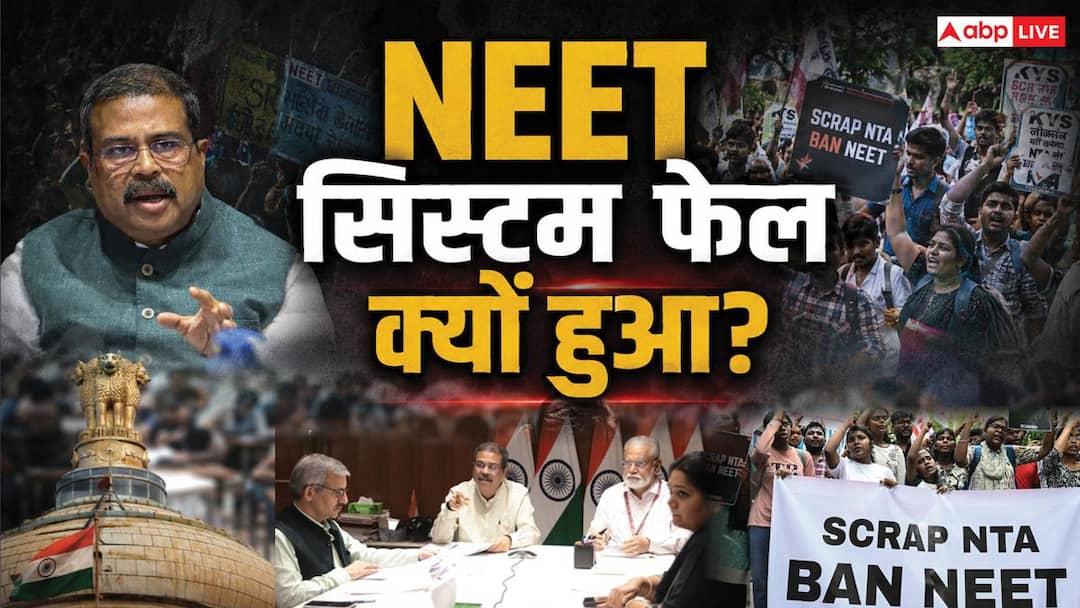
NEET UG examination was held on 3 May 2026. About 22.7 lakh students appeared. During this time, the ‘Guess Paper’ which was going viral on WhatsApp and Telegram before the examination came to light. Out of its 720 questions, about 600 marks matched with the real paper. On May 12, NTA canceled the entire examination. The examination was held again on June 21, 2026, but the confidence of lakhs of students was broken. Politics has its place, but the real thing should be about facts. That means the complete blueprint to stop paper leaks was available with the government about two years ago. The High Level Expert Committee of the Education Ministry itself had prepared this report. Now the biggest puzzle is why that blueprint was not implemented on time…
Warning and solution were received two years ago
After the big controversy of NEET 2024, on June 22, 2024, the Education Ministry appointed former ISRO chief Dr. K. A seven-member high level committee was formed under the chairmanship of Radhakrishnan. After 23 meetings, this committee submitted its 184-page report to the government on 21 October 2024.
In this, not only the weaknesses were enumerated, but complete 101 recommendations were also given to remove them. A large number of these were such that it was said to be implemented from 2025 itself. Along with taking suggestions from more than 37 thousand students, parents and experts, the committee also studied the experiences of IIT, AIIMS, states and investigating agencies. It was clearly written in the report that these reforms should be implemented in ‘mission mode’.
The biggest reason and cure for paper leak found
The committee explained very clearly that the biggest danger in pen-paper examination arises when the question paper comes out of the printing press and reaches the warehouses, transport and then the examination centres. It’s simple – the more hands a paper passes through, the greater the possibility of a leak. That means printing, storage and transportation were the weakest links. Its solution was also ready – ‘Computer Assisted Secure Paper Based Testing.’
In this model, question papers were not to be printed in advance and sent across the country. The encrypted papers would reach directly to the secure server of the examination center and would be printed on a high-speed printer inside the same center and given to the students just before the commencement of the examination. The committee believed that this would eliminate to a great extent the possibility of paper leaking during printing, storage and transportation. Another important thing the committee had written was that before implementing this system, it should be pilot tested. The biggest question is that if the solution was ready in 2024, then why has its pilot not been done till date?
What were the 10 most suspenseful recommendations of the report?
Out of the 101 recommendations given by the Radhakrishnan Committee in its report, there are ten which directly attack the root of the paper leak…
- The paper should not be printed in advance and travel across the country, the questions should be converted into codes and go directly to the computer of the examination center and be printed there on the day of the examination. The committee had also said that first try it at one place, but it was not tried.
- No one should have a mobile phone or camera at the printing place, every employee should be searched while coming and going, camera recording should be kept for one year and every paper should have a unique number.
- It should be written in advance where the paper came from and through whose hands it passed, the box should be sealed, location tracker should be installed on the vehicle and a responsible officer of NTA should be sitting at every centre, like it happens in elections.
- In every district, there should be a team under the leadership of DM which also includes SP, the owner of the school which is to be made an examination center should be thoroughly investigated and the centers should be closed in front of the police and open in front of them only.
- The centers should choose computers and not humans and the centers where irregularities have happened before should stay out.
- Students should find centers in their own district and if many students are suddenly choosing a distant center then this should be caught before the examination and not after.
- When more than two lakh children are appearing, the examination should not be conducted on a single day but over several days.
- Not one but more than three papers should be kept ready, the set names should not be easy like A, B, C and D and the order of questions should be changed in every set.
- The contract for the entire examination should not be given to any one company.
- A committee should send a report every month to the Ministry of Education to see whether all these are being implemented or not.
However, the government has not yet put forward a list of which of these things have been implemented and to what extent.
After the cancellation of NEET 2026, the Supreme Court described the matter as ‘very painful’. The Supreme Court expressed its displeasure at the NTA, saying that it ‘has not learned any lesson’ and the problem will not stop until real accountability is fixed.
Now the government’s side and ground reality
It has been repeatedly said by the government that many of the recommendations of the committee have been implemented and work on some is ongoing. State and district level coordination committees led by DM and SP were formed. Remained active in the examinations of 2025 and 2026. High Powered Steering Committee was also constituted on 14 November 2024, which was to send report to the Ministry of Education every month. But the reality is that the most important pilot of ‘Computer Assisted Secure Paper Based Testing’, which the committee had advised to try first, could not be conducted.
The government has not yet told which of the 101 recommendations of the report or how many have been implemented and which are pending. Education Minister Dharmendra Pradhan’s statement is that the recommendations were followed, but there was a ‘break in the command chain’. A parliamentary committee also admitted that reforms have started, but a roadmap has not been placed before the public till date.
Spread network of multi-state network
The paper of NEET 2026 was leaked from the printing press itself, from where the committee had said that the risk of leakage was the biggest. SOG of Rajasthan Police first detected the leak, after which CBI took over the case. The investigation revealed a multi-state network extending from Maharashtra to Haryana and Rajasthan. More than 99.5 percent of the examination centers were in government institutions and measures like biometric attendance were in place. But the leak did not happen at the examination centers but during printing.
Then whose responsibility is it now?
The question is not just about how the paper was leaked. The real question is why the solution which was identified by the government’s own top expert committee in 2024 itself, was not fully implemented on time? If the most important recommendations are still incomplete and no solid security cover has been prepared for examinations like NEET, then who will decide its accountability? At present, neither the Education Ministry nor any fast track court has the answer to this question, while crores of students are just hoping for a reliable examination system.
Education Loan Information:
Calculate Education Loan EMI