
 By Admin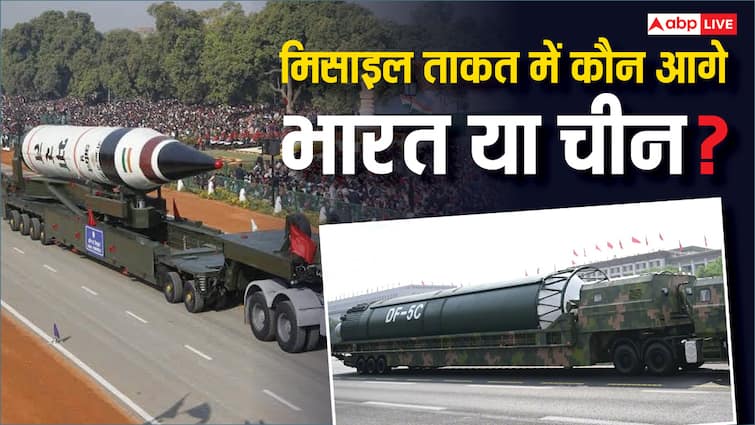
China has been demonstrating its military strength for a long time. The Victory Day Parade is the biggest example of this, in which the People’s Liberation Army (PLA) performed high-tech weapons. The biggest attraction of this parade was Dongfeng-5C missile, which was called ‘Show Stopper’.
Victory Day also showed weapons like not only DF-5C, but also hypersonic glide vehicles, robotic dog drones, anti-ship cruise missiles and unmanded underwater vehicles. It is a clear indication that China wants to make its technical lead not only in the land but also in cyber, sea and air war fair. This power of PLA under the leadership of President Xi Jinping strengthens the position of China not only on Asia but also on the global platform. However, if you compare the missiles of India and China, then there will be a difference between the two.
DF-5C missile technical capacity
Dongfeng-5C is China’s most advanced intercontinental ballistic missile (ICBM). It has some major technical characteristics. Its range is 13,000–16,000 km. It is a base-fuel missile on liquid-fuel. Its payload capacity is 3,900 kg (1–3 megaton nuclear warhead). It can attack by locking the taregate from 800 meters away. Its length is 32.6 meters and weighs 183,000 kg. The biggest strength of DF-5C is its MIRV capacity. That is, it can target many goals in the same launch. It has a firepower to the US and Europe and is definitely a threat to India.
India’s most modern ICBM
India’s most modern missile system is ICBM Agni-V. It also has its own special feature, which brings it into the category of dangerous missiles. Its range is 5,000–8,000 km. It is based on solid-fumed. Its payload capacity is 1,000–1,500 kg. It can attack by locking the target from a distance of 10-100 meters. Its length is 17 meters and weighs 50,000 kg. Agni-V is road-mobile and canister-laws, which means that it can be deployed anywhere and the enemy is unable to detect it. Apart from this, India has a ballistic missile defense (BMD) system – like Prithvi Air Defense (PAD) and Advanced Air Defense (AAD). These systems can intercepted the upcoming missiles.
India’s maritime capacity
India’s maritime capacity is also getting stronger. The K-4 SLBM (3,500 km range) has been successfully tested from INS Arighat, which ensures India’s second-stroke capacity. That is, even if there is an first attack on India, it is still capable of answering.
Is DF-5C threatened to India?
Technically, DF-5C can target any part of India. Its range and payload makes it a nuclear armagadon missile, but only the strength of the missile does not determine the war. India has continuously strengthened its defense system and missile technology in the last two decades. India’s nuclear tride (the ability to carry out nuclear attack from the ground, air and sea) enables it to combat threats like DF-5C.
Also read: After heavy destruction, this country shook due to tremors of tremors once again after heavy destruction