
 By Admin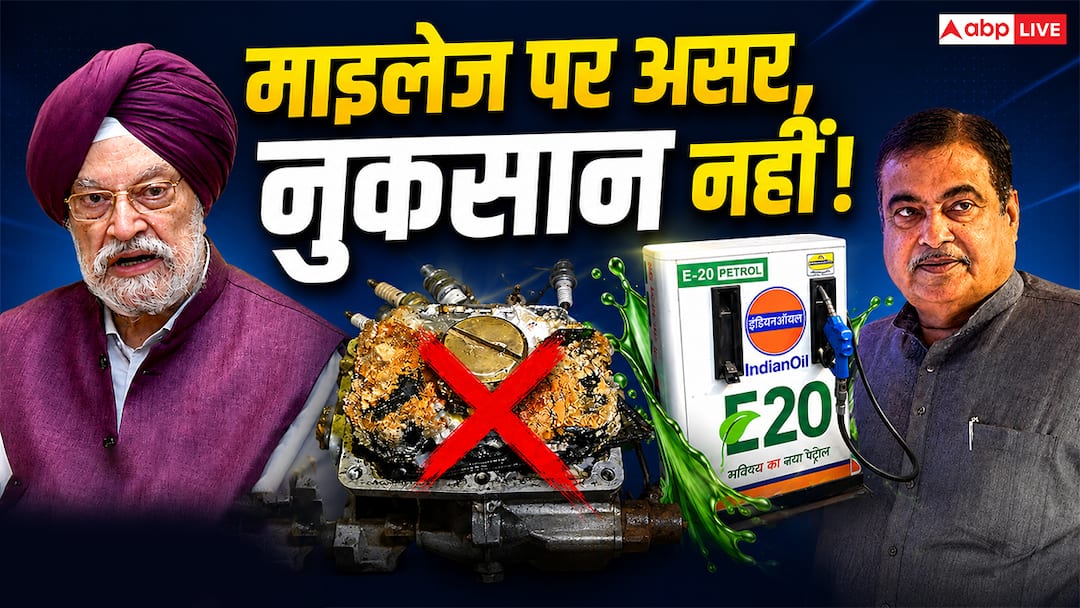
Six days ago, on July 4, 2026, Petroleum Minister Hardeep Singh Puri had said, ‘E20 is completely successful, no one has any problem.’ But on July 10, 2026, Road Transport Minister Nitin Gadkari himself said, ‘E20 will affect the mileage.’ These two statements have started a new debate across the country regarding E20 petrol. On one hand, common people are complaining on social media about reduced mileage of their vehicles and engine failure, while on the other hand, two senior ministers of the government are saying different things. What is going on, will there really be a difference in mileage and what is the meaning of the statements…
What’s the fuss over E20 petrol?
E20 means a mixture of 20% ethanol and 80% petrol. Ethanol is made from crops like sugarcane and corn. The government has made E20 petrol the standard fuel across the country from April 2026. Before this, E10 (10% ethanol) was used, for which most old vehicles were designed.
The government says that this will reduce oil imports, farmers will benefit and pollution will reduce. Starting from 1.5% ethanol blending in 2013-14, India achieved the target of 20% by 2025-26 5 years in advance.
The root of the problems is that ethanol is alcohol. It has two major chemical properties that can become a headache for the vehicle:
- Habit of absorbing water: Ethanol draws moisture from the air. When the amount of water in petrol increases, ‘phase separation’ occurs i.e. ethanol and water settle down and petrol remains on top. This lower layer goes directly into the engine and causes rust and poor combustion.
- Melting of rubber and plastic: The fuel lines, seals and gaskets of older vehicles are not made of ethanol-resistant materials. Ethanol slowly corrodes these, creating the risk of fuel leaks and costly repairs.
First Hardeep Singh Puri said- ‘Everything is fine, no problem’
Petroleum Minister Hardeep Singh Puri clearly said about E20, ’20 crore two-wheelers and about 20 lakh cars in the country are using E20 petrol and no one has any problem.’
Puri said that E15 is being used in India for the last three and a half years and E20 from April 2025. Both car-bike companies and mechanics have agreed that E20 is not causing any problems in the engine. Puri also said that the government is now testing on E25 (25% ethanol). He described the E20 as a ‘complete success’.
Then Nitin Gadkari said – ‘Mileage will decrease, but the car will not get damaged’
Road Transport Minister Nitin Gadkari also expressed his views on this matter. He was the first to admit that E20 would affect mileage because the calorific value (energy) of ethanol is less than that of petrol. Gadkari said, ‘There is a difference in the calorific value of ethanol and petrol and this is a fact.’
However, he also said that in most cases this impact will be very minor. Giving an example, Gadkari said, ‘In the intermittent traffic of Delhi-Gurugram, you apply brakes continuously, the speed does not go above 40-50. But if you drive at a constant speed of 100 km/hr, some difference may be visible.
Gadkari rejected the claims of engine damage due to E20 and said, ‘Show me even one car which has been damaged due to E20. What is going on on social media is part of a false story.
Gadkari also said that E20 was launched only after several tests by the Automotive Research Association of India (ARAI) and vehicle companies. For old vehicles, companies have been instructed to replace some parts (like washer) free of cost during servicing.
Then why is there an uproar over E20?
Despite the statement of the Central Government, the complaints of common people are not stopping. Thousands of people on social media are complaining about engine damage, reduction in mileage and effect on performance. Some people even demonstrated in Delhi.
The big problem is that older vehicles (which were built for E10) are now running on E20. Although unblended petrol (without ethanol) is still available, it is 40-50% more expensive. That means the common man has no option. The ARAI report also points to the danger of rubber fuel-system parts in older E10-compatible vehicles.
Former Delhi CM Arvind Kejriwal took this matter seriously. Kejriwal wrote a letter to 29 automobile companies demanding a clear answer whether E20 will harm old vehicles. Kejriwal said that in the manuals of some companies, E10 has been advised instead of E20. He sought written assurance from the companies that E20 will neither reduce mileage nor damage the engine.
After all, what is the truth about E20 petrol?
Nitin Gadkari has given an open challenge to the critics, ‘If even a single car, bike or scooter has been damaged by E20 petrol, then tell the name.’ He also alleged that a ‘false and paid campaign’ is being run against E20. At the same time, Hardeep Singh Puri clearly said that he does not think that the general public has any problem with E20.
According to experts, E20 will affect the mileage, it is true. Gadkari himself has accepted this. Ethanol contains less energy than petrol, so it is natural for the mileage to be slightly less. Companies have also said that mileage will be reduced by 3-3.5%. According to some estimates it could be up to 4-12%.
On the other hand, there is no concrete evidence that E20 causes engine damage. Government, ARAI and companies say that E20 was launched only after testing. Maruti Suzuki said that it has serviced more than 1.5 crore old vehicles, in which no defects related to E20 were found. But the big problem is that the government made this change very quickly (in just 3 years). Countries like Brazil made this change in 40 years. Even in America, E20 is optional, not mandatory.
There is no major contradiction in the statements of the two ministers regarding E20 petrol, but the real issue is about old vehicles and the experiences of common people. Thousands of complaints are coming on social media, but the government is calling them ‘fake news’. The opposition has also made it a political issue.