
 By Admin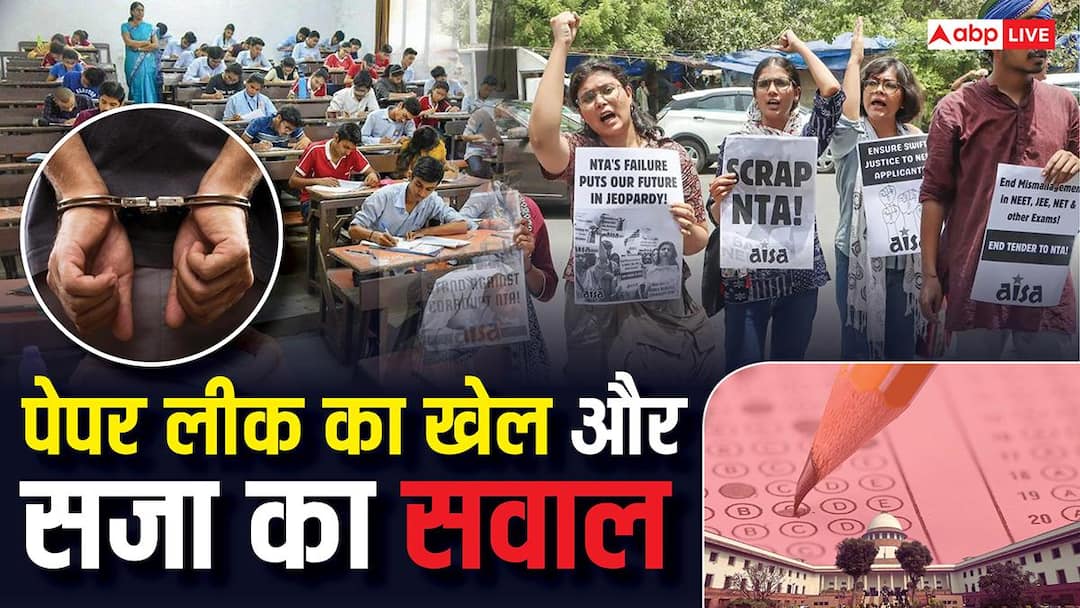
From NEET UG to UGC-NET, UP Board to Railway Recruitment, every major exam leak is followed by a few days of headlines, some arrests, an inquiry committee and then… silence. The question remains whether the real kingpin was ever caught? Did anyone get severe punishment? In most of the cases, the culprits are either acquitted or the case dies after languishing in the courts for years. But this is not just a newspaper story. NCRB data, police records of several states and surveys of education activists all paint the same picture that there is little guarantee of punishment for exam leakers in India. Let us understand in the explainer what is the ecology of paper leaks, what do the statistics say, how effective is the new law and why is punishment so rare in this game?
Paper leak is no longer just theft, an underworld economy
First it is important to understand that paper leak is no longer a matter of any one examination centre. Many investigations, including a report by the Indian Express, show that it has become a homogeneous economy, in which coaching operators, printing press owners, examination board employees and even the local administration are involved. The biggest market for paper leaks is social media and encrypted messaging apps, where a copy of a paper is sold to thousands of students within minutes. The Railway Recruitment Board (RRB) exam leak, UP Police constable recruitment, and the recent NEET controversy all found a central role for WhatsApp and Telegram groups. According to media reports, this illegal business is worth hundreds of crores of rupees annually.
What the statistics say: Conviction rate less than 10%
According to the Indian Express, in the last decade, out of the exam leak cases in which FIRs were registered, less than 10 percent resulted in conviction. The 2022 report of the National Crime Records Bureau (NCRB) also points to the same:
- In education fraud cases (which include paper leaks), the charge sheet filing rate may be 70%, but the conviction rate is only 12-15%.
- The record of Madhya Pradesh is even worse. Barring the Vyapam scam, between 2013 and 2023, the conviction rate in general paper leak cases was found to be less than 5%.
- In high-profile cases like Teacher Recruitment Exam Leak (2022) in Rajasthan, more than 100 accused were caught, but till now only 3 have been convicted and they too were not the main accused.
Why is punishment so difficult in paper leak case?
The question of punishment in case of paper leak is very complicated. When a major exam is leaked, after a few days of media coverage and a few arrests, the real culprits often escape. Behind this is not just one or two, but many layers of the entire system that work together:
- Weak investigation infrastructure and limited resources: Most of the paper leak cases are initially investigated by the local police. Often they do not have the expertise to get to the bottom of cyber crime, digital forensics and encrypted messaging apps. Today’s paper leak game is played on WhatsApp, Telegram and Dark Web, but the investigating agencies remain dependent on traditional methods only. The second problem is that leak conspiracies often spread from one state to another. That means the server is somewhere else, the buyer is somewhere else, the middleman is somewhere else. Local police have limited jurisdiction and both time and evidence are lost in inter-state coordination.
- Political Patronage and Influence: In many paper leak cases, the direction of investigation is decided from above. When the accused is linked to a politician or bureaucrat, the case is put on hold. According to the Indian Express, there are many instances where the arrest of the named accused was postponed for years, or the charge sheet was not filed at all. Transfer of investigating officer, loss of files and witnesses turning hostile are common symptoms of this game.
- Lack of evidence and absence of witnesses: The crime of paper leak is digital and the evidence is very delicate. It is common to delete or encrypt data from phones, laptops and servers. Often by the time the police takes action, the evidence has been destroyed. On the other hand, students and parents shy away from testifying out of fear. The students who have paid to buy the paper also remain silent for fear of implicating themselves. In such a situation, it becomes very difficult to prove the crime in the court and the accused are acquitted on the benefit of reasonable doubt.
- Slow pace of judicial process: On an average, it takes 6 to 10 years to settle a case in India. Paper leak cases are also not untouched by this. Over such a long period of time, witnesses become hostile, evidence becomes weak and victims lose interest. This slow pace of investigation and trial is the biggest shield for the accused. By the time the verdict comes, their career and life have progressed elsewhere and the fear of punishment is gone.
- Limitations of the new law: The ‘Public Examinations (Prevention of Unfair Means) Act’ of 2024 is very strict on paper, with 10 years’ imprisonment and a fine of up to Rs 1 crore. But there is no fixed time limit for investigation, nor is there a mandatory provision for fast-track hearing. Most importantly, no matter how stringent the law is, if the machinery enforcing it (police, prosecution, courts) continues to have the same old flaws, the result will remain the same.
- The students suffering are disorganized and weak: Lakhs of students and parents are scattered victims of paper leak. They neither have money for legal battle, nor any strong platform to raise their collective voice. As a result, public pressure on the government and investigating agencies does not last more than a few days and then everything becomes normal. When the victims themselves give up demanding justice, it becomes even more difficult to punish the culprits.
New Law: How effective is the Act of 2024?
In June 2024, the Central Government implemented the ‘Public Examinations (Prevention of Unfair Means) Act’, in which there is a provision of imprisonment of up to 10 years and a fine of Rs 1 crore, considering paper leak as an organized crime. This law is better than before, but the ground reality is different. Even after the implementation of the law, many major leaks occurred in 2025-26. Bihar Public Service Commission (BPSC) preliminary examination, Chhattisgarh PSC and CSIR-UGC NET in August 2025.
In none of these cases has the harsh punishment provided for been given so far. The biggest limitation of the law is that it does not have a fixed time limit for investigation nor is there a clear provision for compensation to the victim students. Legal experts believe that unless the capacity and independence of the investigating agencies increases, this law will also remain a paper tiger.
Impact on students: One year wasted, career in danger
Those lakhs of students who prepared honestly suffer the biggest brunt of the leak. The exam had to be canceled after the NEET PG 2025 leak, affecting around 2 lakh medical graduates a year. Due to Teacher Eligibility Test (CTET) and TET leaks of various states, candidates have to pay fees again and again and the wait for jobs becomes longer. The most frightening situation occurs when students commit suicide under mental pressure. Many such cases have been reported from Rajasthan, Uttar Pradesh and Madhya Pradesh, but the system never took accountability for them.
What can change?
- Centralization and specialization of investigation: The investigation of all paper leak cases should be handed over to a central agency or a state unit with cyber experts.
- Fast-track courts: It should be made mandatory to dispose of cases within one year so that the evidence does not go cold.
- Digitization of examination boards: Paper transportation and printing is a fully encrypted digital process with GPS tracking at every step.
- Strict administrative action: The service of any government officer or employee involved in the leak should be immediately terminated and criminal case should be filed against him.
- Justice to students: In case of cancellation of the examination, not only the fees should be returned but there should be a provision for lump sum compensation and priority in the next examination.
The game of paper leak will continue until there is no fear of punishment. Examination mafia is thriving like a protected species in India. Making laws is half the battle. The real fight is to make the process of investigation, prosecution and punishment fast and fair. Till then, the assurance of ‘action will be taken against the culprits’ after every leak will remain just a political slogan.
Education Loan Information:
Calculate Education Loan EMI