
 By Admin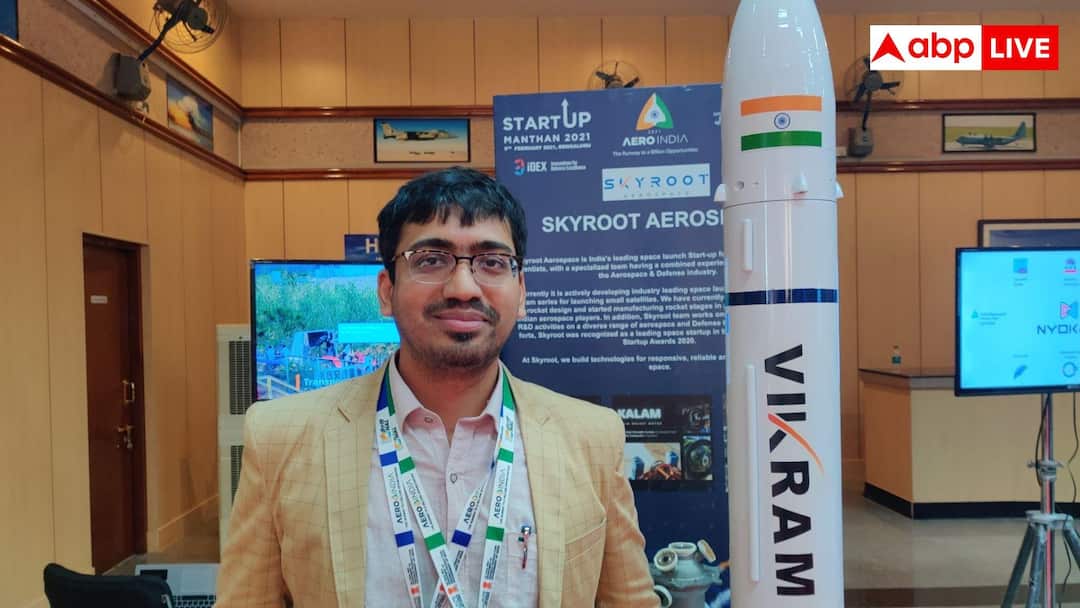
Pawan Chandana Success Story: Hardly anyone would have thought that after scoring only 51 marks in Mathematics in the school examination, this same student would later become a big face of India’s private space sector. But Pawan Kumar Chandana has proved that success is not determined only by marks. Today, the Vikram-1 rocket developed by his company Sky Root Aerospace has become India’s first privately developed rocket to reach space. This achievement is being considered an important milestone not only for the company but also for India’s private space sector.
Was weak in mathematics, but especially interested in machines
Pawan Chandana, who grew up in Hyderabad, comes from an ordinary middle class family. Since childhood, he was interested in understanding machines and technology. However, mathematics was not his strong subject during his studies and he got only 51 marks in an examination. Despite this he did not stop learning. Especially his father encouraged him in every difficult time, due to which his self-confidence remained intact. Over time, mathematics and science, which once seemed a challenge to him, became the strongest foundation of his career.
IIT in first attempt, then got a chance in ISRO
About two decades ago, Pawan Chandana passed the IIT entrance examination in the first attempt and took admission in IIT Kharagpur. After completing his engineering studies, he got the opportunity to work in ISRO through campus placement. Even though the salary in ISRO job was less compared to private companies, the biggest thing for Chandana was to be a part of the country’s space program.
Worked on GSLV MK-3 project
During his 6-year tenure at ISRO, Pawan Chandana worked on many important projects related to the development of India’s most powerful launch vehicle GSLV Mk-3 at Vikram Sarabhai Space Centre, Thiruvananthapuram. For his contribution he also received the Innovation Award within the institute. During this time, the thought came to his mind that private sector in India can also play a big role in the field of rocket manufacturing.
Left ISRO and started Skyroot Aerospace
In June 2018, Pawan Chandana founded Sky Route Aerospace in Hyderabad with his partner and former ISRO scientist Naga Bharat Daka. At that time, it was not easy to start a startup from a private space in India. Investors were also not completely confident about this sector. In the initial phase, Flipkart co-owner and IIT Kharagpur alumnus Binny Bansal invested 1.5 million dollars in the company. The pace of funding slowed down during the Covid-19 pandemic, but later Greenco gave financial support to the company to accelerate its further journey.
Also read- NEET result 2026: Which college will get what number after NEET, students with 700+, 650+, 600+ scores see here
Continuous great successes
In July 2020, Square Root became the first private company in India to successfully test a rocket engine. This engine is named after Nobel laureate C.V. Raman-1 was named in Raman’s honour. After this, after the Government of India opened the space sector to the private sector, Sky Route became the first private company to enter into an agreement with ISRO. The company later also secured a major funding of $51 billion, which was counted among the largest deep sector investments in India at that time.
Journey from Vikram-S to Vikram-1
On 18 November 2022, Vikram S was launched in the Sky Route, which was India’s first privately developed sub-orbital rocket. This launch marked a new beginning for the country’s private sector industry. After this the company continued working on its launch vehicle and technology. Recently, Vikram-1 created history as the first privately developed space rocket in India by reaching space. This is being considered a major achievement of the Indian private space sector.
Also read- NEET UG Result 2026: NEET toppers Aryan Gupta and Panshul Bansal both got 715 marks, then why did they get AIR-1 and AIR-2?
Education Loan Information:
Calculate Education Loan EMI