
 By Admin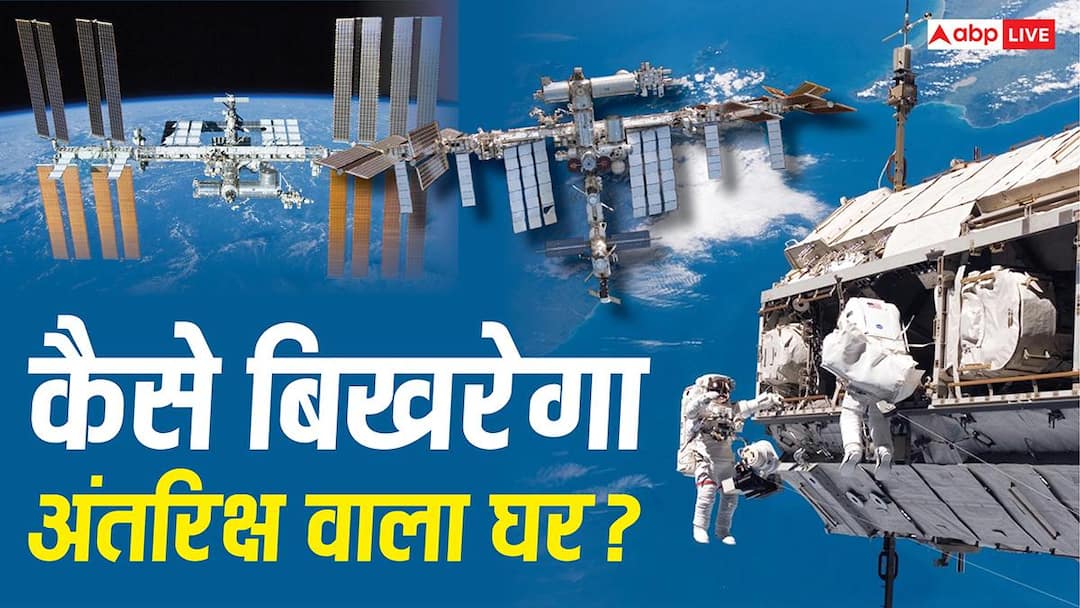
There is a place in space at an altitude of about 400 kilometers, where humans have been living continuously for the last 25 years. This is the International Space Station (ISS). This station, weighing about 450 tonnes, is as big as a football field. It started in 1998 and astronauts have been living here continuously since 2000, but now its age is coming to an end. It will be retired in 2030. NASA has prepared a plan of 1 billion dollars (about Rs 9500 crore) for this and there is a plan to bring it back to Earth and drop it in the Pacific Ocean between 2028 and 2030. After all, why is this space house being destroyed, what will happen in space after this and what effect will it have on India and the world?
What is International Space Station?
ISS is a joint project of the world’s five largest space agencies. This includes NASA (America), Roscosmos (Russia), JAXA (Japan), ESA (Europe) and CSA (Canada). Its first part was sent into space in 1998 and astronauts have been living here continuously since 2000.
It is a space lab the size of a football field, weighing approximately 450,000 kg, which orbits at an altitude of about 400 kilometers. Every part of the station is interconnected and it cannot function without the help of any one partner. This is not only a scientist’s laboratory, but it also shows how different countries can work together to accomplish difficult tasks like space.
Why is it being abolished?
In fact, ISS has now completed its prescribed age. Its tenure has been extended several times, but now its condition is worsening. There are three major reasons due to which the decision to recall the ISS has been taken:
1. Aging and cracks of the station: For the last few years, there have been continuous technical glitches in the ISS. The biggest problem is the continuous air leakage in the ‘Zvezda’ module of the Russian section. On June 5, 2026, the situation became so serious that NASA had to order its astronauts to be ready for evacuation. These cracks and leaks have been a persistent problem in parts of Russia for more than five years, which NASA’s Inspector General has termed as ‘the biggest security risk’. Although efforts are underway to seal the cracks, the situation is on the verge of getting out of control.
2. Very expensive to run ISS: Billions of dollars are spent every year to keep the ISS safe and operational. Instead of investing so much money on this aging station, NASA now wants to invest it in Moon and Mars missions. Under the Artemis program, NASA wants to send humans to the Moon again and after that there are preparations to go to Mars also.
3. Inflow of Commercial Space Station: NASA wants private companies to take over the work of research and habitation in low Earth orbit. For this, NASA is building new space stations in collaboration with many private companies. Therefore, retiring the government station i.e. ISS is a more sensible step.
How will the ISS be dismantled and what will be the entire process?
ISS will not be dismantled overnight. This will happen under a long and very precise plan:
- Phase 1 – Astronaut evacuation (2028-2029): The operation of ISS will be stopped gradually. Around 2028, the last crew (astronauts) will be safely brought back to Earth from the ISS and no new crew will be sent after that.
- Second phase- lowering the orbit to enter the Earth’s atmosphere: By the time the ISS is in its last phase, its orbit will be gradually brought down. To do this, a new spacecraft named American Deorbit Vehicle (USDV) will be built. NASA has given the contract to build this vehicle to SpaceX for 843 million dollars (about Rs 7000 crore). This vehicle will be a larger and more powerful version of the Dragon capsule, which will dock with the ISS and slowly pull it down from its orbit.
- Third Stage – Final Dive and Fall into the Sea: At the right time, this USDV will push the ISS into the Earth’s atmosphere with the final thrust. When the ISS reaches an altitude of about 280 kilometers, it will be the point from where return is not possible. As soon as it collides with the atmosphere, tremendous heat will be generated, due to which most of the station will burn up. Still, some larger pieces will not burn and will have to fall to Earth. These pieces will be dropped at a particular place. This place is a deserted area in the Pacific Ocean, which is also called ‘Spacecraft Cemetery’. There is no population here, so there will be no loss.
What will happen after the ISS ends?
The demise of the ISS is not the end of any story, but the beginning of a new era. What are different countries going to do after this?
1. Commercial Space Station
NASA will no longer build government stations for research in lower Earth orbit. Instead, he is helping several different private companies build the stations. Then NASA will rent space from these companies. There are four major contenders:
- Axiom Space: This company is at the forefront. It plans to launch the first two parts of its station by 2028. First these parts will remain connected with the ISS and later they will separate and form their own separate station.
- Blue Origin: It is building a versatile station named ‘Orbital Reef’. This will be a platform where work ranging from research to manufacturing and even tourism can be done.
- Voyager Space: This station is also being built under the name ‘Starlab’. Its specialty is that it will be launched completely at once and not in parts.
- Vast: This company is building a small and economical station named ‘Haven-1’, which is planned to be launched from SpaceX’s Falcon 9 rocket.
NASA has kept a budget of approximately 2.1 billion dollars (about Rs 17,600 crore) for all this.
2. China’s Tiangong Space Station
After the departure of the ISS by 2030, China’s ‘Tiangong’ (which means ‘heavenly palace’) will be left as the only major space station in space. At present it has three modules, but China is going to increase it to six modules soon. With this its weight will be around 180 tonnes. China has planned to operate it for 15 years. In 2026 itself, China has sent two of its astronauts to this station, one of which will stay there for a year.
3.India’s Indian Space Station (BAS)
India is also not behind in this race. ISRO is preparing to build its own space station, named ‘Indian Space Station (BAS)’. In September 2024 itself, the Cabinet had approved the launch of its first module (BAS-01) by 2028. However, the entire station will consist of five modules and is expected to be completed by 2035. Once built, India will join the list of select countries that have built their own space station. ISRO is also trying to join hands with Russia for this project.
The International Space Station is scheduled to end in 2030. This is the end of an era, which proved that humans can live in space for years and can make great scientific discoveries there. But with the retirement of the ISS, a ‘new era’ is beginning where private companies will have commercial stations. Countries like India and China have now jumped into this race.